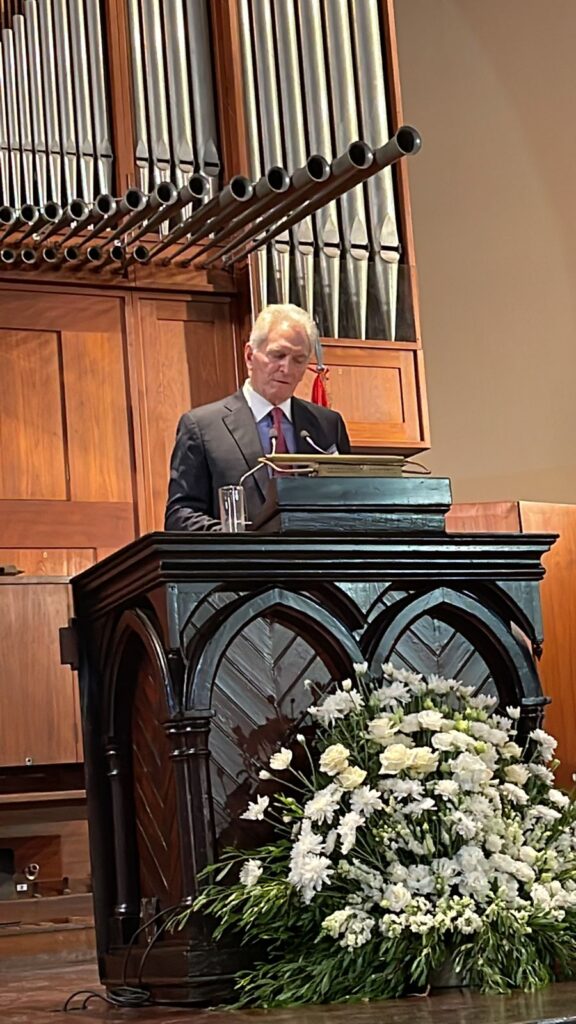
Panelist at Reuters Next Gulf 2025 event in Abu Dhabi, 22 Oct 2025

Dr. Nasser Saidi joined the panel titled “Tariff Wars and Trade Shifts” at the Reuters Next Gulf 2025 event held in Abu Dhabi on Oct 22nd, 2025.


Major shifts in global trade driven by new tariffs and the move toward nearshoring and friendshoring come as the Gulf continues its push for economic diversification beyond oil. How are businesses and governments adapting to these changing trade dynamics, and what is the impact on global economies and inflationary pressures.
The high level themes covered in the panel discussion were: the changing picture of trade following Donald Trump’s tariffs, the changing nature of investment flows.; and the geo-economic and geopolitical position of the Gulf and the Middle East.

Watch the discussion below from point 3:37:40 onwards till 4:09:22


Panelist at the IMF Regional Economic Outlook Middle East & Central Asia Report Launch in Dubai, 21 Oct 2025

Dr. Nasser Saidi participated in the panel discussion during the launch of the IMF Regional Economic Outlook (REO) report held in Dubai on Oct 21st, 2025.


Despite rising global policy uncertainty, economies in the Middle East and North Africa have demonstrated resilience this year, driven by increased oil production, lower energy prices, strong remittances and tourism inflows, and supportive global financial conditions. Can this resilience be maintained? What risks remain and how can MENA policymakers best navigate them? What new opportunities might emerge for the region in a rapidly shifting global economy?

The insightful discussion titled “Resilience Amid Uncertainty: Will it Last” delves into these critical issues highlighted in the IMF’s Regional Economic Outlook: Middle East and Central Asia issued in Oct 2025.


Watch the discussion below:


“Digitalization, Growth, and Diversification in the Gulf”, AGSIW webinar, 11 Mar 2025

Dr. Nasser Saidi participated in the presentation and discussion hosted by the Arab Gulf States Institute in Washington (AGSIW) ahead of the publication of an IMF report on Digitalisation in the GCC – held as a webinar on March 11th, 2025.

The Gulf Cooperation Council member countries have actively embraced digital transformation, making notable progress in the extensive development of digital infrastructure, the maturity of government digitalization, and a dynamic ecosystem for financial technology activities.

In a forthcoming paper, the International Monetary Fund highlights the positive relationship between progress in digitalization and more favorable macroeconomic and financial outcomes, including economic growth, government effectiveness, financial inclusion, and private sector resilience to shock.

New analysis by the Mohammed bin Rashid School of Government (along with Nasser Saidi & Associates and Developing Trade Consultants) also emphasizes the important and growing role of digitalization in supporting growth and economic diversification.

Within the context of these two papers, what additional efforts can be made toward improving digital skills, industry, and innovation? What are the challenges raised by the broad adoption of digital technologies and artificial intelligence, especially relating to cybersecurity and the potential effect on the labor market? Could comprehensive strategies help further accelerate the GCC countries’ already impressive progress on digitalization and support their broader economic transformation agendas?

Watch the discussion below:


“What does Lebanon’s new government mean for its future?”, Chatham House webinar, 6 Mar 2025

Dr. Nasser Saidi participated in the panel discussion titled “What does Lebanon’s new government mean for its future?” hosted by Chatham House on March 6th, 2025.

The webinar examines the new government’s likely approach to political and economic reform, Lebanon’s evolving position in regional and international affairs, and the impact of U.S. policy on the country’s future.

Watch the discussion here (no login necessary).


Keynote interview at the AVCJ Private Equity Forum Abu Dhabi 2025, 11 Feb 2025

Dr. Saidi discussed the current global economic conditions and the implications for private equity investment strategies in the Middle East in this keynote interview.

The interview can be accessed via this link

The main points of discussion were as below:

  1. The geo-political landscape is changing. Important to understand the big shift in economic activity towards Asia (particularly, China)
  2. Trump & his Maganomics policies (including tariffs) can play to the benefit of the GCC: China can divert their trade away from the US to this region; GCC can emerge as “Middle Powers” & GCC can use this as an opportunity to shape MENA region into an interlinked trade and investment hub. Start thinking of trade in infrastructure services.
  3. GCC countries have matured very quickly in the past 15 years. A trend of regionalised globalisation, driving regional integration.
  4. Need to support the increased trade & investment with Asia with banking, financial & payments links: use of renminbi to settle trade transactions, digital payments, the mBridge cross-border CBDC platform
  5. GCC SWFs are growing their domestic role, but will pivot towards Asia
  6. GCC are emerging as Global Old & New Energy & Climate Tech hubs. Middle East dominates crude oil exports and are increasing investments in renewables & climate tech.
  7. Opportunities in sectors: Tech (AI, data centres, robotics but all customised to the needs of the region), renewables (no reason you cannot export solar-based electricity to India or Europe), demographics related (health, education), e-mobility (EVs, e-transport systems), electrification of existing infrastructure.


Panelist at the Investment Conference 2025 session “Shaping the Future – GCC Economies in Transition”, 10 Feb 2025

Dr. Nasser Saidi participated as a panelist in the discussion titled “Shaping the Future – GCC Economies in Transition” at the Investment Conference 2025 by Kamco Invest, held in Kuwait on 10th February 2025. 

The session covered the broad headings of cyclical growth vs. structural transformation, fiscal policy and government spending, monetary policy, capital markets, productivity challenges & overall resilience.


View the session below (original link)


“Economic Costs & Consequences of the War on Lebanon” Presentation to LIFE, 21 Nov 2024

Dr. Nasser Saidi shared his views on the topic “Economic Costs & Consequences of the War on Lebanon” at LIFE Lebanon‘s event held in Dubai on 21st November 2024.

The main discussion points spanned the below headings:

•Middle East is at multiple crossroads, living consequences of wars & violence
•Lebanon: in the clutches of a protracted polycrisis
•Economic consequences & costs of war on Lebanon
•Lessons & Proposals
•Key Takeaways

The presentation can be downloaded here.


Panelist at the IMF Regional Economic Outlook Middle East & Central Asia Report Launch in Dubai, 31 Oct 2024

Dr. Nasser Saidi participated in the panel discussion during the launch of the IMF Regional Economic Outlook (REO) report held in Dubai on Oct 31st, 2024.


Amid high uncertainty and the threat of intensifying conflicts, how can the countries of the Middle East and North Africa safeguard macroeconomic stability? What risks and vulnerabilities lie ahead? Which policies can help countries navigate this uncertain economic landscape while strengthening medium-term growth prospects?

The insightful discussion titled “Growth Challenges and Opportunities in the MENA Region Amid Uncertainty” delves into these critical issues highlighted in the IMF’s Regional Economic Outlook: Middle East and Central Asia issued in Oct 2024.


Watch the discussion – the video titled Press Briefing: Middle East & Central Asia, October 2024 (Dubai) – via: https://www.imf.org/en/Videos/view?vid=6364122084112


Comments from the discussion appeared in an article on AGBI titledMiddle East, not the West, should lead rebuilding, say experts: Dr. Saidi’s comments are highlighted below. 

Economist Nasser Saidi, founder of Nasser Saidi and Associates and AGBI columnist, said the cost to rebuild countries in the region impacted by conflict in recent years – including Iraq, Syria, Lebanon, Jordan, Egypt, Sudan, Libya and others – could be as much as $2.5 trillion.

“The private sector will not invest until they see stability and a political strategy,” he said.

He suggested forming an organisation called the Arab Bank for Reconstruction and Development to unite the countries in the region in helping rebuilding efforts.


“IMF Report Launch 2024: Economic Prospects and Policy Challenges for the GCC Countries”, Panel Discussion, AGSIW webinar, 17 Jan 2024

Dr. Nasser Saidi participated in the panel discussion hosted by the Arab Gulf States Institute in Washington (AGSIW) related to the launch of the IMF report titled “Economic Prospects and Policy Challenges for the GCC Countries” held as a webinar on Jan 17th, 2024.

After exceptionally strong economic expansion in 2022, growth in the Gulf Cooperation Council countries slowed in 2023 largely as a result of cuts in oil production. Nonhydrocarbon growth remained robust driven by higher domestic demand, increased capital inflows, and ongoing reforms. Unemployment rates continued to decline, while inflation remained well contained.  

The challenging global and regional situation creates an uncertain outlook for the GCC countries in 2024. The commitment to economic and financial reforms bodes well for continued expansion of the nonhydrocarbon sector, but uncertainty in the global oil market, the ongoing conflict in Gaza, and the trajectory of U.S. monetary policy all present risks to the outlook. 

AGSIW was pleased to host a discussion of the International Monetary Fund’s report on Economic Prospects and Policy Priorities for the GCC Countries.The discussion focused on the economic outlook in the region and the policies that need to be implemented to navigate the challenges posed by current global and regional uncertainties and the longer-term need to diversify economies and reduce reliance on fossil fuel revenue.

Watch the discussion below:


Fireside Chat with Dr. Nasser Saidi on MENA’s Energy Transition, Bloomberg Green at COP28, 4 Dec 2023

Dr. Nasser Saidi, in his capacity as the Chairman of MENA Clean Energy Business Council, discusses what role governments can play in accelerating the adoption of renewable energy sources in the Middle East with Bloomberg’s Abeer Abu Omar at Bloomberg Green at COP28 in Dubai.

Watch the interview below:


“The Rise of the Falcon Economy”, Panel Discussion at Asset Abu Dhabi 2023, 28 Nov 2023

Dr. Nasser Saidi participated in the panel discussion titled “The Rise of the Falcon Economy” during the Asset Abu Dhabi 2023 event held in Abu Dhabi on 28th Nov 2023, part of the Abu Dhabi Finance week .

Watch the discussion below:


“State and Future of the GCC Economies: A Story of Transformation”, Presentation to the International Jurists, 20 Oct 2023

Dr. Nasser Saidi was invited as a keynote speaker at a meeting of the International Jurists held in Dubai on 20th October 2023.

Dr. Saidi’s presentation, titled “State and Future of the GCC Economies: A Story of Transformation“, focused on regional macroeconomic and geo-political developments, with a special focus on the Gulf Falcons. The talk also highlighted the GCC’s economic transformation and concluded with how the Gulf Falcons would drive regional structural transformation.


“Global Macroeconomic Developments: Impact on Travel & Tourism / MICE”, Presentation at the Abu Dhabi Business Events Forum, 26 Sep 2023

Dr. Nasser Saidi was invited to join as a guest speaker at the Abu Dhabi Business Events Forum held in Abu Dhabi on 26th September 2023.

Dr. Saidi’s presentation, titled “Global Macroeconomic Developments: Impact on Travel & Tourism / MICE“, focused on the global and regional macroeconomic developments, with a special focus on the drivers and major headwinds. The talk also centred on the GCC’s economic transformation and the role played by tourism/ MICE before concluding with slides on the opportunities and risks for the sector in the Middle East.


“A Pending Crisis? Global Economic Slowdown in the MENA Region”, Panel Discussion, Middle East Council on Global Affairs webinar, 5 Sep 2023

Dr. Nasser Saidi participated in the panel discussion hosted by the Middle East Council on Global Affairs titled “A Pending Crisis? Global Economic Slowdown in the MENA Region” held as a webinar on Sep 5th, 2023.

Current projections by leading international institutions point to a global economic slowdown in the second half of 2023 and through 2024. The Middle East and North Africa (MENA) region will not be an exception as countries face lower oil prices, exports, and foreign investment and remittance flows. Moreover, uncertainty over international monetary policy continues to complicate policymaking and pose risks for macroeconomic and banking stability. Several countries in the region are already struggling with double-digit inflation, high public debt obligations, and severe foreign exchange pressures. Socioeconomic outcomes, including concerns related to food security, poverty, and unemployment, will likely deteriorate for many.

To examine the potential impact of the global economic slowdown on the MENA region, the Middle East Council on Global Affairs (ME Council) will hold a webinar bringing together a panel of regional experts in economics, finance, and public policy. The discussion will address key questions including: How will the impact of the global economic slowdown differ among MENA countries? What are the specific risks and exposures faced by governments and financial institutions? And what policy options are available to mitigate the negative impact on socioeconomic outcomes?

Watch the discussion below:


“China-GCC FTA Negotiations and Prospects for Broader Economic Collaboration”, Panel Discussion, AGSIW webinar, 5 Apr 2023

Dr. Nasser Saidi participated in the panel discussion hosted by the Arab Gulf States Institute in Washington (AGSIW) titled “China-GCC FTA Negotiations and Prospects for Broader Economic Collaboration” held as a webinar on Apr 5th, 2023.

The China-Gulf Cooperation Council summit in December 2022 renewed interest in concluding negotiations for a China-GCC free trade agreement. These trade negotiations began in 2004, but progress toward establishing an FTA has proceeded slowly. A finalized FTA with the GCC would be a prestigious accomplishment for Beijing, strengthening China’s economic linkages to the region and potentially boosting trade and investment flows. For their part, GCC governments hope to expand economic cooperation with Asian partners, such as China, to advance ambitious economic diversification agendas. 

What are the key Chinese and GCC interests behind completing an FTA, and what obstacles have posed the biggest challenges to finalizing negotiations? What do FTAs reveal about the nature of Chinese economic diplomacy in the Middle East? How would the establishment of a China-GCC FTA impact trade and investment ties over the short, medium, and long term? Looking beyond the potential FTA, what are the other trends and mechanisms facilitating deeper economic cooperation between China and GCC countries? 

Watch the discussion below:


“Navigating the Energy Crisis: A Middle East Viewpoint”, Presentation at the Global Investment Management Summit, 28 Mar 2023

Dr. Nasser Saidi was invited to join as a guest speaker at the Global Investment Management Summit held in London on 28th March 2023.

Dr. Saidi’s presentation, titled “Navigating the Energy Crisis: A Middle East Viewpoint”, covered among other points the sources and consequences of the ongoing global energy crisis in the backdrop of weaning away from fossil fuels and investing in Renewable Energy. The geopolitics and emergence of a new global energy map formed another key point in the discussion which advocated for GCC to become the centre of a transformed, new, global energy map.


“Climate Finance Gap in the MENA”, Keynote Speech at Emirates Environmental Group’s Forum, 24 Feb 2023

Dr. Nasser Saidi was invited as a keynote speaker to a forum called “Bridging the Climate Finance Gap” organised by the Emirates Environmental Group (EEG), held in Dubai on 24th February 2023.

Dr. Nasser Saidi, Chairman of Clean Energy Business Council, the Honorary Member of Emirates Environmental Group, delivered the keynote address. Saidi called for climate and net-zero emission commitments to be enshrined in constitutions, making them more difficult to disregard. He stressed the enormous financial needs of countries to address climate change and estimated that Arab countries require US$570 billion by 2030, while only US$34 billion has been allocated to public international climate finance in this region, which is a mere 6 percent of what countries say they need. Saidi highlighted the enormity of the gap that needs to be filled and the urgency to take action.

More details about the event is available at https://www.wam.ae/en/details/1395303134035


“A New Global Energy Map: On the Road to COP28”, Presentation at the 10th CEBC Annual Summit, 31 Jan 2023

The presentation titled “A New Global Energy Map: On the Road to COP28“, was given by Dr. Nasser Saidi as the opening keynote address at the 10th CEBC Annual Summit held in Dubai on 31st January 2023.

In his speech, Dr. Nasser Saidi, in his capacity as Chairman of the Clean Energy Business Council, spoke about the emergence of a new global energy map, its financing requirements as well as deep-dived into the energy transition in the GCC region & combating climate change.


“How Can MEA Prepare for the Novacene?”, Presentation at the Huawei Finance Day, 12 Oct 2022

Dr. Nasser Saidi delivered a keynote address at the Huawei Finance Day, held in Dubai on the 12th of October 2022.

Titled “How Can MEA Prepare for the Novacene?“, the presentation covered 4 key themes: (a) global outlook and underlying risks; (b) evolving economic geography; (c) Economic Outlook of Middle East and Africa; and (d) what are the transformation drivers and new horizons for the MENA/ GCC nations.


“A Time to Reflect, a Time for Action”, Keynote Speech at American University of Beirut 50th Reunion Memorial, 23 Jun 2022

Dr. Nasser Saidi was invited as a keynote speaker to the American University of Beirut’s 50th Reunion Memorial, held in Beirut on 23rd June 2022.

Download the full speech titled “A Time to Reflect, a Time for Action“: a snippet from the speech is posted below.

Volatile conditions, uncertainty and Lebanon’s uncivil war made many of us nomads, but networked global citizens. What brings us together in this 50th reunion? What should we strive for? This is a milestone, a time to reflect but also a time for action. 


“Lebanon: Failed State or Transformation?” Presentation to LIFE, 9 Jun 2022

Dr. Nasser Saidi shared his views on the topic “Lebanon: Failed State or Transformation?” at LIFE Lebanon‘s event held in Dubai on 9th June 2022.

The main discussion points spanned the below headings:

  • Lebanon’s Path to Economic Collapse
  • Roots of Lebanon’s meltdown 
  • Reforms & Transformation

The presentation can be downloaded here.


Panelist at the IMF’s MENA Conference”Divergent Recoveries in Turbulent Times in the Middle East & North Africa”, 24 May 2022

Dr. Nasser Saidi participated as a panelist at the IMF’s event related to the Regional Economic Outlook report for the Middle East and North Africa region held on 24th May, 2022. The panel discussion was titled “Divergent Recoveries in Turbulent Times in the Middle East & North Africa” and discussed in addition the impact of US elections on the Middle East.

Dr. Nasser Saidi touched upon the potential risks of a global recession / stagflation, its impact on MENA nations, drivers of inflation, rising food prices and on Lebanon’s recovery prospects (post elections).

Watch the video of the webinar below:


Impact on Trade with Middle East as a New Arena for Asian Competition (?), Panel Discussion at the MEI NUS Annual Conference, 18 May 2022

Dr. Nasser Saidi joined a panel discussion online titled “Impact on Trade” within the wider context of “Middle East: A New Arena for Asian Competition?” which was the theme of the National University of Singapore’s Middle East Institute Annual Conference.

The session, held on 18th of May, discussed the background of trade, investment and labour flows, in addition to what the contrasts are for China and India’s policies in the Middle East.

Watch the session below


“Lebanon’s Meltdown: Failed State or Reforms & Transformation?”, Presentation to the American University of Beirut OSB, 18 Nov 2021

On 18th Nov 2021, Dr. Nasser Saidi gave a presentation titled “Lebanon’s Meltdown: Failed State or Reforms & Transformation?” during a webinar organised by the American University of Beirut’s Suliman S. Olayan School of Business.

A quick summary of the talk: Lebanon is experiencing historically unprecedented multiple crises: political, economic, banking & financial, debt, currency, environmental and health crises. The talk will discuss the underlying drivers of the crises; a multi-faceted failure of governance; economic, monetary, fiscal and financial mismanagement, and corruption. Lebanon has become a failed state. Will it be possible to rescue Lebanon, undertake the necessary deep reforms and transformation?

Watch the presentation below:


“Digitalization and the Future of Global Economy”: Panelist at the 8th Abu Dhabi Strategic Debate, 14 Nov 2021

Dr. Nasser Saidi joined as a panelist in the session titled “Digitalization and the Future of Global Economy”, at the Eight Annual Abu Dhabi Strategic Debate organised by the Emirates Policy Centre on 14th November 2021.

Watch the full session below from 10:13 till 1:21:24:


“Clean Energy Market in MENA: Finance, Mobility, Hydrogen, Energy Efficiency”, Keynote presentation at the CEBC-Enterprise Ireland event, 5 Oct 2021

Dr. Nasser Saidi, in his capacity as the Chairman of the Clean Energy Business Council, gave a keynote address at the CEBC-Enterprise Ireland High-Level Seminar & Networking Event held at the Capital Club in Dubai on the 5th of October 2021.

Titled “Clean Energy Market in MENA: Finance, Mobility, Hydrogen, Energy Efficiency“, the presentation discussed:

(a) Clean Energy Ecosystem in the MENA region

(b) New investment in renewable energy, by region & sector

(c) Climate Finance in MENA

(d) E-mobility in MENA

(e) Hydrogen in MENA: an infant, but rapidly developing market

(f) Energy Efficiency in MENA

(g) Green post-Covid19 transformation presents a major diversification opportunity for MENA; How can MENA grow & develop its Clean Energy market?


“Prospects for the Hydrogen Market: a MENA Perspective”, Keynote presentation at the Danish PtX Event, 5 Oct 2021

Dr. Nasser Saidi, in his capacity as the Chairman of the Clean Energy Business Council, gave a keynote address at the Danish PtX Event held at the Etihad Museum in Dubai on the 5th of October 2021.

Titled “Prospects for the Hydrogen Market: a MENA Perspective“, the presentation touched upon the fact that:

(a) Addressing climate change will change geoeconomy & geopolitics

(b) Hydrogen market is in its infancy: need to nurture the bases of a well-defined market

(c) Addressing the nascent state of the hydrogen market; Imperative that key players collaborate to set, define & implement common standards

(d) Total investments in Green & Blue Hydrogen in the MENA region touches $55bn

(e) Hydrogen exporters should form a club similar to OPEC. How and why?


Panelist at the AUB OSB SME Webinar Series “The Region’s Economic Outlook”, 6 July 2021

The webinar titled “The Region’s Economic Outlook” was organised by the Olayan Suliman School of Business (OSB) Executive Education at the American University of Beirut (AUB) on 6th July 2021.

The panel, which included Dr. Nasser Saidi & Dr. Saade Chami, was moderated by Mrs. Sara Abdul Samad, Board Member at the Lebanese Business Council in Kuwait.

Watch the webinar below (in English):


"Lebanon’s Financial Meltdown and the Prospects for Recovery": Panel session, Middle East Institute, 25 Mar 2021

Dr. Nasser Saidi participated as a panelist in the session titled “Lebanon’s Financial Meltdown and the Prospects for Recovery” held online on 25th March 2021.
Where does Lebanon stand today, a year after the first sovereign debt default in its history? How did we even get here? What are immediate monetary and fiscal policy priorities to course-correct? What social policies and programs are needed in the immediate term? What can still be saved? Panelists, including Dr. Saidi, tackled these issues and shed more light on Lebanon’s uncertain financial, economic, and social future as part of the Middle East Institute’s (MEI) Lebanon program’s events series.
Watch the video below:


"A China-GCC Strategy to Support the Next Growth Phase", Presentation to the Oman Economic Association, 10 Mar 2021

Dr. Nasser Saidi was invited to present to the Oman Economic Association on 10th Mar 2021.
The presentation titled “A China-GCC Strategy to Support the Next Growth Phase” covered the sub-topics of (1) COVID & its aftermath: Global & GCC consequences; (2) China has changed economic geography; (3) China and the GCC linkages; (4) China-GCC strategy: pivot to Asia.
The discussion was in Arabic and can be watched below.


Currency Board: Salvation for Lebanon’s Woes? Presentation at LIFE webinar, 4 Feb 2021

Dr. Nasser Saidi shared his views on the topic “Currency Board: Salvation for Lebanon’s Woes?” at LIFE Lebanon‘s webinar held on 4th February 2021, concluding that a Currency Board is NOT a salvation for Lebanon’s woes.
The main discussion points were:

  • What are Currency Boards? Main characteristics.
  • Currency boards in history and practice: colonial history, recent examples
  • Macroeconomic requirements for a sustainable currency board
  • Is a Currency Board feasible for Lebanon? Reforms and requirements
  • A Currency Board is not a salvation for Lebanon’s woes

The presentation can be downloaded here.


"Lebanon in 2021: A Year of Existential Challenges": Panel session, Carnegie MENA’s 4th annual conference, 16 Dec 2020

Dr. Nasser Saidi participated as a panelist in the session titled “Lebanon in 2021: A Year of Existential Challenges“, part of the Malcolm H. Kerr Carnegie Middle East Center’s fourth annual conference – A Global Renewal? What to Expect in 2021 – held online on 16th Dec 2020.
With the pillars of the Lebanese Republic crumbling at an accelerated pace over the past year, the Lebanese fear for their future and speculation is rife about the impact of the financial, economic, political, and health crises that have overwhelmed the country. The panel also addressed how changing regional and international dynamics would affect Lebanon.
Watch the video below:


"A COVID-19-induced macroeconomic overview of the GCC", Keynote presentation at Bonds, Loans & Sukuk Middle East, 8 Dec 2020

Dr. Nasser Saidi, a keynote speaker at the latest Bonds, Loans and Sukuk Middle East event, held virtually on 8-9 Dec 2020, presented a 30-min talk titled “A COVID-19-induced macroeconomic overview of the GCC”.
The presentation covered the macroeconomic impact of Covid19 pandemic on the global economy and the Middle East/ GCC region (economic growth, capital flows, trade, investment, labour movements, job losses). Also covered were the policy responses (monetary, fiscal, social and health policies) in addition to thoughts on the Biden Presidency and its regional consequences. The concluding remarks focused on GCC’s way forward post Covid19, looking at three pillars: geopolitics, the economy and new sectors of focus.
Download the presentation here.


"The 50 trillion dollar question: Closing the emerging markets’ capital gap", The Economist’s virtual event, 25 Nov 2020

Dr. Nasser Saidi joined a panel discussion titled “The 50 trillion dollar question: Closing the Emerging Markets’ Capital Gap”, organised by The Economist and supported by Standard Chartered, on 25th November 2020.
The topic overview is as follows:
The goal of ESG impact alongside financial returns is becoming the new default for investors. Today, the UN’s Principles for Responsible Investing represents more assets than it ever has. The flurry of social-bond issuing this year, far above 2019 levels, to underpin the covid-19 economic recovery, is also testament to this upward trend. The implications should be heralded across the board. Sustainable finance will underpin the world’s ability to meet the 2030 Agenda and the Paris Agreement. It is also key to international development, as emerging markets race against time to transition to low-carbon and climate resilient economies. For now though, sustainable investments tend to be skewed to the West. The irony is that if impact is the bottom line, then emerging markets – where the impact of every dollar is disproportionately greater – should be top of mind. There is a growing imperative to transfer a portion of the estimated 50 trillion dollars under asset management into sustainable projects in emerging markets, if we are to make an impact on decarbonising.

Watch the discussion below:


"The Middle East after the Pandemic: Surviving the economic shockwave": Panel session, FT Global Boardroom, 12 Nov 2020

Dr. Nasser Saidi joined the FT Global Boardroom event on 12th Nov 2020, in the panel session titled “The Middle East after the Pandemic: Surviving the economic shockwave” to discuss a few questions:

How deep and long will the recession be in the Middle East? How has the pandemic affected the region’s diversification away from oil? What support is there for businesses in the consumer-facing sectors, and how can they plan for recovery? What will the US elections mean for regional geopolitics, and how will that impact on investment? What is the role of the region’s sovereign wealth funds in buying distressed European assets?
A summary of the session is available here: http://brochure.live.ft.com/the-global-boardroom-report/day-two-summary/#d2-9
Excerpts from the session/ Dr. Saidi’s comments are highlighted below:
The coronavirus pandemic has damaged the economy of the Middle East and it will take time to recover.
NS: If you look at the size of the impact of the great lockdown, you are talking about a 6.7 per cent GDP decline for the GCC. This is unprecedented. We haven’t had a recession of this scale in the region since the second world war.
The hydro-carbon producing countries of the Middle East have been diversifying away from oil and gas into other industries and this is accelerating.
NS: Diversification creates employment opportunities. Sixty per cent of our population is under 30 years of age, so we need to invest in activities that create jobs for them. Where will the new jobs be created? Previously we created them in government in most countries of the region. That is not where we will create them in the future. They have to be in the private sector.
The election of Joe Biden as the new US president will have a positive impact on the region
NS: Biden is very much a multilateralist, as opposed to the unilateralism that Trump advanced. The Biden approach to the region will be to discuss policy with the region. It will not be Twitter-based.


"Post-Coronavirus Economy: Trajectories of Global Order": Panelist at Abu Dhabi Strategic Debate, 11 Nov 2020

Dr. Nasser Saidi joined as a panelist in the session titled “Post-Coronavirus Economy: Trajectories of Global Order”, at the Seventh Annual Abu Dhabi Strategic Debate organised by the Emirates Policy Centre on 11th November 2020.
The session discussed two broad questions: How long will COVID-19 continue to affect global economy? How will COVID-19 change the global economy in the future?
Dr. Nasser Saidi, the Founder and President of Nasser Saidi & Associates, stated that the global economy is being hit by higher uncertainty as global production has dropped by 4.5 percent, global labour income is estimated to have declined by 11 percent and direct foreign investments have fallen by 15 percent at a minimum in the first half of 2020.
“It is important to realise that world top technology companies such as Amazon, Apple, and Microsoft have developed into major powers in the global arena. The COVID-19 pandemic has demonstrated the need for bridging the digital gaps between various countries and the need for addressing internal divisions in these countries themselves,” he added.
Watch the full session below:

A summary of the event can be accessed at: https://wam.ae/en/details/1395302885959


Panel discussion "Managing energy transition in the Middle East" at World Energy Week Live, 7 Oct 2020

The collapse in oil demand and prices due to Covid-19 has had a devastating impact on the resource-dominant countries of the Middle East. Will this delay economic reforms and a transition to lower carbon economies, or can this pose an opportunity for the region to accelerate energy transition and economic diversification?

This panel session, broadcast on 7th Oct 2020, was part of the Middle East and Gulf States session at World Energy Week LIVE on the theme “Managing Energy Transition in the Middle East”

Dr. Nasser Saidi joined an esteemed panel comprising of Adam Sieminski, President, KAPSARC, Adnan Shihab-Eldin, Director General, Kuwait Foundation for the Advancement of Sciences and Robin Mills, CEO, Qamar Energy in a session moderated by Eithne Treanor, Executive Chair, WE Talks, World Energy Council.

The session can be accessed below:


Panelist at the IMF’s MENA Conference "Coping With Covid19", 27 Oct 2020

Dr. Nasser Saidi participated as a panelist at the IMF’s event related to the Regional Economic Outlook report for the Middle East and North Africa region held on 27th October, 2020.
The panel discussion was titled “Coping with Covid19: Challenges & Policy Priorities for the MENA region and the Global Economy” and discussed in addition the impact of US elections on the Middle East.
The IMF report can be accessed at https://www.imf.org/en/Publications/REO/MECA/Issues/2020/10/14/regional-economic-outlook-menap-cca
Watch the video of the webinar below:


Panelist at Aldic webinar "Lebanon’s financial and economic crisis – keys for recovery", 15 Oct 2020

The webinar titled “Lebanon’s financial and economic crisis – keys for recovery” was organised by the Lebanese Association for Taxpayers’ Rights (ALDIC) on 15th Oct 2020.
A writeup of the main discussion points appeared in this news article in L’Orient-Le Jour.
The session focused on 4 main areas: the origin of the current economic, financial and political crisis; the approach to recovery (i.e. how to exit the crisis); enablers of the recovery and finally the tools of recovery.
Watch the webinar below (in English & French):


"Turning War Economies into Peace Economies: Lessons from Lebanon & Beyond", Presentation at IFIT webinar, 24 Sep 2020

Dr. Nasser Saidi presented on the topic “Turning War Economies into Peace Economies: Lessons from Lebanon and Beyond(click title to download), at a webinar hosted by the Institute for Integrated Transitions (IFIT) on 24th Sep 2020.

In conflict-affected states, achieving sustainable and inclusive growth depends in no small part on transforming the incentives and structures that underpin a wartime economy. The talk analysed key structural lessons from Lebanon and other countries in the wider region.

During the talk, Dr. Saidi touched upon Lebanon’s short history (1920-2020) in addition to laying out the economic consequences of conflicts and post-conflict reconstruction. Impact of population displacement and refugees as well as state capture by militias and allies formed valid discussion points. The talk was wrapped up by focusing on Lebanon, with respect to the structural reforms needed for economic-financial-fiscal-monetary-banking-financial stabilisation and reform.


"Lebanon: a multi-pronged tragedy with unforeseeable consequences", CJBS Perspectives Interview with Dr. Jenny Chu, Sep 2020

How has the Beirut explosion disaster been exacerbated by the global pandemic, economic crisis and the failures in government leadership? What is needed to rebuild Lebanon? Dr. Nasser Saidi shared his thoughts when interviewed by Dr. Jenny Chu as part of the University of Cambridge Judge Business School (CBJS) Perspectives series.
Watch the interview below:


Role of Governments and Private Sector Players in accelerating Climate Finance in the Arab States, CEBC-UNDP webinar, 31 Aug 2020

Dr. Nasser Saidi offered the introductory remarks during the Clean Energy Business Council (CEBC) – UNDP Regional Hub (based in Amman, through its regional project “SDG-Climate Facility: Climate Action for Human Security”) webinar focusing on the Climate Finance for Resilience in the Arab States region.
The discussions focused on the role of climate finance – public and private – in enabling transformative climate action and to meet the SDGs in a region that is characterized by a diverse set of countries, from highly developed, high income countries, to those that are continuously at risk of falling into poverty traps as a result of ongoing conflict and crises. These discussions are expected to lead to the development of partnerships among different actors to facilitate private investment to address the climate-SDGs nexus in the Arab States region.
The objective of the webinar (recording below) is to understand the experiences of governments and private sector players in accelerating climate finance in the Arab States region, leading to resilient development and growth.


"Staring into the Abyss: Where does Lebanon go from here?", Brookings Doha Centre webinar, 17 Aug 2020

Dr. Nasser Saidi joined the Brookings Doha Center webinar (held on 17th Aug 2020) for a discussion on the dire political and economic situation in Lebanon.
The session addressed the following questions: Is the country on its way to becoming a failed state, or will the repercussions of the Beirut blast lead to serious reform? Does the French political initiative steered by President Emmanuel Macron have the potential to resolve the crisis? What are the prospects for economic recovery amid stalled negotiations between the Lebanese government and International Monetary Fund? And what role can the international community play in order to assist Lebanon?
Watch the webinar below:


“Tackling the Climate Emergency with Climate Finance”, Emirates Environmental Group webinar, 28 Jul 2020

Dr. Nasser Saidi participated as a panelist in the webinar organised by the Emirates Environmental Group (EEG) on 28th of July – under the theme “Tackling the Climate Emergency with Climate Finance”. The panel discussion focused on the urgent need for increasing government and private spending on crucial sectors such as health, education, infrastructure, and climate change as well as open up a dialogue about the financial opportunities in the UAE that can be diverted towards combating climate change.
The panel discussion can be viewed below:


"Can Lebanon be rescued?", Instagram Live session with D Does Business, 16 Jul 2020

Can Lebanon be rescued?
In an Instagram session with D Does Business, Dr. Nasser Saidi touched upon possible solutions. But, remember that all is conditional upon political will. His 10-points rescue plan also underscores the need to establish an economic stabilization & liquidity fund.
Watch the session in 2 parts, on YouTube:


Interview with Energy & Utilities on the impact of Covid19 on renewable energy, 9 Jul 2020

Dr. Nasser Saidi, Chairman of the Clean Energy Business Council speaks to Middle East Energy’s “Energy & Utilities” about the impact of COVID-19 and low oil prices on the renewable energy programmes.


"Stability Redefined: Who Authors the Future?", Beirut Institute Summit e-Policy Circle 7, 17 Jun 2020

Dr. Nasser Saidi participated in a webinar on 17th June 2020 titled “Stability Redefined: Who Authors the Future?” organised by the the Beirut Institute Summit.
Beirut Institute Summit e-Policy Circle 7 hosted by Raghida Dergham under the theme of ‘Stability Redefined: Who Authors the Future?’ with HE Elliott Abrams, United States Special Representative for Venezuela; HE Brian Hook, United States Special Representative for Iran; HE Nasser Saidi, Lebanese Former Minister of Economy, Trade and Industry; and Ms. Nora Mueller, Executive Director for Körber-Stiftung.
Dr. Saidi discussed many themes including Middle East’s deep recession and a potential “lost decade”, the economic, social & political effects of sanctions, higher military spending, nation-rebuilding & reconstruction of war-torn nations and more. Watch the webinar below.


"Prospects for sovereign debt restructuring and access to financing", OMFIF webinar, 4 Jun 2020

Dr. Nasser Saidi participated in a webinar on 4th June 2020 titled “Overcoming debt crisis in emerging markets: Prospects for sovereign debt restructuring and access to financing” organised by the the Official Monetary and Financial Institutions Forum (OMFIF) on 4th June 2020.
As emerging markets face humanitarian and economic shocks, the ability to service their sovereign debt has led to concerns of a widespread debt crisis. While the G20 agreed to a standstill in April by freezing repayments on bilateral loans for 76 poorer countries, uncertainty remains over trade offs between debt relief and re-financing, the outlook for middle income countries, and how the private sector creditors will respond. The panel looks at the prospects for sovereign debt restructuring and access to financing across Africa, the Middle East and Asia.
Dr. Saidi focused on the case of Lebanon, while also highlighting the role of China as a global lender. Watch the webinar below.


"Lebanon’s Economy: Meltdown & Redemption Through the IMF", Ana Khat Ahmar webinar, 1 Jun 2020

Dr. Nasser Saidi presented at the Ana Khat Ahmar webinar held on 1st Jun 2020, during which he gave the presentation titled “Lebanon’s Economy: Meltdown & Redemption Through the IMF?“.


"Lebanon’s Economy: Meltdown & Redemption Through the IMF", YPO Lebanon webinar, 22 May 2020

Dr. Nasser Saidi was part of a YPO Lebanon webinar held on 22nd May 2020, during which he gave the presentation titled “Lebanon’s Economy: Meltdown & Redemption Through the IMF“.


"Pulling Lebanon Out of the Abyss", Najjar Culture and Liberties Foundation webinar (Arabic), 7th May 2020

Dr. Nasser Saidi participated as a speaker at the Najjar Culture and Liberties Foundation’s webinar held on 7th May 2020. The session, in Arabic, can be viewed below and at the original link.


"The Economic Consequences of COVID-19 & Impact on Clean Energy", CEBC webinar, 6 May 2020

Dr. Nasser Saidi’s presentation titled “The Economic Consequences of COVID-19 & Impact on Clean Energy” was part of the Clean Energy Business Council’s webinar titled “A Pandemic, Oil Price Collapse, A Recession: Is the Future still Green?” held on May 6th 2020.
A summary of the webinar is available on the CEBC website (https://cebcmena.com/knowledge-centre/reports-and-publications/) and can be downloaded directly here.
Watch the webinar below:


Panelist at the launch of IMF's MENA Regional Economic Outlook, 27 Apr 2020

Dr. Nasser Saidi participated as a panelist at the IMF’s launch of the Regional Economic Outlook report for the Middle East and North Africa region on 27th April, 2020.
The panel discussion covered the macro outlook for the region given the inter-twined effects of Covid19, fall in oil prices and financial shocks.
The IMF report can be accessed at https://www.imf.org/en/Publications/REO/MECA/Issues/2020/04/15/regional-economic-outlook-middle-east-central-asia-report
Watch the video of the webinar below (link to the IMF: https://www.imf.org/external/mmedia/view.aspx?vid=6152433693001)


"Lebanon's Economy: Staring into the Abyss", Presentation to the Harvard Business Club in Lebanon, 24 Apr 2020

Dr. Nasser Saidi’s presentation titled  “Lebanon’s Economy: Staring into the Abyss“, was aired as a webinar to the Harvard University Alumni Association of Lebanon (HUAAL) and the Harvard Business Club in Lebanon on 24th April 2020.
Click below to access the webinar, including Q&A.


Pandenomics 2020, webinar presentation at the Athenaeum Dialogue, 16 Apr 2020

Dr. Nasser Saidi was invited to speak about the impact of Covid19 on the global and regional economy on 16th Apr 2020, as part of The Athenaeum Dialogue (a closed group of members).
As part of the presentation titled “Pandemonics 2020“, Dr. Saidi explored past pandemics’ facts, the current status of covid19, its economic effects as well as the priorities and policy responses required to move forward. Ending the presentation with a question whether a new post-Covid normal would emerge, Dr. Saidi also explored plans for the recovery phase.


"Low Oil Prices, Coronavirus, and the Future of Gulf Economies", Panel Discussion, AGSIW webinar, 7 Apr 2020

Titled “Low Oil Prices, Coronavirus, and the Future of Gulf Economies”, this panel discussion was held by the Arab Gulf States Institute in Washington (AGSIW) as a webinar on 7th April 2020.
Gulf Arab states have announced $97 billion in emergency stimulus packages and other support measures to help offset the economic impact of the coronavirus outbreak. Spending needs are likely to increase over the short term, and regional governments must simultaneously manage the fiscal repercussions of oil prices sliding below $30 per barrel. Saudi Arabia and Oman announced budget cuts across various government ministries as states across the Gulf explore opportunities to rein in spending.

How will the spending needs and constraints stemming from the coronavirus and low oil prices affect the fiscal health of Gulf Arab states? What policy options do these states have at their disposal to confront these interrelated crises? What are the longer-term implications for economic diversification efforts across the Gulf region?

 
Watch the discussion below:


"Climate & Financial Stability are Interdependent Public Goods", Keynote Presentation at CEBC's "Landscape of Sustainable Finance" event, 2 Mar 2020

Dr. Nasser Saidi presented an opening keynote, titled “Climate & Financial Stability are Interdependent Public Goods“, at the Clean Energy Business Council (CEBC)’s Sustainable/Climate Finance event, held in Dubai on 2nd March 2020.
The presentation provided an overview of the major issues relating to climate change globally, before moving on to exploring the various fiscal and regulatory tools available for climate action, with a specific focus on financing. Dr. Nasser Saidi also spoke at length how the Middle East can adapt to climate change before ending with a snapshot of how the CEBC plans to contribute to this effort.


"MENA Corporate Governance: a steep path to improvement & reform", Presentation at the Oman Center for Governance and Sustainability Annual Corporate Governance conference, 5 Dec 2019

Dr. Nasser Saidi participated as a speaker at the the Oman Center for Governance and Sustainability’s annual Corporate Governance conference held in Muscat on 5th Dec 2019.
Titled “MENA Corporate Governance: a steep path to improvement & reform”, the presentation highlighted recent developments in international and regional governance. It also identified issues facing the MENA/ GCC region including (a) Conflicts of interest; (b) Role of boards in strategy; (c) Governance of AI; (d) Governance of SOEs & GREs; and (e) Governance of subsidiaries & holding companies.
The presentation can be downloaded here.


"Whither Saudi Arabia & the GCC? Challenges & Opportunities": Opening Keynote at the the Bonds, Loans & Sukuk Saudi Arabia, 19 Nov 2019

Dr. Nasser Saidi presented the opening keynote at the Bonds, Loans & Sukuk Saudi Arabia event held in Riyadh on 19th Nov 2019.
The presentation titled “Whither Saudi Arabia & the GCC? Challenges & Opportunities” covered a perspective on growth and structural change in Saudi Arabia alongside views on MENA’s economic outlook and risks. With the global economy in a synchronized slowdown, it was also pertinent to understand the key drivers of asset prices and also discuss the impact of trade and economic wars.


Clean Energy Challenges & Prospects, Presentation at the CEBC 7th MENA Clean Energy Summit, 20 Nov 2019

The presentation titled “Clean Energy Challenges & Prospects” was given as the opening keynote address at the CEBC 7th MENA Clean Energy Summit held in Dubai on 20th November 2019.
In his speech, Dr. Nasser Saidi, in his capacity as Chairman of the Clean Energy Business Council, provided an oversight on the clean energy and clean technology developments while outlining the major themes for the MENA region’s renewable energy sector.
The focus was on energy efficiency (how it needs to be scaled up), the transformation of transportation (e.g. EVs), energy transition, and financial stability risks rising from climate change risks among others.


Panelist at the launch of IMF’s MENA Regional Economic Outlook, 28 Oct 2019

Dr. Nasser Saidi participated as a panelist at the IMF’s launch of the Regional Economic Outlook report for the Middle East and North Africa region, which took place at the Dubai International Financial Centre on 28th October, 2019.
The panel discussion covered many aspects including the economic outlook for UAE, Saudi Arabia, Egypt and other nations while also addressing the issues of geopolitical risks, job creation and climate change among others.
The IMF report can be accessed at https://www.imf.org/en/Publications/REO/MECA/Issues/2019/10/19/reo-menap-cca-1019
Watch the video of the panel discussion below:


Introductory remarks at CEBC’s "ESCO Market in MENA: Challenges vs Opportunities" event, 15 Sep 2019

Dr. Nasser Saidi, in his role as the Chairman of the regional Clean Energy Business Council (CEBC), provided the introductory remarks at the event titled “ESCO Market in MENA: Challenges vs Opportunities” that took place on September 15th in Dubai.
Dr. Saidi’s presentation explored the current energy use in the Middle East region, before highlighting the benefits and challenges of energy efficiency policies and outlining the role of Energy Service Companies (ESCOs) and their regional experience. The presentation finishes touching on the way forward in energy efficiency reforms and the role of theCEBC in this regard (including the working group on energy efficiency).


"Clean Energy in MENA: Industry & Workforce Readiness", CEBC report launch, 23 Apr 2019

The Clean Energy Business Council (CEBC) launched a survey-based report titled “Clean Energy in MENA: Industry & Workforce Readiness” on 23rd Apr, 2019, at the Capital Club in Dubai.
To download the report, please access the CEBC webpage – here
To download the presentation, which discusses the climate change-related challenges facing the MENA region as well as the results of the CEBC survey, please click here.


"Managing in an Increasingly Turbulent Geopolitical Climate", Opening Keynote at the Corporate Counsel Middle East Forum, 18 Apr 2019

Dr. Nasser Saidi gave the opening keynote presentation titled “Managing in an Increasingly Turbulent Geopolitical Climate” at the Corporate Counsel Middle East Forum held in Dubai on 18th Apr 2019.
The presentation focused on the current global and regional geopolitical climate as well as the ongoing economic wars. In the regional backdrop, the presentation highlighted how the GCC have been undergoing a transition and transformation, also highlighting the ongoing structural reforms across multiple areas. Of interest for the corporate counsel was the recent changes in laws related to attracting FDI, opening up new sectors for foreign companies, changes to the legal, regulatory and financial infrastructure. It ended with a glimpse into expected changes  in the near to medium term: including taxation reform, corporate restructuring & insolvency as well as how digital laws and regulations were needed to support FinTech, e-commerce etc.
The presentation can be downloaded here.


"Is a New GCC Emerging? A Geo-Eco-Political Outlook", Closing Keynote at the Bonds, Loans & Sukuk Middle East conference, 26 Mar 2019

Dr. Nasser Saidi was invited to present the closing keynote at the Bonds, Loans & Sukuk Middle East conference held in Dubai on 26th March, 2019.
Titled “Is a New GCC Emerging? A Geo-Eco-Political Outlook“, the presentation covered the regional geo-economic & political outlook, while also shedding light on the key risks (including the oil market). It looks in-depth at the performance of the GCC, its diversification policies, also outlining the steps needed to support private sector businesses and activity.
The presentation ends with a “bucket list” for economic policy and reform for the GCC, while providing a best, base, and worst case scenario for the region.


"Transforming & Disrupting the Insurance Landscape: InsurTech, RegTech & SupTech", Lecture at Institut Supérieur des Sciences de l’Assurance USJ, 27 Feb 2019

Dr. Nasser Saidi presented “Transforming & Disrupting the Insurance Landscape: InsurTech, RegTech & SupTech” at the Institut Supérieur des Sciences de l’Assurance, Université Saint-Joseph de Beyrout on 27th February 2019.
The presentation focused on the characteristics, trends and outlook for global and regional insurance markets, and progresses to address technology-led disruption in the sector, before ending with some key takeaways and recommendations for Lebanon’s insurance sector. A section is also dedicated to the factors affecting the insurance industry including climate change and the data revolution (Big Data) among others. Click to download the presentation.


"AI & the Digital Revolution: Implications for Regional Economies", Keynote at the Order of Engineers & Architects Beirut, 26 Feb 2019

Dr. Nasser Saidi was invited to present a keynote at the Order of Engineers & Architects in Beirut on 26th February, 2019. Titled “AI & the Digital Revolution: Implications for Regional Economies“, the presentation covered the economics of AI & digitalisation – including recommendations on how policy makers should prepare for five primary economic effects due to AI-driven automation. It looks in-depth at the performance of the Middle East region, also providing a peek at whether there is an ambition-action gap. The presentation ends with takeaways and recommendations as to what an AI strategy should include in the region.
An interview was published in Daily Star where Dr. Saidi airs his views on how AI is key to beating corruption.
“Developing an integrated artificial intelligence government strategy and devoting resources to concretely implementing them is the best way to fight corruption, provided it is driven from the highest level, from our prime minister,” Saidi told The Daily Star Wednesday. Read more here.
Dr. Saidi’s keynote (from 1:41 in Video 1) and related panel discussion (Video 2) can be accessed below:
Video 1

Video 2


“Is the Middle East Ready for China?”, Presentation at NUS Middle East Institute Annual conference, Feb 11-12 2019

Dr. Nasser Saidi participated in the National University of Singapore(NUS)’s Middle East Institute’s annual conference held in Singapore over 11th and 12th of February, 2019.
Part of the panel on “Finance and Economics”, Dr. Saidi presented his views on whether the Middle East is ready for China, also identifying the building blocks of a strategic China- Middle East partnership. He stated that if Middle Eastern states could behave like the 10-member regional trading bloc, it could pave the way for a regional free-trade agreement with China to further improve trading volumes and future infrastructure investments from the Chinese; working together would also help the region battle the ongoing threat of terrorism.
Click to play the video of the panel session below:

More on the event: https://mei.nus.edu.sg/event/the-middle-east-pivot-chinas-bri-between-geostrategy-and-commercial-opportunity/
Media coverage:
https://www.scmp.com/news/asia/southeast-asia/article/2185754/middle-eastern-states-have-lessons-learn-asean-building
https://www.forbes.com/sites/arielcohen/2019/02/14/will-china-replace-the-u-s-as-the-middle-east-hegemon


"The Role of Boards in Promoting Good Corporate Governance", Presentation to boards of UAE’s listed companies, Feb 2019

Dr. Nasser Saidi presented “The Role of Boards in Promoting Good Corporate Governance” to the chairmen and board members of UAE’s listed companies at workshops organised by the Emirates Securities & Commodities Authorities in Dubai (on 5th Feb, 2019) and in Abu Dhabi (on 7th Feb, 2019).
The presentation discussed the importance of corporate governance, and how to build an effective board governance structure, while also highlighting some results from international frameworks for corporate governance. “Good corporate governance is not about compliance, it is an investment to improve performance, shareholder value & economic development” was one of the key takeaways highlighted during the talk.


"Central Bank Governance: Looking Back, Looking Forward to Disruption & Transformation", Keynote Presentation at the IMF-Hawkamah Central Bank Governance Forum, 28 Jan 2019

Dr. Nasser Saidi presented the opening keynote at the IMF-Hawkamah Central Bank Governance Forum held in Dubai on 28th Jan 2019.
Titled “Central Bank Governance: Looking Back, Looking Forward to Disruption & Transformation”, the presentation looked at lessons learned from past crises, and identified the need to look forward to plan and manage disruption and transformation. Focusing on the new global economic and financial geography, the talk identified some key implications for central bank governance, including from recent trends in technological disruption and transformation.
Click here to download the presentation.


"2019 Outlook: Navigating Choppy Waters", Presentation at the Chalhoub Group seminar, 27 Jan 2019

Speaking at the Chalhoub Group’s annual seminar in Dubai on 27th Jan 2019, Dr. Nasser Saidi shared his views on the changing global economic landscape, while highlighting a macroeconomic overview for the GCC region. The presentation also identifies the global consumption trends drivers, and focuses on the luxury segment including trends, use of technology and disruption. The talk ended with some key takeaways for the Group.
Click here to access the presentation titled “2019 Outlook: Navigating Choppy Waters”.


Speaker at the Arab Strategy Forum, 12 Dec 2018

Dr. Nasser Saidi participated in the Arab Strategy Forum, held in Dubai on 12th December 2018.
Part of the panel session discussing the State of the Arab World Economy in 2019, Dr. Saidi spoke at length about the volatile prospects for oil market, impact of US-China economic war, and how the risks of a new global financial crisis in 2019-2020 are rising (thanks to global debt, high interest and low growth rates).
Below are some key quotes from the panel session:
“Arab countries should focus on digitization because it is the future of the world, infrastructure, and work to transform our economies into digital economies”
“The economic war between China and America – the two biggest engines of growth globally – goes beyond just trade & will negatively affect the world”
“Renewable Energy policies should be a priority: need to invest in it and export it abroad”
“The Arab region needs new trade & investment agreements to reflect the shift in trade partners- “pivot East & South”


MENA-OECD Working Group on Investment and Trade meeting, 27-28 Nov 2018

Dr. Nasser Saidi participated in the MENA-OECD Working Group on Investment and Trade meeting held over 27-28 Nov 2018 at Dead Sea, Jordan.
Titled “Making trade and investment policies work for all”, the meeting’s first panel session discussed the state of play of investment and trade trends and reforms in the region in a changing world economy. It also took stock of the global debate on trade and investment, while analysing the impact on regional and national policies of the growing scepticism about the benefits of international economic co-operation, and looking at ways MENA countries and societies can better benefit from trade and investment.
Click here to download Dr. Saidi’s presentation which focused on the findings of the policy paper prepared for the OECD titled “Trends in trade and investment policies in the MENA region“.


Jordan: Adjustment & Reform along the Path(s) to Economic Prosperity – Opening keynote at EY’s Entrepreneur of the Year 2018 Jordan Forum, 26 Nov 2018

Dr. Nasser Saidi gave the opening keynote presentation “Jordan: Adjustment & Reform along the Path(s) to Economic Prosperity” at EY’s Entrepreneur of the Year 2018 Jordan Forum titled “The Path to Economic Prosperity” in Amman on the 26th of November 2018.
The presentation covered the global macroeconomic outlook and risks, and focused on Jordan’s economic performance and recent reforms. Dr. Saidi also proposed a list of structural reforms needed for private sector development in Jordan, including increasing female labour force participation and a national digitalisation policy. The talk ended with a slide on focused reforms for “Paths to Prosperity” for Jordan.
Click here to download the presentation.


"The Fintech Challenge: Transforming Banking, Finance, Payments & Central Banking", Presentation to the UAE Central Bank, 20 Nov 2018

Dr. Saidi provided a keynote address on “The Fintech Challenge: Transforming Banking, Finance, Payments & Central Banking” to the UAE Central Bank on Nov 20, 2018.
The presentation, given as part of the UAE Central Bank’s Strategy Session, covered issues like why Fintech is growing globally and in the MENA region, industry trends, as well as how central banks are adapting and embracing Fintech. Developing the right ecosystem for FinTech and how central banking could change over the next generation were also key discussion points.


"Navigating in Turbulence", Presentation to the AlShall Investment Holding Group, 19 Nov 2018

Dr. Nasser Saidi gave a closing keynote presentation titled “Global & GCC Outlook: Navigating in Turbulence” at the AlShall Investment Holding Group strategy session held in Kuwait City on the 19th of November 2018.
The presentation covered the global macroeconomic outlook and risks, and looked in depth at the reform and transition in the GCC given the backdrop of the New Oil Normal. The session also discussed investment opportunities in the region including renewable and clean energy as well as FinTech.
Click here to download the presentation.


"Markets, Oil & Trade Wars: Choppy Waters Ahead for the GCC", Presentation at the Institutional Investor Middle East Global Private Markets Forum, 18 Sep 2018

Dr. Nasser Saidi gave a closing keynote presentation titled “Markets, Oil & Trade Wars:  Choppy Waters Ahead for the GCC” at the Middle East Global Private Markets Forum organised by Institutional Investor in Dubai on the 18th of September 2018.
The presentation covered the global macroeconomic outlook and risks, and looked in depth at the reform and transition in the GCC given the backdrop of the New Oil Normal. The session also discussed the medium-term outlook for Saudi Arabia and GCC, and concluded with a few key takeaways.
Click here to download the presentation.


"The Coming Chinese Century: Building a Strategic Alliance between the UAE Falcon & the Chinese Dragon", Presentation to the Ajman Executive Council, 18 Sep 2018

Dr. Nasser Saidi delivered a presentation titled “The Coming Chinese Century: Building a Strategic Alliance between the UAE Falcon & the Chinese Dragon” to the Ajman Executive Council on 18th September 2018. The presentation focused on the US-China trade wars, and concluded with recommendations on how the UAE/ Ajman and China can strengthen relations going forward.
 
More details on the knowledge event, which was attended by H.H. Sheikh Ammar bin Humaid Al Nuaimi, Crown Prince of Ajman and President of the Ajman Executive Council, can be accessed here.
The presentation can be downloaded here.


“Building Blocks For Effective Corporate Debt Management”, Keynote Address at the Corporate Restructuring Summit 2018, 5 Sep 2018

Dr. Nasser Saidi was one of the opening keynote speakers at Corporate Restructuring Summit 2018 held in Dubai on September 5th,2018. The presentation titled “Building Blocks For Effective Corporate Debt Management″ started with an overview of the global debt market and the risks of monetary policy normalisation, with a more focused look at the MENA/ GCCdebt levels, before highlighting what the necessary building blocks and reforms were for creating an active, deep and liquid local currency debt market.

Click here to download the presentation; a synopsis of Dr. Saidi’s presentation and talk was published on Zawya and can be accessed here (excerpt below):

The development of securitisation laws to allow for banks to package and trade distressed debts is one of a number of capital market reforms that could help to improve both the credit position of banks and the ability of Gulf governments to withstand economic shocks, a leading regional economist has said.

He argued that local currency-denominated capital markets were needed both as an alternative source of financing, and as a useful policy tool.

“It’s important both for governments as well as for corporates. For governments, they could then use debt markets for infrastructure projects instead of tapping the banks.”

The fact that many GCC governments peg their currencies to the U.S. dollar means that they have few monetary policy levers in times of a crisis, he said, but local currency debt markets allow central banks to conduct open market operations (e.g. quantitative easing).


Clean Energy Transformations 2018 & Beyond, Presentation at the CEBC 6th MENA Clean Energy Summit, 5 Mar 2018

The presentation titled “Clean Energy Transformations 2018 & Beyond” was given as the opening keynote address at the CEBC 6th MENA Clean Energy Summit held in Dubai on 5th March 2018.
In his speech, Dr. Nasser Saidi, in his capacity as Chairman of the Clean Energy Business Council, provided an oversight on the massive changes that can be expected in the near future for the renewable energy sector, including the role of Blockchain & AI.
Discussions at the event focused around the key factors that are going to shape the renewable energy industry in future, with an emphasis on the policy, socio-economic and financing challenges that the MENA region – and the world – faces.
More information, including presentations, can be found at http://summit.cebcmena.com