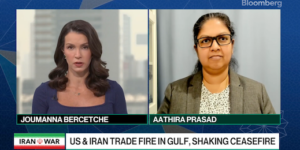


Aathira Prasad’s comments appeared in an article in AGBI titled “UAE businesses scramble for Hormuz trade alternatives” published on 17th March 2026.
The comments are posted below.
The problem, analysts say, is not just the existence of alternatives, but their limits. Capacity constraints, higher transport costs and longer transit times mean these routes cannot absorb the volumes that normally pass through Hormuz.
“[Multimodal routes] are quite costly and time consuming. And there aren’t sufficient, say, trucks that you can use to transport these goods from one place to the other,” said Aathira Prasad, director of macroeconomics at Nasser Saidi and Associates.
Roughly 20 million barrels of oil a day transit the waterway. By comparison, an oil tanker truck typically carries about 240 barrels. Replacing 20 million barrels daily by road would require around 83,000 truck journeys every day.
A significant share of trade entering the UAE has been re-exported from here to other markets,” Prasad said. “So there are lots of dependencies here which have come to an abrupt halt.”
Crises of this scale often accelerate structural change. Analysts expect the disruption to sharpen the focus on supply chain resilience and alternative logistics infrastructure across the Gulf. “Projects like Etihad Rail become quite important because suddenly you have connectivity within the Emirates. If you extend it across the GCC, it will become an alternative infrastructure that you don’t have in place currently,” Prasad said.
Regional policymakers may also move to activate long-discussed cross-border logistics systems. Customs corridors across the GCC – previously largely conceptual – could gain momentum. Saudi Arabia last week launched a new Logistics Corridors Initiative aimed at strengthening supply chain resilience and facilitating cargo movement between the kingdom’s ports and those across the GCC.
“You always see a shift immediately after a crisis,” she added.