“Digital remittances will unlock financial inclusion in the Middle East”, Oped in The National, 21 Jan 2026

The article titled “Digital remittances will unlock financial inclusion in the Middle East” appeared in the print edition of The National on 21st January 2026 and is posted below.


Digital remittances will unlock financial inclusion in the Middle East

Nasser Saidi 

Financial inclusion remains a challenge for Arab countries in the Middle East. Only 50 per cent of adults in the region have a financial account, the lowest global score in financial account ownership, the World Bank says.

There are also wide gaps between the Gulf and the rest of the region, while women are disproportionately less likely than men to have accounts.

The gender gap in account ownership is most severe in the region, at 15 percentage points, more than double the average of other upper-middle-income countries.

Financial exclusion forces people into the informal cash economy, limiting their ability to save, invest and protect themselves from economic shocks. By contrast, globally, 78.7 per cent of people aged over 15 have an account with a bank, financial institution, or mobile money provider, up from 50.6 per cent in 2011.

Of the 1.3 billion adults that remained unbanked globally in 2024, the majority are located in the Arab region, Asia and Africa.

But digital technology is transforming the financial landscape. The Global Findex Digital Connectivity Tracker finds that 84 per cent of adults in developing economies own a mobile phone (in the Middle East and North Africa, it is a higher 89.3 per cent). Mobile phones and internet connectivity allow more people to access and use digital financial services. Mobile money accounts are gaining popularity as an alternative means of accessing financial services, with 2.1 billion registered mobile money accounts globally in 2024, according to the GSMA.

The Middle East is a global hub for migration, characterised by a unique demographic flow.

The Gulf Co-operation Council-South Asia (India, Pakistan, Bangladesh and Nepal) labour flow corridor is the single largest labour migration corridor into the Mena region.

Beyond South Asia, many migrants come from labour exporting Arab states such as Egypt, Jordan, Lebanon and Syria.

Remittance outflows from the Gulf clocked in at $131.5 billion in 2024, with $77 billion from Saudi Arabia and the UAE alone. For recipient countries such as Egypt, Jordan, Lebanon, India and Pakistan, these flows are not merely supplementary income; they are vital economic stabilisers that often outstrip foreign direct investment and official development assistance.

In Lebanon, remittances have become a critical lifeline amid economic collapse, representing 27.5 per cent of gross domestic product and more than 80 per cent of total external resource flows in 2023.

Money to send money

The traditional channels for remittances are costly and slow. High fees erode the value: when a migrant worker pays 7 per cent or more to send money home, it acts like a tax on development, with the reliance on cash agents an additional source of uncertainty and security risks.

The digital space offers a transformative opportunity. Digital remittances are not just about cost, efficiency and convenience; they are a gateway to broader financial inclusion.

The Mena region is already embracing this: in 2024, only 9.1 per cent of respondents to the Global Findex survey used a bank account for sending or receiving domestic remittances, compared to 26.3 per cent by all means including money transfers.

Empirical evidence finds a positive correlation between remittances and formal deposits/ credits, and using accounts for such transfers leads to remitters sending on average 30 per cent more than via informal channels.

By bypassing physical networks and leveraging mobile technology, the cost of sending money can drop to below the UN Sustainable Development Goals target of 3 per cent.

Digital transfers are near-instantaneous and secure, while also reducing the risks associated with carrying cash. Importantly, using digital channels creates a financial footprint.

For a migrant worker or displaced person who has never had a bank account, a digital remittance history can be the first step towards accessing credit, insurance and savings products. The success stories of M-Pesa in Kenya and Jazz Cash in Pakistan highlight mobile money services that have revolutionised financial inclusion by leveraging high mobile phone penetration – sporadic internet access is not a limiting factor in such cases. Both digital platforms have since expanded beyond simple transfers to offer loans, savings, insurance and merchant payments.

These models can be easily introduced in the Mena region, especially given the migration and expatriate labour patterns.

Users in Morocco are embracing digital payments, with various international money transfer operators present in the country (eg, Wise, Remitly, Xoom etc), and government and the central bank are working to streamline regulations for such operators.

In Jordan, “Digi#ances” (a CBJ-GIZ implemented project) aims to increase the use of digital financial services, including cross-border remittances via e-wallets, among unbanked Jordanians and refugees, with a specific focus on women.

Cross-border interoperability between payment systems is important, with the Arab Regional Payment System (Buna) aiming to streamline clearing and settlement across Arab currencies.

Blockchain technology holds the promise of offering transparent and immutable ledgers for cross-border transactions.

The use of central bank digital currency (CBDCs) also offers a transformational solution for financial inclusion. A retail CBDC can be stored in a digital wallet on a basic mobile phone (even without access to the internet), allowing unbanked populations in rural areas to receive funds directly and safely.

Superapps are imminent, with remittances just one feature within a broader set of lifestyle and financial services, embedding financial inclusion into users’ daily digital experience.


Nasser Saidi is the president of Nasser Saidi and Associates. He was formerly Lebanon’s economy minister and a vice-governor of the Central Bank of Lebanon. 


Impacts from the ongoing Russia-Ukraine turmoil: AnNahar Interview (Arabic), 9 Mar 2022

فكرة حرة- ناصر السعيدي لـ”النهار”: 2022 سنة الخطر الكبير… والأزمة ستمتد

بغياب الحسم العسكري في الحرب الأوكرانية الروسية، فان المشهد الاقتصادي المرتسم يحكي الكثير عن التغيير في الاستراتيجيات والأسواق بعد العقوبات المتعاظمة المفروضة على #روسيا واستخدام الطرف الأميركي ورقة النفط، وكذلك عن أزمات الغذاء والطاقة و#التضخم والركود.

الاقتصادي ناصر السعيدي أطلّ في برنامج #فكرة_حرة مقدماً قراءته للمشهد، لاسيما للتداعيات في المنطقة.

واعتبر السعيدي أن العالم يمكن أن ينزلق الى انخفاض بالناتج القومي، وهذا ما يؤثر على المنطقة بطبيعة الحال، لكن هناك بالطبع تفاوتاً في التأثير بين البلدان، هناك دول تستفيد من ارتفاع أسعار النفط ودول مستوردة للنفط والقمح كلبنان ومصر، تتأثر سلباً جراء ارتفاع أسعار.

وفي شأن أزمة السيولة في أسواق المنطقة، رأى السعيدي أن الحرب المالية والمصرفية بدأت بحظر مصارف روسية من نظام “سويفت”، واذا توسع الحظر ليشمل كل المصارف الروسية سيكون التأثير ضخماً، ويمكن أن ينخفض الناتج القومي الروسي بحدود العشرين في المئة، وبنتيجة ذلك سيكون هناك اثر على السيولة عالمياً.

ويتحدث عن مشهد انخفاض بالانتاج وارتفاع بالتضخم، ما يشكّل الخطر الأكبر في 2022 عالمياً بعد أن كنا نترقب التعافي من “كوفيد”، و”برأيي الأزمة ستمتد”.

ووسط مشهد الأزمة، ورداً على سؤال حول الملاذات الآمنة للمستثمرين، عدّد: الذهب، وبيئات استثمارية في دول مستفيدة من ارتفاع سعر النفط، والعملات المشفرة…
Watch the interview below


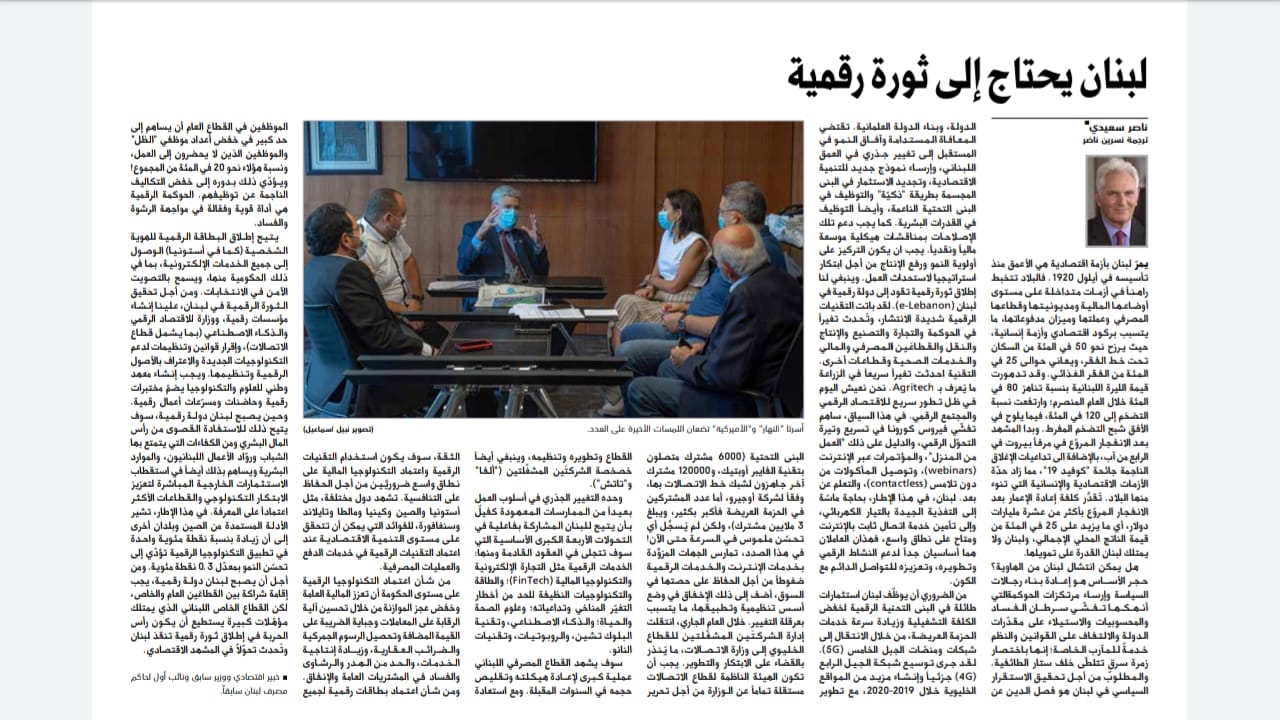
"Lebanon needs a digital revolution", Oped in AnNahar, 27 Sep 2020

The Arabic version of the article titled “لبنان يحتاج إلى ثورة رقمية” can be accessed on the website directly (paywall) or read below.  The English version of the same article, titled “Lebanon needs a digital revolution” can be downloaded here.


Lebanon Needs a Digital Revolution to Leap Forward: Article in An Nahar newspaper, 27 Sep 2018


Dr. Nasser Saidi’s article titled “Lebanon Needs a Digital Revolution to Leap Forward” was published on 27 September 2018 in a special issue of the daily An Nahar newspaper with the American University of Beirut. The article is posted below.

Click to download the original article in English and Arabic.


 Lebanon is in deep economic malaise, suffering from stagflation: dismal economic growth, high budget deficits, debt, unemployment and inflation. Lebanon’s recovery and its future growth prospects are highly dependent on developing a new economic development model, renewed investment in physical infrastructure and in soft infrastructure, including human capital and rebuilding political capital which has been depleted by mal-governance, the widespread cancer of corruption, nepotism and state and regulatory capture. Lebanon’s corruption rankings are dismal: 87th out of 113 countries on corruption. We rank 105 out of 137 countries on competitiveness and ranked 133 out of 190 countries on cost of doing business. 

Yet things can be turned around. Beyond the much discussed structural, fiscal, and monetary policy reforms, we need a major, growth lifting, productivity growth increasing strategy. We should launch a “Lebanon Leap Forward” strategy, a Digital Revolution to create e-Lebanon. New technologies are disrupting markets, products and services. Digitalization is becoming pervasive, transforming retail, manufacturing, industry, transport and logistics, banking and finance, health services and other sectors. Technology is rapidly changing agriculture to AgriTech. We are increasingly living in digital markets. 

Lebanon must make massive investments in digital infrastructure to lower the cost and have faster telecom services (jump to 4G), networks and platforms in order to actively participate in four major transformations that will unfold over the coming decades: Digital Services such as e-commerce, Clean energy & Clean Technologies to mitigate the risks and consequences of climate change, health and life sciences, AI, BlockChain, FinTech, robotics and nanotechnologies. 

Digitalization can radically change, revolutionize, Lebanon’s banking and financial sector. FinTech for banking & corporate finance, capital markets, financial data analytics, payments, insurance, and asset and wealth management has the power to open new horizons and cross-border markets for our banking and financial sector. Countries as diverse as Estonia, China, Kenya, Malta, Thailand and Singapore show the benefits of digitized payment and banking services. Digitized services are the most efficient tools to serve our wealthy Lebanese expatriate community. Crowdfunding can be key to economic development and economic diversification supporting SMEs and financial inclusion. 

Digitalization can substantially strengthen public finances and reduce budget deficits through better reporting of transactions and collection of VAT, customs and other taxes, increase the efficiency of spending and reduce waste, bribery and corruption in public procurement and spending. Introducing a national digital ID system (like in Estonia) can provide access to all e-services, including those provided by government. Digital IDs for all public sector employees would dramatically reduce “shadow” and absent employees and workers. Digital government is a potent, effective tool against bribery and corruption. 

To enable Lebanon’s Digital Revolution, we need to establish digital institutions, set-up a Ministry for Financial Services, Digital Economy and Innovation, enact laws and regulations to support new technologies and FinTech and recognize digital assets to enable Lebanon to develop a Silicon Valley and attract investment and startups. Our universities and institutes of technology will need major investments in labs, incubators and accelerators; a multiplication of current initiatives. A digital Lebanon would maximize the use of Lebanon’s talented youth and entrepreneurs and human capital and attract FDI to promote technological innovation and knowledge-intensive sectors. Lebanon ranks 4th globally on math and science education (WEF, 2018)! The evidence from China and other countries indicates that a 1 percentage point increase in digitalization increases growth by 0.3 percentage points. 

Our private sector can make Lebanon Leap Forward. A Digital Revolution can transform our economic landscape. Are our politicians and policy makers capable of delivering their side?