“Global Economic Diversification Index 2025”, report released at the World Governments Summit, Feb 2025

Global Economic Diversification Index 2025” was released by the Mohammed Bin Rashid School of Government (MBRSG) at the World Governments Summit held in Dubai on 12th Feb 2025. Dr. Nasser Saidi & Aathira Prasad were co-authors of the report, which  was developed in cooperation with Keertana Subramani, Salma Refass and Fadi Salem (MBRSG) and Ben Shepherd (Developing Trade Consultants). 

Access the latest and past reports as well as the underlying data on the website


Effective governance of economic diversification efforts is highly reliant on the availability of representative and robust data that informs evidence-based development and policy directions. The Global Economic Diversification Index (EDI) 2025 report provides valuable longitudinal datasets to inform policy, research and economic development efforts across the globe. It specifically highlights the importance of economic diversification for commodity-producing nations to mitigate the risks of growth, trade, and revenue volatility. The report underscores the vulnerability of countries dependent on   commodities to various shocks, such as price fluctuations, climate change, and global pandemics. Successful diversification can be accelerated through adopting new technologies and digitalisation, moving towards a services-based economy, focusing on value-added manufacturing, and investing in human capital and infrastructure.

The findings of this latest edition of the EDI emphasises the need for commodity-dependent nations, particularly those reliant on oil and gas, to adopt policies that prevent the natural resource curse and promote sustainable economic growth. Globally, there are numerous examples of successful transitions, including Norway’s diversification into high-tech sectors and Malaysia’s move towards greater industrialisation. However, the report highlights that there is no one-size-fits-all approach to diversification, as the urgency and pace of reform depend on multiple factors, including institutional effectiveness and governance, among others.

The Economic Diversification Index, first published in 2022, provides a comprehensive measure of economic diversification across countries. The EDI, derived by calculating the scores of three key sub-indices: government revenue, output, and trade, allows countries to assess the state and evolution of their economic diversification, as well as compare themselves with peers, and identify factors that can foster or impede diversification. The 2025 edition covers the performance of 115 countries, using publicly available quantitative indicators to ensure transparency and allowing reproducibility of the results. 

The top-ranked EDI nations in the current EDI edition continue to include the United States, China, and Germany. In 2023, twenty-five of the top 30 nations were high-income countries, alongside only four upper-middle-income nations (China, Mexico, Thailand, and Turkey) and a single lower-middle-income nation (India, at rank 20 globally). Only three of the eight regional groupings show an increase in EDI compared to pre-pandemic readings (Western Europe, East Asia Pacific and South Asia). It is, however, important to highlight that while EDI and GDP per capita are generally positively correlated, high-income countries, particularly oil dependent economies, do not always have high economic diversification scores.

In 2024, the Global EDI report introduced new digital trade augmented index (the ‘EDI+’). In the post-pandemic years, digitalisation continues to play an important role in increasing economic diversification while also enabling emerging and developing nations to catch up. The inclusion of digital indicators in the EDI shows that many developing nations are diversifying into the digital space and catching up with more advanced economies. this progress is dependent on factors such as infrastructure availability, regulatory support and the presence of a skilled workforce among others. The 2025 edition confirms that multiple countries in the top quintile of the EDI rise even higher with the inclusion of the digital indicators within the trade sub-index (i.e. trade+ sub-index). Over two-thirds of the nations’ show greater improvements in the trade+ sub-index (comparing 2023 versus 2010) than in the overall EDI+ scores. On the other hand, the lower income groups have yet to recover to pre-pandemic levels, in either EDI or EDI+ scores. This underscores the challenge of achieving recovery without substantial investment in digital infrastructure and relevant enablers.  The performance of EDI+ is in line with other digital indices, with the scores showing a positive correlation.

Insights from the latest EDI scores point to a few policy directions. Commodity producing nations need to consider three key factors while deciding on economic policy: (a) the implications of climate change will have an impact on commodities production and extraction; (b) how energy transition is affecting the demand for commodities, including fuel and metals; (c) the continued risks from geopolitical tensions and trade fragmentation, particularly for low-income and emerging market countries that depend on commodities, which may potentially leading to long-term output losses.

In this EDI edition, 40 countries in the index, nearly 35 percent of the countries covered, are commodity exporters, and within that subset, close to 50 percent of the commodity dependent nations are reliant on fuels. While the more diversified Mexico and Malaysia retain top rankings, given the dynamic nature of diversification, other countries are also undertaking transformational policies: notable cases in 2023 compared to 2000 include Saudi Arabia (up more than 30 ranks), UAE (+24 ranks), Kazakhstan (+17 ranks), Qatar (+12 ranks) and Oman (+10 ranks).Low to middle-income nations such as Angola, Congo and Nigeria remain consistently within the lowest quartile (with common characteristics such as poor governance scores and/ or being politically unstable) along with upper middle-income Azerbaijan. Among the Gulf Cooperation Council (GCC) countries, Bahrain and the UAE have both scored highly in the output sub-index in recent years, while the UAE outperformed in the trade sub-index. Kuwait lags its peers in all sub-indices, making it the lowest scoring among the GCC countries. 

Today, the world faces heightening environmental concerns exacerbating social inequalities and economic instability. The World Economic Forum’s Global Risks Report 2025 underscores the urgent need to address these environmental concerns, with “biodiversity loss and ecosystem collapse” ranked by respondents as the second-most concerning risk over the next decade. Climate change is forcing nations to hasten low-carbon energy transition plans and policies and consumers to make gradual behavioural shifts away from fossil fuels. Geopolitical forces also reconfiguring the global energy map. Even as the GCC countries emerge as “Middle Powers” in a globally fragmented world, its member states are stand out as energy powerhouses in both fossil fuels and renewable energy amidst global fragmentation.


“Global Economic Diversification Index 2024”, report released at the World Governments Summit, Feb 2024

Global Economic Diversification Index 2024” was released by the Mohammed Bin Rashid School of Government (MBRSG) at the World Governments Summit held in Dubai on 12th Feb 2023. Dr. Nasser Saidi & Aathira Prasad were co-authors of the report, which  was developed in cooperation with Keertana Subramani, Salma Refass and Fadi Salem (MBRSG) and Ben Shepherd (Developing Trade Consultants). 

Access the latest and past reports as well as the underlying data on the website


Economic diversification is a gradual, transformative process for countries that are dependent on commodities or a limited set of products or services.

Diversification for commodity producers leads to greater macroeconomic stability, more sustainable growth patterns, enables a gradual move to higher value-added economic activities (from over-dependence on primary commodities) and helps lower trade concentration (i.e., increase a country’s ability to export a wider set of products to a larger set of trade partners). This requires active and productive private sector participation, and in parallel, governments need to rollout effective policy reforms (often structural) and undertake productive investments – while diversifying the government revenue base by raising non-commodity-related revenues.

The Global Economic Diversification Index (EDI), based on publicly available indicators, data and information,provides a quantitative measure of the state and evolution of the economic diversification of countries going back to 2000. The current edition expands the coverage of countries to a total of 112 countries (7 additional countries compared to the previous EDI edition) owing to improved data availability.

The United States, China and Germany retain the top 3 ranks in the EDI for 2022, with the top 10 nations having small margins between scores (implying the strength of diversification). Western European nations account for almost two-thirds of the top 20 highly-ranked nations and while 26 of the top 30 nations are high income, there are representatives from upper-middle income (China, Mexico, and Thailand) and one lower middle-income nation (India).

At the other end of the spectrum, however, the diversification process has been long and slow. Four nations – three from Sub-Saharan Africa alongside Kuwait from the Middle East and North Africa region (MENA) – continue to remain in the bottom 20 ranks of the EDI over the period. The share of MENA nations in the bottom 20 ranks fell to just 10% from one-fourth in 2000. At the same time, there were 13 Sub-Saharan African nations among the lowest 20-ranked nations in the year 2022 from nine in 2000. Furthermore, the catch up for lower ranked nations in the post-Covid era will be a tougher ask, given the long-term scarring effects and output loss induced by the pandemic in addition to an already limited fiscal space and existing debt burdens.

As the global economy slowly recovers post-pandemic, it is contending with a lasting structural change: the accelerated adoption of digital technologies, which has resulted in societal gains such as higher labour force participation rates and productivity gains among others (especially in nations where the basic infrastructure was already in place). Despite challenges in data availability in this realm, this edition of the EDI includes indicators that aim to capture the growth of the digital economy: three digital-specific indicators are added to the trade sub-index.

Using this updated list of indicators and availability of data, a revised trade+ (“trade-plus”) sub-index is calculated for the years 2010-2022, for a subset of 106 countries. The revised trade+ sub-index is also used to calculate a digital augmented EDI+ (“EDI-plus”) score and ranking. Other than the Sub-Saharan Africa region, all regional groups improved their trade+ sub-index scores in 2020-2022. While the top four ranked countries are the same in both the trade and trade+ sub-indices, of the bottom 20-ranked nations in the original trade sub-index, thirteen are worse-off when including digital indicators. This finding is in line with what other studies have shown i.e. if adoption is delayed, existing digital divides can widen leading to deteriorating outcomes and prospects in the absence of an acceleration of reforms. South Asia shows a significant upwards jump in trade+ scores over time and this is reflected as well in the EDI+ scores as well.

A clear outcome across countries is that digital economy investments improve trade diversification, notably through the ability to export services. For commodity producers and exporters, the report finds that they can strongly improve their overall EDI and trade rankings by investment in and adoption of new digital technology and its services. Additionally, country geographical size does not appear to be an impediment to economic diversification and EDI scores (e.g. highly-ranked nations such as Singapore, Ireland and Netherlands among others are relatively small economies, both in the EDI and EDI+ versions).

Commodity producing nations are vulnerable to volatility in commodity prices. Prices can be more or less volatile depending on the type of commodity.  For instance, price of oil has been more volatile than the price of copper, wheat or cotton and other commodities, as shown by historical data. In the EDI sample of countries, more than 50% of the commodity dependent nations are reliant on fuels. The demand and supply shocks that occurred during the pandemic and those caused by ongoing wars, in addition to the planned energy transition to Net-Zero Emissions, increase the urgency for fossil fuel exporters to diversify – else these nations run the risk of being left with lower valued or stranded assets.

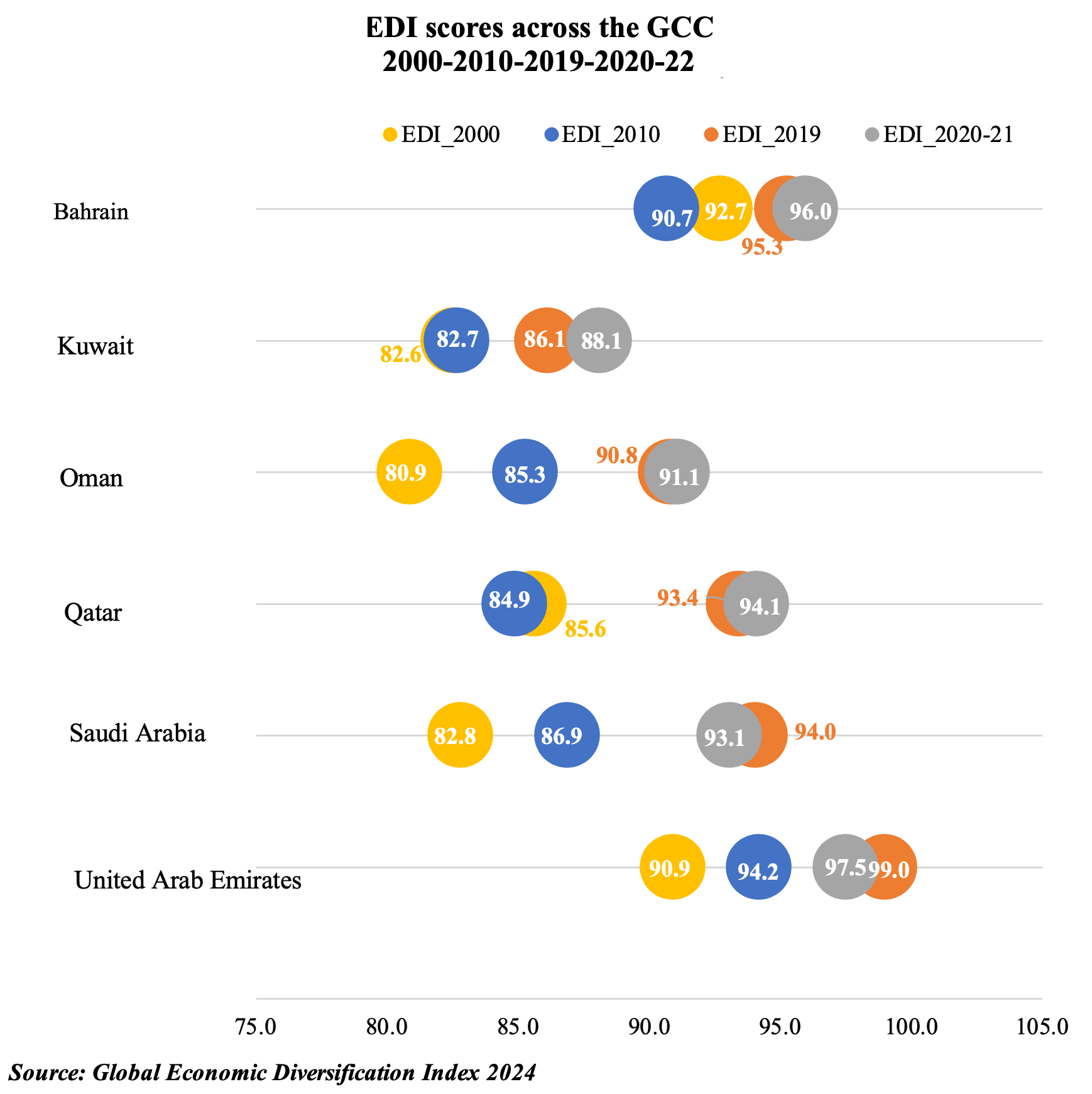
Sub-Saharan Africa’s commodity exporters posted the lowest EDI scores over time, with the 2020-2022 average score falling below the 2012-2015 period, underscoring not only the pandemic’s negative impact on performance but also the divergent paces of recovery. However, both the MENA and Eastern Europe & Central Asia regions reported a slight improvement in the 2020-2022 period versus pre-pandemic scores: these nations were all fuel exporters (i.e. not exporters of any other commodities). The report also finds that countries that reduced (increased) the share of resource rents have seen an increase (decline) in EDI scores, but the relation is one of correlation and not causation. Among the GCC, UAE and Bahrain have higher EDI scores compared to their peers, while Saudi Arabia and Oman have both gained over 10-points in 2020-2022 compared to their EDI score in 2000. Improvements in GCC scores have resulted from the implementation of reforms at a much more aggressive pace after the pandemic – including incentives to invest in new tech sectors, plans to broaden tax bases, trade liberalisation through free trade agreements and improvements to regulatory and business environment among others facilitating rights of establishment and labour mobility – that support diversification efforts and provide long-term economic resilience.
Lastly, the report highlights an increasingly relevant discussion related to climate change and the vulnerability of commodity-dependent nations. As countries adapt to and mitigate climate change risks, energy transition and “Green economy” investments, such as renewable energy, can play a key role in transforming economies and output structures. Fossil fuels are likely to remain in the global energy mix for decades, but a potential sustained decline in demand necessitates the roll-out of diversification policies at the earliest. With many oil-exporting nations in the Middle East already diversifying energy sources, potential export of clean energy from these nations could widen their export base (both in terms of products and trade partners). Furthermore, regional integration would aid diversification efforts of commodity producers and also provide a massive opportunity to link with domestic or regional value chains, adding to diversification efforts.


“Global Economic Diversification Index 2023”, report released at the World Government Summit, Feb 2023

Global Economic Diversification Index 2023” was released by the Mohammed Bin Rashid School of Government (MBRSG) at the World Government Summit held in Dubai on 14th Feb 2023. Dr. Nasser Saidi & Aathira Prasad were co-authors of the report, which  was developed in cooperation with Salma Refass and Fadi Salem (MBRSG) and Ben Shepherd (Developing Trade Consultants). 

Access the latest and past reports as well as the underlying data on the website. The report’s release was covered in newspapers like The National and Khaleej Times among others. 

Economic diversification has been a guiding policy theme for commodity producing nations to minimize volatility, support economic growth and development, create jobs. alongside greater private sector activity and more sustainable public finances. While research about economic diversification centers around its determinants and the impact of policies on economic development, there had been no agreed, available measure or index of economic diversification till the first edition of the Global Economic Diversification Index (EDI) was published in 2022. The EDI measures and ranks countries on the extent of their economic diversification from a multi-dimensional angle, exploring diversification of economic activity, international trade as well as of government revenues (away from a dependence on natural resource or commodity revenue).

The EDI is based solely on quantitative indicators, with no survey or perception indicators, providing a quantitative benchmark and ranking of the economic diversification of countries, using 25 publicly available indicators, data and information. This edition of the EDI extends the coverage to a total of 105 countries, for the period 2000 to the Covid19 affected 2020 and 2021, allowing an international, cross-country, regional comparison and ranking of commodity dependent countries.

The United States, China and Germany hold on to their top 3 positions in this edition of the EDI. Nations that rank 4th to 10th have only a 6-point difference between them, highlighting the strength of diversification among the highly ranked countries. Three oil producing nations continuously remain in the bottom 10 nations across the period, but the MENA region has recorded an improvement towards the latter part of last decade (supported by the acceleration of many oil producer’s diversification plans).

Overall regional rankings held steady even during the pandemic years (though the scores were much lower): North America topped the list while Sub-Saharan Africa remained a laggard. The analysis highlights that while commodity dependent nations have made gains in both output and trade diversification sub-indices over time, revenue diversification has been holding back overall advances for many. Tax revenue as a % of GDP in Norway, highly ranked in the revenue sub-index, stands at a high 30%+ and compares to single digit readings in countries like Bahrain, Iran or Kuwait, to name a few.

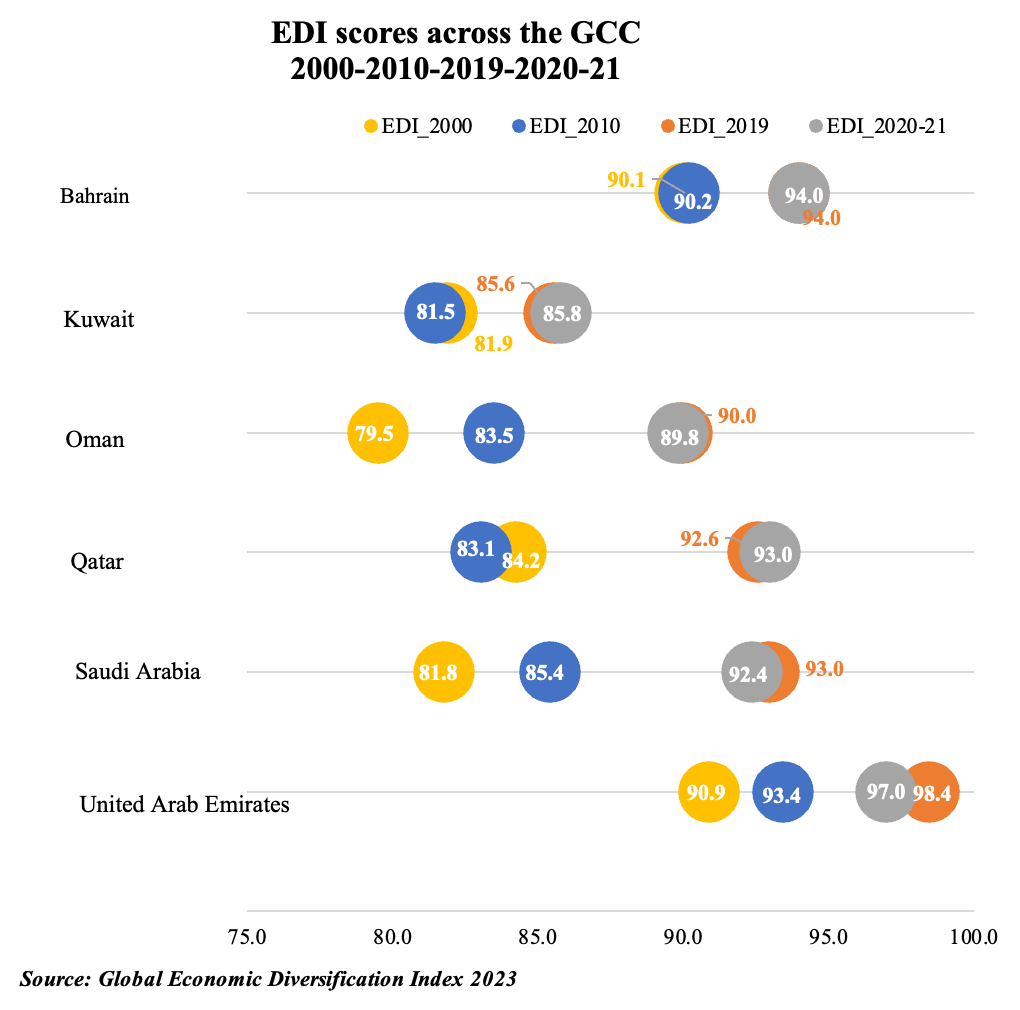
Within the GCC, UAE and Saudi Arabia have made the most significant economic diversification progress, thanks to a conscious effort to diversify into the non-oil sector. Following the onset of Covid-19, which put the brakes on non-oil sectors of focus (like tourism, infrastructure and logistics), there has been an accelerated shift in policies rolled out to enable economic transformation. This includes structural reforms (especially directed at the labour market and increased mobility), embracing the digital economy, efforts to broaden the tax base and a concerted push towards the privatisation of certain state-owned assets and enterprises to de-risk fossil fuel assets among others. This will support the next phase of economic diversification in the region.


“A new global economic diversification index”, post in OECD’s Development Matters blog, 1 July 2022

The below article was published as a post in the OECD’s Development Matters blog on 1st July 2022. The original post can be accessed directly at: https://oecd-development-matters.org/2022/07/01/a-new-global-economic-diversification-index/


A new global economic diversification index

By Aathira Prasad, Director, Macroeconomics and Nasser Saidi, President, Nasser Saidi & Associates


“My dear, here we must run as fast as we can, just to stay in place. And if you wish to go anywhere you must run twice as fast as that.” 

Lewis Carroll, Alice in Wonderland


The well-known “natural resource curse” comes from the observation that economic growth in nations with an abundance of natural resources tends to be lower and more volatile. A number of empirical regularities characterise these countries: (a) resource-abundant countries tend to underperform their resource-poor counterparts, with evidence of a negative relationship between real GDP growth per capita and resource exports; (b) resource-based economies’ exposure to adverse external shocks leads to macroeconomic instability and higher economic risks; (c) non-resource based activities get crowded out; and (d) institutions tend to be weak and anarchic.

Economic diversification – a key to addressing economic risks, macroeconomic stability, volatile economic growth and sustainable development issues – has become an everyday term in the policy lexicon of natural resource dependent countries. Although many diversification policies have been implemented over the past several decades, there has been little effort to assess if they have been successful. The majority of existing research focuses on trade diversification.

The Global Economic Diversification Index (EDI) aims to fill this gap. The EDI examines economic diversification from a multi-dimensional angle, exploring activity, trade and government revenue diversification. Some of the main findings from the inaugural edition of the EDI are as follows.

  • For the least diversified nations, overdependence on commodity production and exports has meant growth volatility and a long path to catch up with top performers.
  • Seven nations have consistently ranked among the top ten countries in the EDI from 2000 to 2019, with China joining this cohort from 2008 onwards. Service-led nations stand out among the top-ranked (UK, Ireland, Singapore and Switzerland), highlighting the growing importance of the services sector (and adoption of new technologies) and its pivotal role in enabling a “catch-up” with highly industrialised nations.
  • At the other extreme, seven nations have remained in the bottom ten, including four oil-producing nations (two from the Gulf Co-operation Council – GCC) and two low-income and agriculture-dependent countries.
  • Between 2000 and 2019, the nations that have improved their EDI scores the most include China, the US, Saudi Arabia, Germany and Oman. The GCC nations (except Bahrain) are among the top 20 nations to have improved EDI scores over that period.
  • Low and lower-middle income nations among the commodity producing nations have the lowest EDI scores overtime. Oman and Kuwait (part of the GCC) rank poorly, but the former has embarked on a diversification path, while the latter, due to ongoing political gridlock, has not undertaken economic reforms.
  • In regional terms, North America is the best performer and the Sub-Saharan Africa region is the worst performer on a comparative basis (even though their average scores have improved over time) across overall EDI. The fastest pace of improvement in the EDI has been within the MENA region.

Figure 1. Regional disparities in EDI scores (2000 vs 2019)

  • There is a positive correlation between the EDI and GDP per capita. UAE and Norway are examples of nations in the process of diversification that are inching closer to the mean EDI score in 2019. By 2019, almost all countries’ resource rents readings had declined (versus the level in 2000), and many had improved on their EDI scores. This only shows correlation and not causation.

Figures 2. EDI across commodity producers, by region

The MENA region has lagged behind its regional peers with respect to diversification yet it has caught up relatively fast. This has been supported by diversification strategies introduced by many oil-producing nations in recent years, including the introduction of non-oil taxes (excise, customs and value added taxes to name a few), alongside various liberalisation measures ranging from rights to establishment to trade facilitation measures, and improvements to hard and soft infrastructure.For resource-dependent countries, economic diversification (activity, trade and government revenue) is a strategic imperative given their demographics and job creation requirements, as well as their need to achieve sustainable development and to mitigate the macroeconomic risks of volatile commodity prices and markets. The Global EDI aims to provide guidance for countries, policy makers and analysts to design successful diversification strategies and policies, turning resource rents into an engine of growth rather than a barrier to economic development and thereby avoiding the “resource curse”.