DIFC Economic Activity Survey 2011

While advanced economies of the world are trying to return to a sustainable path in the aftermath of the global financial crisis, magnified by fiscal and debt uncertainties in the Eurozone area, the GCC countries, and the UAE in particular, have recovered. Their growth is buoyed by higher crude oil prices, stimulatory government spending, and growing links with emerging economies, predominantly from Asia. During 2011, despite the upheavals associated with the Arab Spring, oil producers renewed their record levels of export earnings and international reserves, allowing for expansionary fiscal policy that boosted economic activity and led to an acceleration of economic growth, at least in the short term.

During 2011 the DIFC has benefitted from the economic activity revival in the UAE and the region as a whole, as evidenced by the findings in DIFC Economic Note 20 titled “DIFC Economic Activity Survey 2011”, and strengthened its position as a growing financial hub of the region.

This report is based on the survey responses from 533 DIFC entities (8.6% higher than the number of entities that participated in the survey in the previous year – 479) that represent 65.2% of the DIFC’s 817 companies that were active during 2011. The response ratio for the current survey slightly improved from the 63.5% response rate in 2010.

The growth in number of establishments at the DIFC in 2011 was driven entirely by the non-bank Business sector, while the number of companies in the Financial sector remained stable. At the same time we note that a growing number of firms are joining the DIFC from the emerging market economies.

We estimate that total value added (the equivalent of GDP) of the DIFC reached USD 3.13bn in 2011 with an acceleration of the growth rate to 7% from 5.5% in the previous year.

The performance of economic sectors and activities of the DIFC entities at current prices in 2011 can be broken down as follows: Financial intermediation sector recorded a value added of USD 2.2bn, while its contribution to the total value added of the DIFC was 70.3%. The balance of29.7%, amounting to USD 0.9bn, was generated by Business sector entities (e.g. accounting and audit services, management consultants, law firms, restaurants, retailers, and other service providers) and the public sector.

While the contribution of companies to the value added of DIFC can be estimated as above, the indirect contribution of the DIFC to the economies of Dubai and the UAE cannot be so accurately accounted for. As residents in the Emirate, the DIFC workforce contribute to the economy as consumers who invest, rent housing, travel, shop, eat, have relatives visit from abroad (who also shop, eat, travel within the UAE), consult doctors, drive cars, buy real estate all causing an increase in demand for key goods and services in the Emirate – leading to what is called a multiplier effect. This value is more difficult to estimate, but given that the average DIFC workforce compensation falls in the higher end, it is a safe assumption to make that the stimulus to the economy from their spending is substantial.

The questionnaire for the current survey, which is based on the UN-OECD principles and methodology for compiling national income statistics, was expanded to include new sections to capture additional workforce characteristics, paid-up capital, assets and liabilities, and the geographical origin of DIFC entities’ ultimate controlling parents. The new data show that aggregate paid-up capital of DIFC entities owned by non-UAE residents is about 2 times higher than that owned by UAE residents (based on the actual data from responding companies), and that more than half of all ultimate controlling parents of the responding DIFC companies originate from only 4 countries, with the UAE leading the list, while the total number of countries in the list exceeds 50. Also, the new data shed some light on the hierarchical structure of the DIFC labour force, revealing that in the financial sector companies, in contrast to the entities involved in business activities, the proportion of executive officers and managers in the total workforce is notably higher.

A large proportion (55.6%) of the total DIFC’s labour force, estimated at 12,945 people as of end of 2011, was employed in the finance and banking sector. Business sector and public administration entities provided jobs to 41.7% and 2.7% of the total DIFC labour force, respectively. UAE nationals, accounting for only 2.2% of the total DIFC labour force, were mostly represented in the public administration sector (around 1/3 of all people employed by the DIFC and DFSA, on a consolidated basis), while their share in the labour force of private companies was minor at 1.4%.

DIFC human capital is of high quality, with 87.6% of all employees holding university level and post-graduate degrees. Educational attainment features are similar among male and female populations. About 85% of both men and women are university graduates and above, underscoring the availability of an equally highly skilled workforce at the Centre.

The data were collected through the interactive secure web-based online portal DIFCSTAT, which manages all official and administrative communications between the DIFC Authority and licensed companies (https://www.difcstat.ae/difcstatonline/default.aspx).

Click Economic Note 20 – EAS 2011 to download the full report.


From Frontier to Emerging: Does Market Reclassification Matter?

http://nassersaidi.com/wp-content/uploads/2012/03/From-Frontier-to-Emerging-Does-Market-Reclassification-Matter.pdf

DIFC Economic Note 19, titled From Frontier to Emerging – Does Market Reclassification Matter?, discusses and compares the market classification criteria and methodology used by the various index providers, including MSCI, noting the similarities and differences. MSCI have indicated that the UAE and Qatar are being considered for re-classification from Frontier to Emerging market status, subject to a number of reforms. Evidence on the effects of reclassifications in both developed and developing economies is studied in this paper and we find that while MSCI have undertaken some 14 reclassifications over the years, six of them have been downgrades while there have been no reclassification from Frontier to Emerging, yet.

Using past examples of classification changes, this paper examines the short- and long-term impacts of the reclassification – including an empirical analysis of the effects on markets returns of the classification of Egypt and Morocco as emerging markets. Our results indicate that the initial announcement of a potential reclassification leads to an “overshooting” with investors speculatively bidding up securities prices and returns prior to the actual reclassification event, leading to almost no impact post-reclassification. Additionally, too much emphasis is placed on a potential market reclassification, with many forgetting that reclassifications are best viewed as signaling a confirmation of policy reforms and changes in market conditions, which trigger the reclassification. Thus, there is an identification effect whereby improved market conditions, which are a result of policy actions and reforms (leading to a reclassification), could empirically be attributable to the reclassification itself.


The Redback Cometh: Renminbi Internationalization and What to Do About it

http://nassersaidi.com/wp-content/uploads/2012/03/The-Redback-Cometh-Renminbi-Internationalisation-What-to-do-about-it-DIFC-Economic-note-18.pdf

DIFC Economic Note 18, The Redback Cometh Renminbi Internationalisation & What to do about it, analyses the growing international role of China which spans trade, investment, foreign reserve accumulation and Sovereign Wealth Funds. Despite the growing economic & financial international role of China, its currency, the Renminbi (RMB) remains largely a domestic currency. There are increasing calls for the RMB to become an international payment, investment and reserve currency. However, the move towards internationalization necessitates the development of an onshore capital market complemented by domestic policy reforms leading to a changed financial structure, with lower dependence on bank financing.

Internationalization of the RMB forms an integral part of the process of capital market development and financial sector reform. To date, there have been three main channels of RMB internationalization: the introduction of the RMB as the settlement currency for cross-border trade transactions, the provision of RMB swap lines between the People’s Bank of China (PBoC) and other central banks and the creation of a RMB offshore market. In this context we estimate that the RMB will emerge as the third global currency by 2015! In addition, the paper also discusses the GCC’s rising stature as a major trading partner for China, underscoring the fact that it is in the GCC’s strategic interest to move towards greater economic & financial integration with China through accelerating the GCC-China free trade agreement, establishing links between financial markets, finance bilateral trade using the RMB and establishing RMB swap lines with GCC Central Banks.

The Redback cometh and we need to prepare for this momentous coming.


Infrastructure as an Engine of Growth in MENASA

http://nassersaidi.com/wp-content/uploads/2012/04/Economic-Note-15.pdf

DIFC Economic Note 15 titled “Infrastructure as an Engine of Growth in MENASA” provides a descriptive analysis of the infrastructure in the Middle East North Africa and South Asia region. Drawing from the key driving factors behind development of hard and soft infrastructure in the region, the paper also discusses the role of the public and private sector in its investment.

The MENASA region is experiencing a secular wave of transformation with two epicenters, India and the GCC. In the former, the main drivers are a “Goldilocks” demographics and the long lasting impact of reforms enacted in the 1990s by Dr. Singh (India’s current PM) are expected to solidify and extend this transformation process. In the GCC, the main driver is an energy commodity windfall that for the first time in history is not merely amassed in offshore assets, but is increasingly deployed domestically to transform the Arabian Peninsula into an advanced XXI century knowledge based economy.

Two factors will be keys to the future of the region: demographics and urbanization. With fertility rates still well above 2.2, the MENASA region will enjoy the goldilocks of an expanding labor force, while massive internal migration will feed a powerful process of urbanization. These secular waves require a massive commitment to build indispensable infrastructure to sustain the increased population and economic growth. In the two epicenters this need is well understood by policy makers, but a fundamental difference is noticeable. While in the GCC infrastructure projects are anticipating the demand and actually stimulating it (supply side effect), in the rest of MENASA the existing infrastructure are strained due to poor maintenance and intensive usage.

Investment in infrastructure sets in motion a virtuous circle: higher productivity and competitiveness translate into higher incomes and higher government revenues and in turn more public investment in a mutually reinforcing pattern, as has been the case of China over the past two decades and the GCC since the turn of the century. In the process, other positive spill-overs are felt in the form of learning-by-doing effects, efficiency gains in companies, human capital improvement, research and development in construction techniques, technology transfers and process innovation.

Governments’ role as the largest provider of infrastructure financing in the region needs to be redefined given the crisis and resultant fiscal constraints. The role of private sector needs to be enhanced through privatization and Public-Private Partnerships (PPPs). The availability of capital is a key to spur an investment cycle – given the long-gestation nature of infrastructure projects, there is a need to attract private sector funds and more importantly, a need to develop deep and liquid local currency debt markets to improve access to finance.


The Dubai Mercantile Exchange: Trading, Prices and Market Efficiency

http://nassersaidi.com/wp-content/uploads/2012/04/Economic-Note-14-The-Dubai-Mercantile-Exchange-Trading-Prices-and-Market-Efficiency.pdf

The Dubai Mercantile Exchange Limited (DME) is the energy commodities exchange located in the DIFC that lists and trades the Oman Crude Oil Futures Contracts (DME Oman). The DME Oman is the sole benchmark for Oman and Dubai crude oil official selling prices, and the only market listing sour crude in the region. To date, over two million contracts or two billion barrels of crude oil have been traded over the DME since its launch in June 2007. Furthermore, the average daily volumes in DME touched 3,000 contracts during Q1 2011 with the highest record reached in January 2011 when the average daily volume was 3,570 contracts (equivalent to 3.5 million barrels of oil per day). Today, it is considered the largest physically-delivered crude oil futures contract in the world with a 35% (at an annual rate) rise in trading volume in 1Q2011.

Against this backdrop it is important to test the market efficiency of DME and also test whether the prices are reliable and not subject to manipulation. This Economic Note 14, titled “The Dubai Mercantile Exchange: Trading, Prices and Market Efficiency” analyzes the efficiency of DME oil market by using the “weak form of market efficiency”, which posits that future prices are optimal predictors of spot prices. Furthermore, the analysis is done using the Hansen and Hodrick correction which allows treating the overlapping observation problem. Our empirical results are consistent with the hypothesis that the DME market is efficient with reliable prices that reflect available market information. The DME has added value to oil markets by providing a transparent market price mechanism at a time of higher than average volatility in oil prices and market conditions.


The Role of Gold in the New Financial Architecture

http://nassersaidi.com/wp-content/uploads/2012/04/Economic-Note-13.pdf

Beyond its value as industrial input, including in jewelry, gold as a financial asset provides no cash flow or monetary dividend, nor a positive carry, and thus its value depends on non-directly measurable factors. However, its ancestral property as a store of value and a ‘safe haven’ especially in the face of heightened uncertainty and grave disruptions to the financial system would call for a role in the new financial architecture emerging after the global crisis. Absent a return to a fully fledged gold standard or to a gold exchange standard as prevailed pre-1971, gold could provide at least a partial anchor for monetary aggregates in a world that is increasingly multipolar, that is, where one economy would not be able to sustain the dominant international role of its currency without jeopardizing its internal stability as a result of an unsustainable external debt service (Triffin dilemma).
The ongoing real decoupling trend of emerging markets from mature economies will lead to a secular re-centering of the world’s economic and financial geography. This implies that the size of the US economy will shrink relative to other economies and therefore the world will gradually revert to a situation similar to that prevailing before WWI when the first wave of globalization took place.
During the XIX century and up to WWI, the gold standard provided the foundation for the expansion of international trade and the international financial relations. At that time none of the four or five large economies (including their colonial empires) was dominant. In that environment characterised by intense rivalries among major powers, the anchor for the world monetary and payments relationships was gold, i.e. an asset whose supply was independent from the discretionary decisions of national or supranational authorities.
After World War I, and especially after WWII, an economic landscape took shape that was unusual from an historical standpoint (at least since the fall of the Roman Empire). With Europe undergoing reconstruction from the devastation and ravages of war while imposing restrictions on trade and payments, the US became the dominant economy in global trade and investment relations (especially considering that the Soviet Union and, after WWII, China decided to pursue a closed door policy in international economic relations, while India pursued a protectionist model of economic development). The US dollar became the international currency for payments and reserves, thanks to its peg to gold until 1971, the size, depth and liquidity of its financial markets, the dominance of the US as a capital exporter and thereafter thanks to its overwhelming size and military reach.
The Triffin Dilemma, which figured prominently in the international monetary policy discussions right after WW II, posits that the country issuing the reserve currency is bound to run an ever increasing current account deficit as world trade and payments increase in order to allow reserve accumulation and until its foreign liabilities become unsustainable. Against that the US obtained an ‘exorbitant privilege, enabling it to pay for its imports with its own currency.
This dilemma could be side stepped as long as the US economy grew at least as fast as the world global average and had no serious rival on the world stage. However, the global financial crisis which originated in the US severely shook confidence in US banks, financial institutions and markets, which along with the emergence of China and India (with a 10-15 year lag), has reignited these dormant worries. Moreover fiscal laxity in the US, aggravated by the uncertainty over the cost of the health care reform combined with the large unfunded liabilities related to social security and other entitlement programmes, raises the spectre of a scenario in which the international role of the dollar could suddenly come into question.
The US cannot continue to run indefinitely a current account deficit without jeopardizing the stability of the world economy. In a multipolar world the size of a single country would not be large enough to sustain its role as supplier of the dominant reserve currency and international liquidity.
The alternative would be to devise a financial system relying on several major currencies as was the case before WWI. But should such a multi-currency system be left to market forces to set exchange rates or could it benefit from being anchored to an asset such as gold which not issued by a national authority?
Should we base an alternative global monetary system on national fiat currencies or should we move towards a gold exchange standard? The answer – provided in this DIFC Economic Note 13 titled “The Role of Gold in the New Financial Architecture” – is that international liquidity should be supplied on a large scale by an international currency such as the SDR, whose value should be tied to a basket of major currencies and gold, with the weight of the latter set at 20-25%.


The Case for Gold as a Reserve Asset in the GCC

http://nassersaidi.com/wp-content/uploads/2012/06/Economic-Note-11.pdf

The international role of the dollar as a vehicle currency and international reserve asset has come under strain during the financial crisis of 2007-2009. The Triffin dilemma is strongly resurgent: the large balance of payments deficits that the US has been running over the past decade and therefore the piling up external liabilities that have gone to finance the swelling size of international trade and financial markets, has undermined confidence in the US dollar as a reserve asset. Second, the US has been running large fiscal deficits since 2001, leading to a large buildup of public debt, with more than 60% being foreign held. The debt service is becoming a burden which puts the country at risk of negative repercussions when global interest rates will be on the rise again.

Over the years and decades to come, the dominant role of the dollar is likely to give way to a multi-currency arrangement as has been typical of historical phases where three or more economies in the world had roughly the same size and none was clearly dominant as in the late XIX century.

The size and composition of international reserves depends on the choice of exchange rate regime, mandate of the central bank and its policy objectives. Obviously if the national currency is pegged to a foreign currency like the US dollar, as is the case in most of GCC (excluding Kuwait) the reserves will be predominantly kept in US dollar denominated liquid assets. Since oil is priced in US dollars and oil contributes significantly to GCC countries’ government revenues and gross domestic product, governments have preferred to fix the domestic currency against the US dollar. While this has provided an anchor, the obverse is that Gulf currencies have been volatile against the euro, the Yen and other currencies, while trade and investment patterns have been shifting eastward, with Asian countries being the main trade (and increasingly investment) partner of the GCC.

The GCC countries are also considering moving towards a Gulf Monetary Union and potentially a Gulf Common Currency. In this DIFC Economic Note 11 titled “The Case for Gold as a Reserve Asset in the GCC“, we examine the backing for such a common currency in terms of a basket of currencies and whether the composition of reserves could help in conferring the new currency credibility and whether it is possible to demonstrate quantitatively that including gold would help to achieve better macro-economic stability. We conduct a series of simulations based on past data to calculate the return on a portfolio of reserves assets with and without gold.

Our results indicate that if a relatively conservative central bank holds gold as an asset class, its potential returns for any given level of risk (i.e. at any threshold of standard deviation) increase by several basis points more per year than when excluding gold from its optimal portfolio. Similarly, a dollar invested (in January 1987) by a fictional conservative central bank in an international reserves portfolio with gold would have grown to $6.6 by May 2010 – which is about 1.5 times more than an international reserves portfolio without gold.


Dubai World Central and the Evolution of Dubai Logistic Cluster

The logistics sector has been one of the main forces globalization and the DIFC Economic Note 10 “Dubai World Central and the Evolution of Dubai Logistic Cluster” explores the opportunities and benefits for Dubai from its state-of-the-art infrastructure and logistics sector. At the heart of the logistics revolution lays the integration of transport modes and the standardization of procedures which boosted synergies and economies of scale, to an unprecedent extent.

Dubai has been riding high on the wave of this advancements fulfilling a vocation that had suited the Emirate since the late XIX century when its ruler at the time, Sheikh Rashid bin Maktoum, declared its port a free zone. Dubai has thrived in its role as a regional hub reaching a position of prominence in the global logistics network and today it is one of the critical nodes in the global supply chain. This evolution underlines also the growing importance of our region in the world and its gradual transformation from an energy commodity exporter into a diversified economy with a broader economic base and a flourishing, internationally connected, service sector.

The opening of the Al Maktoum International Airport in June 2010 has strengthened and expanded this role. With global trade acquiring an even more strategic importance in the world economy, Dubai will reinforce its position at a time when Asia is supplanting the West as the main engine of growth.

Research highlights that the relationships between transport costs, production locations, and trade patterns follow different stages. At the beginning of the process, when transport facilities slowly improve and costs drop, competitive advantages are the key driver of trade. Later, as the efficiency in transport grows, intra-industry trade starts to dominate, specialization increases and manufacturers exploit massive economies of scale.

To achieve wider supply chain optimization it becomes imperative for companies at different levels of the production chain to coordinate their operations. At the macroeconomic level we observe, as a result, that trade elasticities to global GDP have increased over the last decade all over the world. Likewise, we observe that intra-industry trade among high income economies, but also between low- and high-income countries dominates global trade relationships. As much as 44% of all shipments pertain not to finished goods, but to inputs.

Dubai’s logistics sector is poised to catch the tail wind of this new phase in global trade where the services and the organization of logistics will be the dominant success factors and firms will therefore increase scale and specialization while building sophisticated buyer-supplier networks. To exploit fully the benefits of seamless integration between the major transport infrastructures in Dubai however a few hurdles must be cleared, such as the upgrade of regulation of intermodal links within the Emirate.


Forecasting Tourism in Dubai

During the past decade, Dubai has become a global tourism hub. The DIFC Economic Note 8 “Forecasting Tourism in Dubai” forecasts guest nights demand in Dubai hotels and hotel apartments as a proxy to measure the performance of  the tourist sector in the Emirate. Although tourism represents only 2.5% of recorded GDP, it has a profound impact on retail sales and transportation, which together represent some 44% of recorded GDP.

The empirical analysis uses traditional empirical methods, but in addition to the data compiled by Dubai authorities, it tests the explanatory power of seasonal factors and dummy variables capturing erratic effects such as the Holy Month of Ramadan, the school calendar and major sporting events. As a final element in the forecasting exercise, the analysis includes the number of searches conducted on Google using keywords related to travel to Dubai.


Local Bond Markets as a Cornerstone of Development Strategy

Debt markets represent the leading channel of liquidity for governments, public companies, agencies and financial institutions in many advanced and emerging economies. This DIFC Economic Note 7, “Local Bond Markets as a Cornerstone of Development Strategy” examines the need for developing a local currency fixed income market as it brings multiple benefits: stable access to capital, diversification of monetary policy instruments, creation of a yield curve for pricing financial assets and tailoring risk management tools.

In most countries, the debt market is born out of the need to finance government expenditures. With time, the yield curve on public debt becomes a reference for private entities such as banks, public utilities and corporations, which are then able to tap the market to fund their investments.

The development of local bond markets requires a strong commitment from governments to implement a proactive debt management programme as well as ensure a large and diversified issuers base. Therefore, a focused issuance programme of government securities is essential to establish benchmark bonds. Governments should also encourage publicly owned companies (especially utilities) to issue similarly structured securities to provide a slate of issuers that enjoy local name recognition, thereby paving the way for private corporations to issue debt. The GCC countries are investing heavily in infrastructure, which according to estimates requires USD2.2 trillion in financing. It is both opportune and desirable to raise this financing through securities backed by future cash flows from the infrastructure services, as is typical of project financing schemes.

Although banks are the obvious buyers of bonds, since government debt is highly attractive for meeting statutory reserve or prudential requirements, authorities should encourage the development of a secondary market among life insurances, asset managers and international institutional investors. To ensure the success of the endeavour, the legal environment needs to be tailored to promote transparency, the seamless and timely flow of information, prevention of insider trading and minimal counterparty risk. As markets develop, issuances further down the credit spectrum will increase and more transparent accounting standards in accordance with International Financial Reporting Standards (IFRS) must be adopted. Another pre-requisite for the development of a healthy bond market is a flexible, interlinked, electronic registry clearing and settlement system.

Building and sustaining a vibrant capital market relies on the commitment of long-term stakeholders. In addition to the government and the central bank, market makers, in their capacity as liquidity providers, are essential to ensure an active secondary market, particularly during a hiatus in primary market issuance. Finally, creating a robust framework for creditor rights and investor protection is necessary to instill investor confidence and maintain the momentum of capital market growth.


Wealth Effects in the GCC from Energy Commodity Prices

Oil-exporting countries, including the GCC economies, have experienced a windfall as a result of high oil prices since 2003. Hydro-carbon revenues in the Middle East which has the world’s largest share of oil and natural gas reserves have filtered into their domestic economies through increased government spending and large scale investment projects. However, given the exhaustible nature of energy resorces, long term planning is necessary in order to ensure that the revenues are not spent unwisely.
Friedman’s Permanent Income Hypothesis (PIH) helps to connect economic theory to the practical/empirical approach of estimating the effect of higher energy prices on the stock of wealth represented by fossil fuel underground reserves. The PIH states that individuals base their consumption (and savings) decisions not on their current income which may be subject to transitory, short term fluctuations, but on their permanent income, their longer-term income prospects, and an estimate of their future wealth. The same reasoning, mutatis mutandis, can be applied to countries. In the DIFC Economic Note 6 titled “Wealth Effects in the GCC from Energy Commodity Prices“, we calculate the permanent income effect on the GCC countries deriving from the fluctuations of energy commodity prices and the implications for the future development of this region. Several scenarios are considered – based on assumptions over oil and gas prices and discount rates of income streams.
The central result shows that the present value of the hydrocarbon wealth for the GCC countries can be estimated at USD 11.2 trillion, assuming a 3% rate of return (and discount rate) and a price of $50 per barrel (at 2009 constant prices). The analogous value for natural gas reserves assuming a discount rate of 3% and a price $9 per mn Btu stands at USD 7.1 trillion. Hence, the permanent wealth from oil and natural gas reserves under rather conservative assumptions stands at a whopping USD 18.3 trillion, giving GCC the potential to swap their fossil fuel reserves for half of the world’s current (August 2009) stock market capitalization!
There are a number of important lessons and consequences of the increased wealth of the GCC.
• Their higher current and prospective wealth enables the GCC countries and other energy exporters to use their wealth to invest in economic diversification to reduce their vulnerability to oil and gas price fluctuations.
• The increased financial wealth of the GCC calls for increased investment and resources to be devoted to wealth and asset management and control.
• The fiscal situation and debt capacity of the GCC countries should be analysed taking into consideration the vast current and prospective wealth of the GCC countries.
• The recent financial crisis has demonstrated the importance of the financial cushion provided by the international financial assets that the GCC built up over 2003-2008 in helping them weather the global economic and financial crisis.


Inflation in the GCC: An Analysis of the Causes and Implications for Monetary Policy

In DIFC Economic Note 5 on “Inflation in the GCC“, we have conducted an empirical analysis of inflation in the GCC countries over the period 1980 to 2008, using quarterly data. In our analysis seeking to determine the factors influencing inflationary pressures in the GCC countries, money supply in the region comes up as the foremost factor. In fact, the Vector Auto Regression analysis – starting with a simple three variable model and expanded to more complex specifications – highlights that even when we look simultaneously at variables such as the exchange rate and commodity prices, the influence of money supply shocks predominates in the inflationary process.

International factors such as the foreign exchange rate, and food and raw material prices (which were rising in the first half of 2008) historically have had less influence on inflation in the GCC region. Monetary fluctuations are the major determinant of inflation fluctuations in the GCC over the period 1980-2008. Our results imply that monetary stabilisation and control is at the root of the control and stabilisation of inflation.

The results highlight first and foremost the importance of an independent monetary policy. Given the region’s peg to the dollar (with the exception of Kuwait), the GCC central banks have been forced to mirror the Fed’s monetary policy cycle with real interest rates turning negative at times; this has, in turn, led to an increase in domestic lending, which resulted in excess liquidity, fuelling domestic inflation further. Containing inflationary pressures would have required putting a lid on domestic demand, addressing the non-tradables inflation and easing supply bottlenecks (e.g. the real estate sector) through a tighter monetary policy, which the peg to the dollar prevented.


Trade & the New Economic Geography of the Middle East

World trade has followed an average annual growth rate of 10.1% that increased global exports to USD 13.9 trillion in 2007 from USD 0.06 trillion in 1949. In the past eight years, exports grew on average 2.7 percentage points faster than real gross domestic product. The pattern of international shifted with the increased participation of newly emerging market economies dominating the growth of world trade, and Chinese exports dominate developed countries imports (especially the US).

In this DIFC Economic Note 4 “Trade & the New Economic Geography of the Middle East“, we trace the changing global trade patterns according to the data from the World Trade Organization and the implications for the region, especially the GCC. The data, (available till 2007) reflects the inflated commodity prices that increased rapidly at the start of 2007. The faster rise in commodity prices in 2008 (including the phenomenal rise of oil prices to cross $145 a barrel) has however not been reflected in the available data. But given the aftermath of the financial turmoil and historical evidence of the fall in commodity prices during downturns, the decline in trade volume and value is likely in both 2008 and 2009 in line with growth projections for the world economy).

Detailed analysis of GCC trade data reveals a shift in trading partners with EU and Asia emerging as the major partners with the US share declining. While fossil fuels remain the most important exports from the GCC, there is evidence of trade diversification towards non-oil products. While intra-GCC trade has picked up, there exists potential for sustained intra-regional trade growth, which pales in comparison to regions like Europe (71.2%) or Asia (57.4%). In this context, the GCC should aim to reduce trade barriers (both tariff and non-tariff barriers) impeding regional trade and expedite negotiations with its more important trading partners to facilitate trade. Additionally, the GCC Single Market initiated in 2008 and the expected launch in 2010 of the Gulf Monetary Union and common currency will help GCC to strengthen regional trade and leave a mark on the global trade map.


The Exchange Rate Regime of the GCC Monetary Union

The GCC Monetary Union, when initiated, will need to be accompanied by a re-assessment of the exchange rate policy that links the currencies of the GCC member states between each other and to the US Dollar. The peg to the US Dollar has constrained the monetary policy independence of GCC countries, and limited the options of Central Banks in addressing the global financial crisis that started in August 2007, in particular contagion and spillover effects on the banking sectors financial markets and the real economy similarly, the lack of monetary policy independence prevented an effective response to the surge in inflation over the period 2003- 2008 and has stood in the way of containing the volatility of the real effective exchange rate.

This DIFC Economic Note 3, “The Exchange Rate Regime of the GCC Monetary Union” discusses the optimal currency anchor for the GCC countries and the GCC region as an optimal currency area. We argue that by managing exchange rates against a basket of currencies rather than one currency would allow adequate flexibility to tailor monetary policy that can address domestic conditions and withstand external shocks. In discussing the optimality of a currency area, we stress the role of trade, output and price co-movements and linkages with major economies.

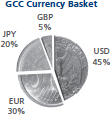
Our empirical analysis of the trade, output and inflation inter-linkages of the GCC economies with their major trade and economic partners suggests that a common GCC currency should be based on managing a basket of currencies comprising the US Dollar (USD), the Euro (EUR), the Japanese Yen (JPY) and potentially the British Pound (GBP). We calculate the weights of an optimal currency basket which could serve as a more appropriate external anchor for the GCC as a whole and the optimal weights are as below.

As a policy recommendation, we propose maintaining the peg of the GCC currencies to the US Dollar until the adoption of a unified currency for the region. Then, at the inception of the Gulf Monetary Union, we  recommend that the Gulf Common Currency be pegged to a basket of currencies as calculated in this Note, with an intervention band of 5% around the central parity. This intervention band could be progressively widened as the ‘Khaliji’ gains credibility in international markets and the monetary policy framework of the Gulf Central Bank is well understood by the public and tested in its daily operation mechanisms.

To download the report, please click here.


The Institutional Framework of the Gulf Central Bank

As the process of the Gulf Monetary Union (GMU) is being finalised, the institutional and governance structure of the Gulf Central Bank is becoming a pressing priority. This report “The Institutional Framework of the Gulf Central Bank” discusses the viable alternatives for a suitable institutional and governance framework for the policy making body presiding over the GMU. We review a series of alternatives from the simplest one (i.e. a Governors Council formed by the Governors of the national Central Banks and Monetary Authorities, each endowed with a single equal vote), to the more elaborate ones, involving the set up of a supranational institution, a Gulf Central Bank (GCB) with permanent staff, an appointed President and an Executive Board, which together with the national governors would form a Monetary Policy Council (MPC) responsible for the setting of monetary policy instruments and taking decisions in all the main areas of monetary policy. The members of the MPC could be given equal voting rights, or a voting power weighted according to the economic and financial size of each country, with some corrective counterweight mechanism such as a specific voting weight for the President and/or the Executive Board to provide checks and balances.

The solution we feel markets (and possibly the public) would find more credible and suitable would be one involving the creation of a new Gulf Central Bank with its own staff and an Executive Board, because it would strengthen the authority and sustainability of the institutional arrangement and create an organisation that is an effective counterpart of the other major international central banks and financial markets. Highly qualified professionals from international markets, national central banks and international institutions could be recruited to foster a process of cross fertilisation, critical for the future of an area whose international economic and financial weight is growing and is increasingly important for global financial stability.

An additional factor deserves special attention: international investors and central banks around the world would be keenly interested in holding assets denominated in the new GCC common currency, as a safe haven and a hedge against oil shocks and inflation, thereby boosting its international role. The new currency will clearly be among the five major currencies in the world. This would also boost the sophistication of local GCC financial markets, extend their depth and strengthen their governance. The intermediate phase in the run up to the launch of the single currency should not be left to a temporary institution, like a monetary institute with weak powers. The GCB must be created as soon as possible with a strong mandate to clear the obstacles while testing and fine tuning the decision-making mechanisms in all areas. Recent financial turbulence and global financial uncertainty inject a sense of urgency into the project: the increasing international economic and financial openness of the GCC countries requires policy coordination and concerted action within a well-conceived economic policy framework, to avoid the risk of being swept by developments that individual countries do not have the power to resist or control.


An Assessment Of The Progress Toward GCC Monetary Union

This report “An Assessment Of The Progress Toward GCC Monetary Union” presents the assessment, as of July 31st 2008, of the convergence process for the Gulf Monetary Union (GMU). The convergence criteria – modeled on the Maastricht criteria that guided the European Monetary Union -were implicitly endorsed by the Supreme Council of the GCC at its 27th session held in Riyadh in December 2006, although the precise definition of most variables has not been disclosed. Using available official and market data, this report shows that as of July 31st 2008, only three countries, Saudi Arabia, Bahrain and Oman meet all the criteria (Omani authorities have reiterated their wish not to join the GMU at inception). Qatar and the UAE have inflation rates which exceed the inflation target, while Kuwait pegs to a currency basket and not to the US dollar.

Moving forward on the GMU
Moving forward, there are three important policy issues that need to be addressed:
1. Inflation should be the priority item on the policy agenda. While a US$ exchange rate peg policy provided for monetary and price stability in the past, structural changes, increased economic and trade diversification with Asia (increasingly the main trade and investment partner) and the weakness of the US $ on international markets, provide the rationale for a change in policy towards inflation targeting, with monetary policy geared to maintaining inflation within an announced target range.
2. The GCC countries will need to invest in building their statistical capacity, in order to provide harmonized, comparable economic and financial data, to support the GMU and The Gulf Common Market.
3. The GMU, if it is to be achieved and serve its purpose, needs to be supported by investments in financial infrastructure (including legal and regulatory), payment systems and the development and linkage of money markets and capital markets.

Another concern is the relevance of the convergence criteria for the GCC region. For example, while the main stumbling blocks on the path to the European Monetary Union were related to fiscal consolidation, in the GCC, public finances display sizeable surpluses and the short term interest rates, given the peg to the dollar, cannot be much different. In compiling this report, the collection of updated official figures has been a major hurdle. In the absence of a precise official definition, for example in the case of the interest rate criterion, we selected the concept that is most widely used on an international basis. It must also be pointed out that the homogeneity of the data across countries cannot be ensured. In contrast to the European Union, the GCC countries lack a supranational statistical agency, like Eurostat, which provides detailed definitions for variables such as public debt or government budget deficits and periodically conducts audits of the official figures. Furthermore a CPI definition valid for all GCC countries has not been provided. Finally, there is a wide difference in the ability of each country to report data in a timely and accurate fashion, an issue that needs to be addressed before the GMU launch.