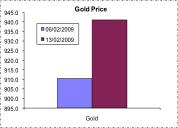
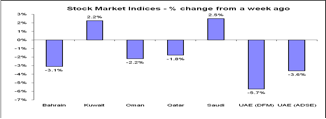
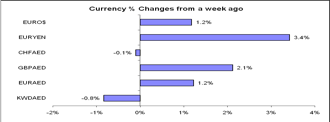
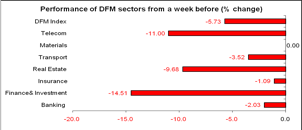
Weekly Economic Commentary – February 07, 2010

Markets
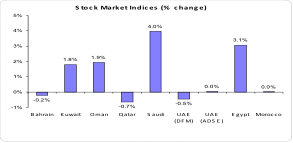
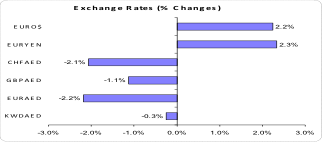
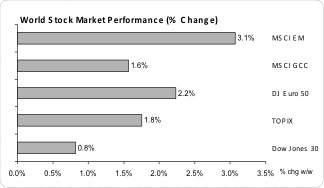
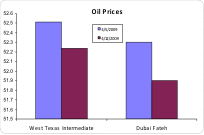
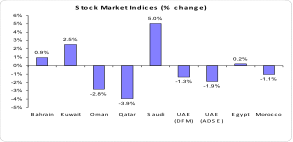
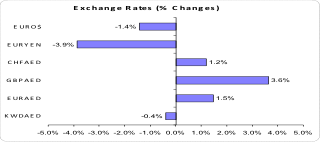
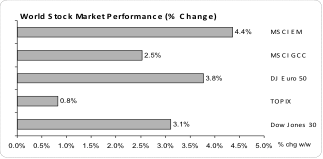
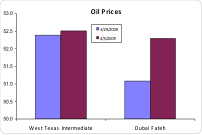
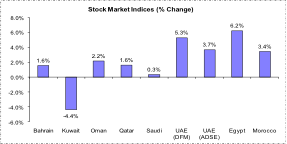
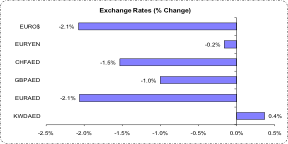
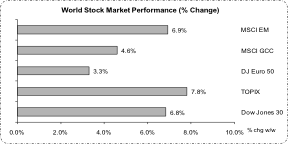
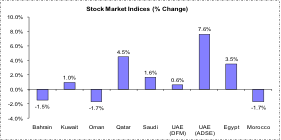
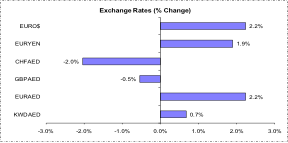
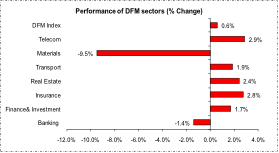
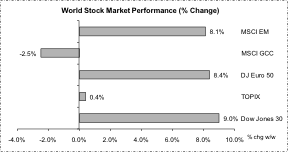
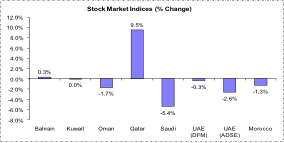
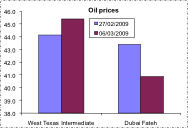
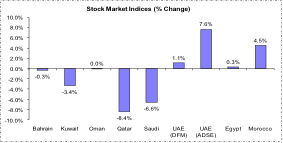
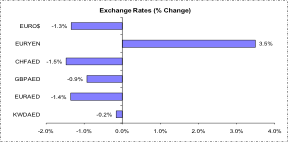
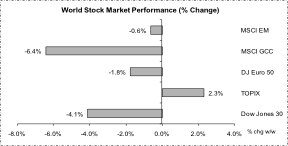
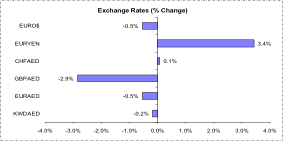
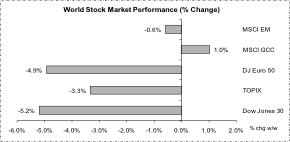
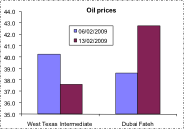
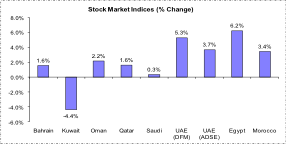
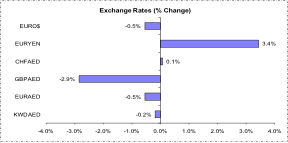
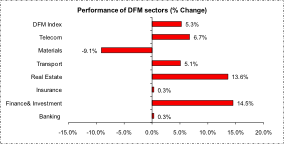
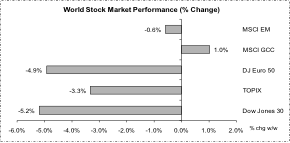
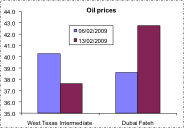
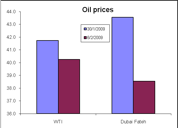
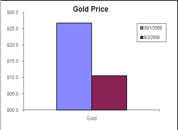
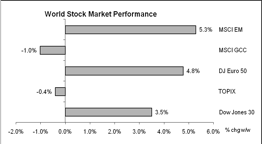
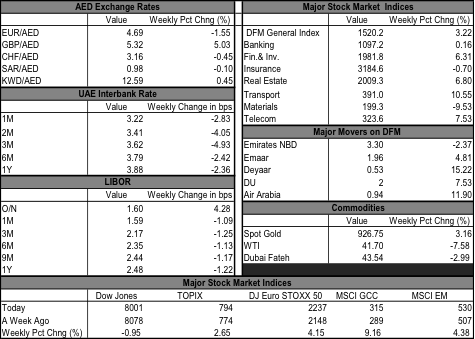
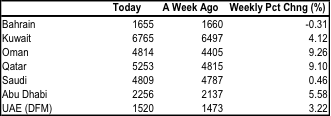
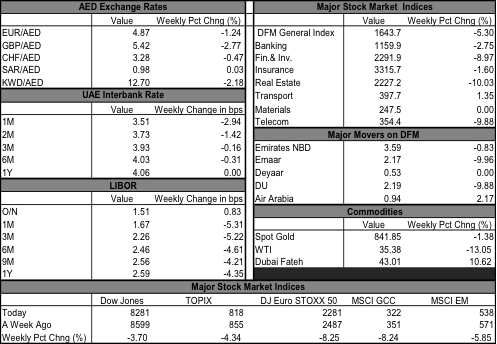
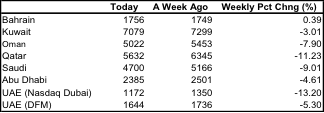
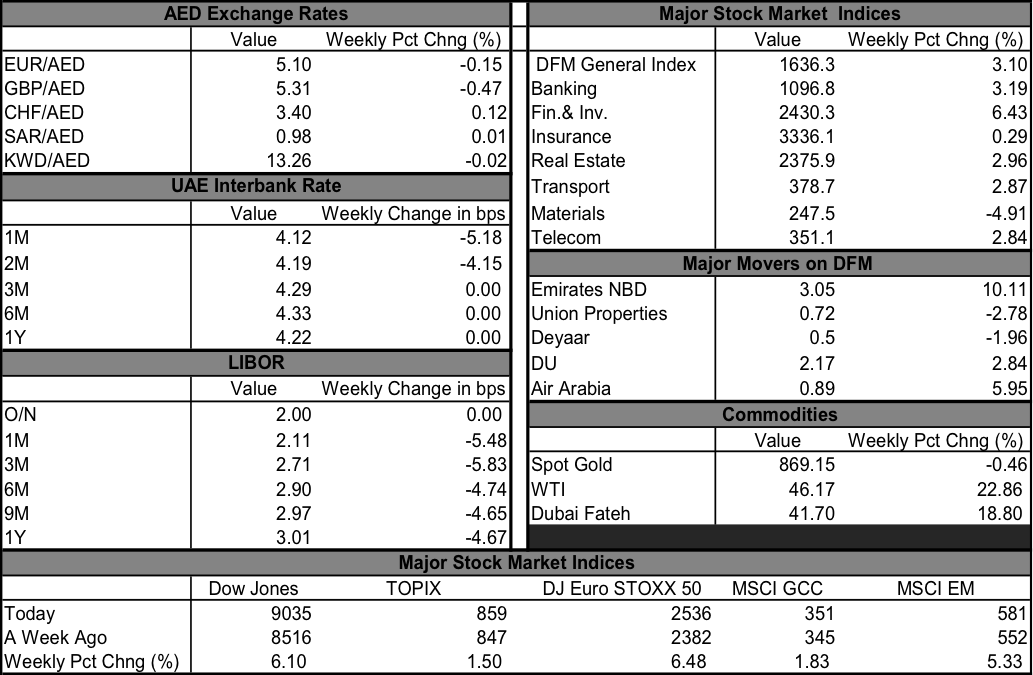
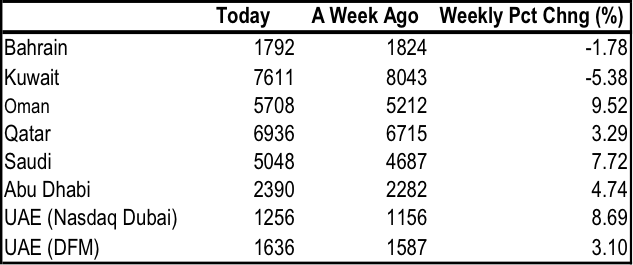
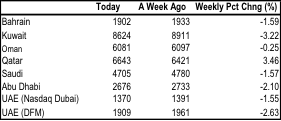
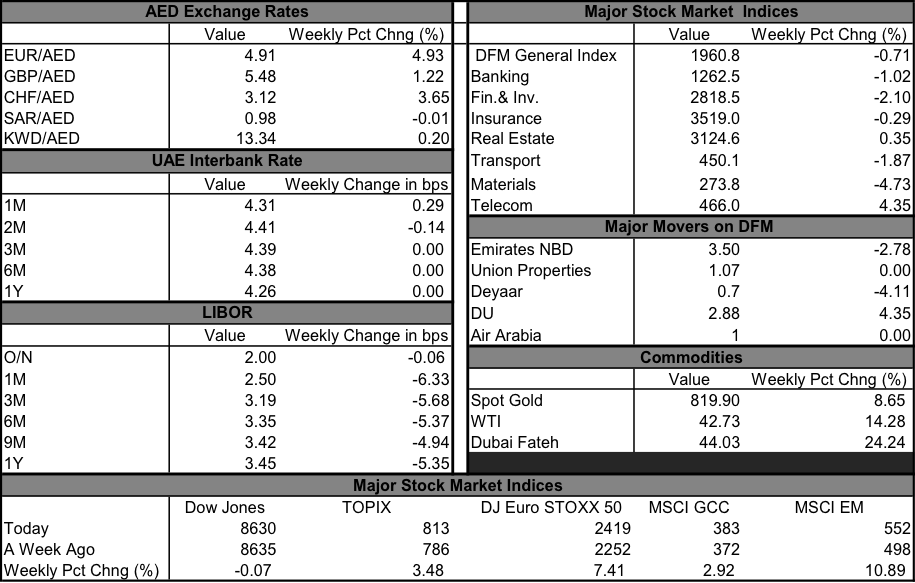
Global stock markets slid sharply to a three-month low on Friday due to widespread concerns about the public finances of Greece, Portugal and especially Spain compounded by negative data on the US job market. Most GCC markets were up, with the exception of only Saudi Arabia. Oil fell nearly 3 percent on Friday to a seven-week low, taking its losses to 14.4% over the past month. The euro weakened to an 8 month low against the dollar.
Global Developments
America:

  • The US payroll data showed further job losses of 20,000 units in January. The unemployment data were more positive with the rate falling to 9.7% from 10.1%, which appears to reflect a genuine move. The household measure of employment in fact rose by 541,000.
  • The US ISM non manufacturing index edges back to 50.5 into positive growth territory, spurred by a gain in order but otherwise slightly disappointing expectations.

 
Europe:

  • Euroland’s PMI manufacturing increased by less one point to 52.4 in January, signaling moderate growth is holding ground. The PMI services on the contrary lost almost one point to 52.5, a lackluster result.
  • German industrial production fell sharply in December by -2.6% mom -6.7% yoy. Although seasonal and calendar effect might explain this weakness it is clear that momentum is waning and is not helped by weakness in the Southern part of the euro area.
  • Spanish GDP fell 0.1% qoq in Q4 2009. This is the first figure to come out of the eurozone, and is not particularly encouraging. But Spain’s woes last week came under the spotlights with markets fretting about the sustainability of its fiscal position.

 
Asia and Pacific:

  • South Korean exports rose 47.1% yoy, and imports 26.7% yoy in January. Exports growth was more broadly based than in December with a distinctive out-performance towards emerging markets.
  • India’s export grew 9.3% yoy and import by 27.2% in December. While improvement in exports continued, non-oil imports jumped, with merchandise imports growing 22.1% qoq (sa).

 
Bottom line: Doubts about the strength of the recovery intensify in developed economy with the job market still weak and the weight of unsustainable public debts coming under scrutiny.
 
Regional Developments

  • Gulf Air’s ownership has been transferred to the Bahraini government from Mumtalakat earlier. According to Mumtalakat’s chief executive, airline industry investment did not fit with the fund’s strategy and given low-returns from such investments, its earlier role was more of a strategic nature.
  • Qatar Financial Centre announced an alteration in its strategy to focus on asset management, reinsurance and captive insurance, the head of its governing body said, in a move to compete with other Gulf financial hubs.
  • Shuaa Capital’s GCC Investor Confidence Index dipped 2.4 points in Jan 2010; Investor sentiment towards the UAE fell into negative territory due to increased uncertainty about the six months outlook of the economy and stock markets.
  • According to a new report by Kamco Research, Saudi Arabia’s banks hold the largest deposit base among its GCC peers (about 38% of total GCC deposit base) or about $283 billion as of Sept09. The banking sector in the UAE followed with 30% (deposit base of $221bn), while Kuwaiti banking sector held the third largest position with 17%, equivalent to $124bn.
  • The GCC railway project is expected to cost $25 billion and likely to be completed by 2017 according to an informed source at the GCC General Secretariat; tenders for an engineering study would be invited from specialized consultancy firms in Q1 2010, and the project is expected to create about 40,000 jobs. (Source: Zawya)
  • Kuwait clocked in a surplus of KWD 6.32 bn in the first eight months of the fiscal year 2009-2010 from higher oil revenues; In other data released, consumer prices rose 5.2% yoy in Apr09, slowing slightly from 5.7% in the previous month.

 
Market Intelligence on the UAE

  • Dubai’s exports grew by 9.3% to Dh40.9 billion in the fourth quarter of 2009. Meanwhile, the total number of Certificates of Origin (COO) issued by the Dubai Chamber during the fourth quarter stood at 152,070, an increase of 1.7% from Q3.
    • Dubai’s offshore oilfield is likely to begin commercial production within a year, according to the office of the Emirate’s ruler. The field which is named al-Jalila will be the fifth in Dubai.
    • The Dubai Financial Support Fund gave Dubai World about $6.2 bn over the past 12 months and stands ready to provide “considerably more”, according to its spokeswoman, adding that the aid was given on commercial terms.  Meanwhile, uncertainty about the company’s $22 billion debt restructuring is starting to weigh on the credit again – pushing up bond yields and Dubai’s debt insurance costs.
    • State-owned Dubai Aluminium Co year-on-year sales volume for 2009 rose 8.7% on higher demand in the Middle East.

Dubai’s Department of Economic Development announced the issuance of 11,635 business licences in 2009, as economic activities continued at similar  momentum. Meanwhile, real estate transactions during Jan 2010 dropped 15% yoy according to RERA.


Weekly Economic Commentary – January 31, 2010

 
Markets 
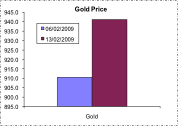
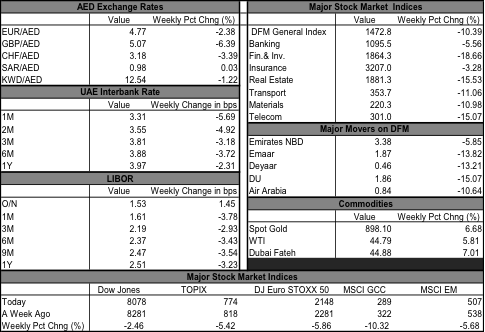
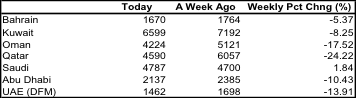
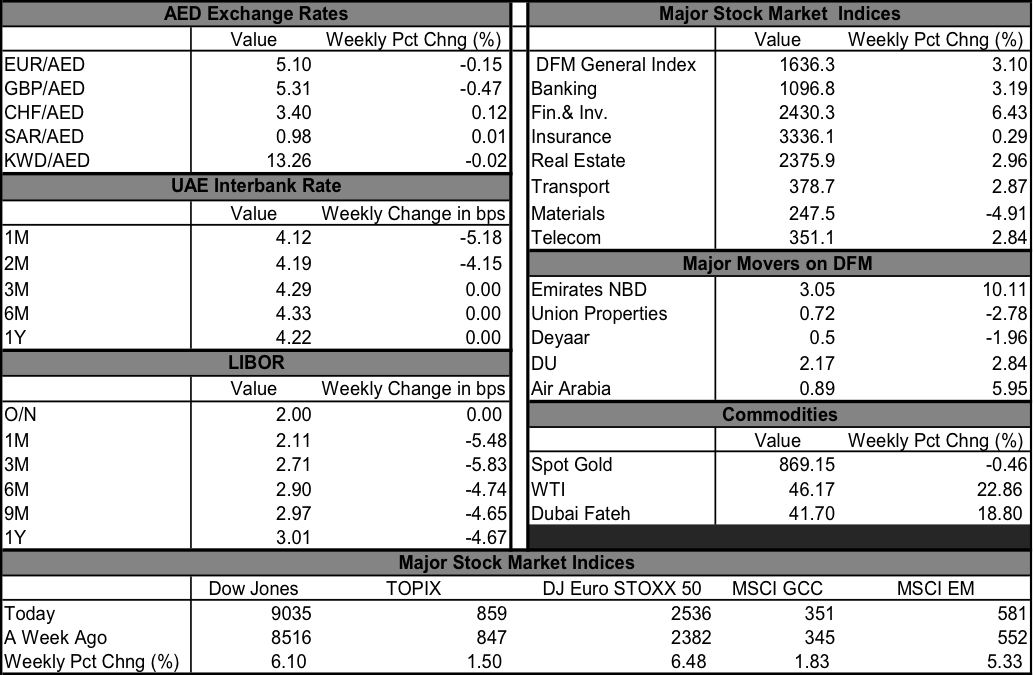
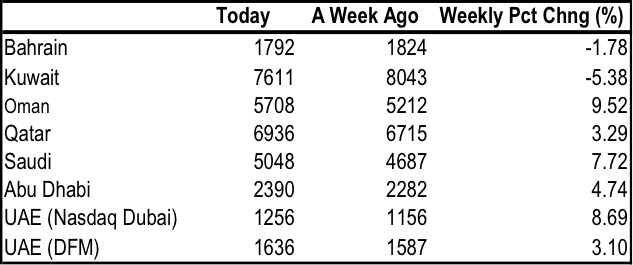
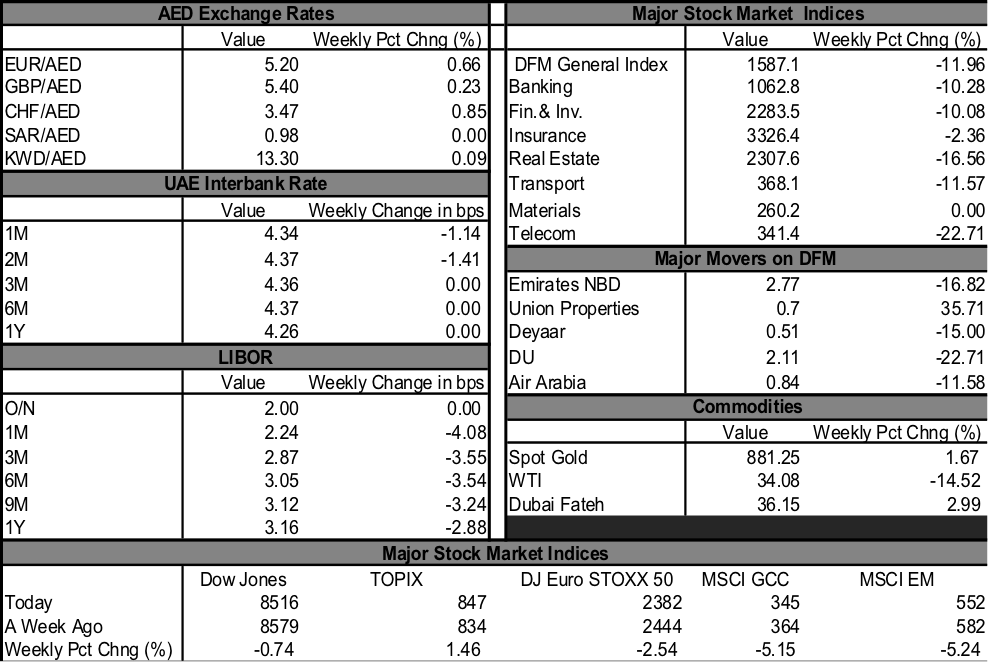
Global stock markets were mostly down last week in reaction to the proposed tax on banks announced by President Obama, but pared some losses following his populist State of the Union speech, the Fed’s statement and positive news on US GDP growth. The Regional markets were mixed with KSA and Qatar down, Oman sharply up and the others mildly positive. The Euro is retreating, while oil and gold fell sharply.
Global Developments 
America: 
• US GDP grew 1.4% qoq or 5.7% annual rate and 0.1% yoy in Q4, due mainly to significant progress toward inventory stabilization, with final sales measures coming close to 2%. Inflation as measured by the personal consumption deflator was 1.4% yoy.
• The Federal Reserve kept rates unchanged while reiterating its promise to keep rates ‘exceptionally low’ for an ‘extended period’.
• Existing home sales slumped in Dec (-16.7% mom) while S&P Case-Shiller index for Nov continued to show modest gains in home prices – both reflecting expectations on the part of homebuyers that the $8k homebuyer tax credit would expire on Nov30, 2009.
• New home sales dropped further in Dec (-7.6% mom) partly due to builders’ poor sentiment, reflecting impact of a supply overhang.
• Durable goods orders rose +0.3% mom in Dec, (-3.1% yoy), a performance reflecting weak transportation orders.
• Initial unemployment claims rose 470k, but continuing claims dropped by -57k to 4.602 million; overall the job market prospects remain difficult.
 
Europe: 
• UK 4Q GDP was up +0.1% qoq, an encouraging sign that the worst is over.
• According to the ECB’s quarterly lending survey, banks are still tightening lending standards on a net basis.
• Euroland consumer and business confidence indices edged up one and two points respectively, in line with expectations.
• Germany’s Jan IFO survey registered an upside surprise (95.8 – the highest since July 08), pointing towards improved sentiment regarding recovery. With the exception of retail, sentiment was higher in all sectors surveyed (manufacturing, wholesale, construction).
 
Asia and Pacific:
• Japan Industrial Production posted its 10th successive increase, rising 2.2% mom (-4.2% yoy) in December, the same as November, suggesting sustained growth. However, S&P downgraded the outlook for the Japanese economy to ‘negative’ and warned that it would revise the ratings of government debt if the ballooning deficit was not contained. Deflation remained entrenched with prices dropping 1.3% yoy in Dec.
• South Korea 4Q GDP was up 0.2% qoq, driven by services sector growth. On the demand side, fixed investment was up but consumption fell, reflecting the waning fiscal stimulus.
• Industrial production in Taiwan increased 47.3% yoy in Dec, the highest recorded rate. IP is now near its peak levels in early-2008. Taiwan is benefiting from strong Chinese economic growth.
• Singapore’s Dec industrial production was up 14.4% yoy (Nov: -9.6%) on stronger production in the electronics sector.
Bottom line: Recovery is almost complete in Asia excluding Japan (where a new populist Finance Minister is unsettling the markets), while the US and Europe maintain a weaker tone. The US GDP figures were positive, but without job creation this turnaround might not last.
Regional Developments 
• Central Bank of Bahrain announced an oversubscription of the monthly issue of the Sukuk Al-Salam Islamic securities: subscriptions worth BHD 63mn were received for the BHD 12mn issue.
• Kuwait announced KWD 12.9bn in total revenues for first 9 months of the fiscal year – this was 59.8% more than projected revenue, but significantly lower (30.7%) compared to a year ago.
• The foreign and local workforce in Qatar grew by 7.9% in 2009 to 1.26 mn. The workforce was concentrated in the construction sector (44%), while the mining and manufacturing sector accounted for another 14%.
Market Intelligence on the UAE 
• The IMF has revised downwards its projections for the UAE, forecasting flat growth this year due to the real estate crisis in Dubai, where output is expected to contract in 2010. The UAE economy in 2009, fell 0.7% according to the latest IMF figures
• A RERA draft law in Dubai would impose financial penalties on developers who deliver properties late and also gives investors a refund or replacement if the delivered property is defective. It would also specify provisions for cancellation of contracts.
• The National Human Resources Development and Employment Authority (Tanmia) has estimated the UAE population would rise in 2010 to 7.56 million (13.3% of which would be Emirati nationals) from 5.63million in 2006.
• Abu Dhabi municipality will develop 26 infrastructure projects this year prominent among which are the commercial area at Khalifa City, completion of roads at Zayed City and completion of projects at Al Salam, East Coast and Presidential Palace roads.
• Three Gulf investors, including Rafed Al Khorafi, chairman of the Kuwait-based AM Al Khorafi group, are suing Bank Sarasin-Alpen and Bank Sarasin & Co in the DIFC Courts for what press reports said was “negligent investment advice”.
• Both Dubai World and Emirates NBD have announced a parting of ways with S&P, on increasing tensions with the ratings agency.
• Dubai may start importing up to 37 billion cubic feet per year of natural gas from Qatar as early as Sept, 2010 according to The National.
• UAE hotels occupancy level rose to 65.5% in Dec for the first time in months. However, Dubai hotels reported the largest RevPar decline of 31.4% yoy to $163.31 in 2009, according to the hospitality research firm STR Global.


Weekly Economic Commentary – January 24, 2010

Markets
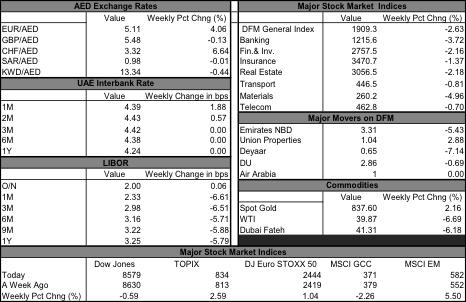
Global stock markets were mostly down hit by the impression of a tightening stance by the People’s Bank of China and concerns over US plans to rein in banks. Regional markets were down as well, with the exception of Bahrain and Kuwait. The DFM was dragged down by the real estate and materials sector. Haven demand boosted the dollar and the yen as worries over China’s monetary tightening and US banks weighed on risk appetite. Commodities – oil, gold and most base metals – fell from the previous week on dollar gains.
Global Developments
America:

  • Global flows of FDI fell to nearly $1 trillion in 2009 from $1.7trn in 2008 according to UNCTAD.
  • Housing starts weakened in Dec09 (-4.0% mom), but permits for construction were stronger – up 10.9% overall.
  • Initial jobless claims were up 36k to 482k in the latest release, but the four-week average is roughly steady just under 450,000.

 
Europe:

  • The German statistical office warned that growth might have been stalled in Q4 2009, but did not provide figures (yet).
  • U.K. inflation jumped up in Dec09, to 2.9%yoy from 1.9% in Nov09. Prices were up 0.6%mom pushed by energy prices.
  • The U.K. Treasury is planning to host a meeting of G7 (and IMF and FSB) on the 25th to discuss a “global insurance levy” (i.e., higher taxes on large banks).
  • Euro Group Finance Ministers criticized Greece it for having failed to enact hard spending cuts. Spreads however narrowed 10bp.
  • The ZEW index edged lower in Jan 2010 to +47.2 from +50.4 in Dec09. This downside surprised the markets.
  • January’s flash Euroarea manufacturing PMI rose to 52 (51.6 in Dec09), with Germany up to 53.4 (from 52.7). However, the services PMI was weak as it fell to 52.3 from 53.6 in Dec.
  • UK retail sales were up 0.3% mom in Dec, resulting in a solid Q4, at 2.8%q/q, saar. This series has been surprisingly robust through much of the U.K. recession.

 
Asia and Pacific:

  • China released a slew of data ranging from GDP to industrial production: real GDP growth accelerated to 10.7% yoy in 4Q 2009 and 3Q growth was revised up to 9.1%, taking 2009 GDP to 8.7%; industrial production slowed to 18.5% yoy in Dec (Nov: 19.2%), with steel and cement output leading to the growth. On the demand side, retail sales accelerated – up 17.5% yoy in Dec (Nov: 15.8%). Fixed investment spending also remained strong while inflation rose to +1.9% yoy, up from +0.6% yoy in November – Chinese domestic final demand growth remains strong but rise in inflation might lead to more tightening of the monetary policy soon.

 
Bottom line: The pause of reflection in global markets continues while the economic situation remains uncertain. The outlook remains clouded by two uncertainties: strength of US labor market and the exit strategy from the exceptional measure taken in 2008-09. Draghi head of the Financial Stability Board warned that the general situation “is not as good as the markets think it is…there are very substantial fragilities in the [financial] system”. China is beating expectations and the authorities looks ready to push the brakes.
 
Regional Developments

  • The outlook for corporate credit quality in the Gulf is stabilizing and might even recover albeit a slow pace, as “the worst is over”, Moody’s Investor Services stated in a new report. Nevertheless credit conditions in some sectors, particularly real estate, will continue to be challenging in 2010. The same also applies to Dubai where restructuring of certain entities is likely to be a prolonged exercise.
  • Contracts for the GCC rail project are expected to be awarded in December while the $15.5 bn project is set to be operational by 2016, according to the GCC Secretariat.
  • According to the World Bank’s Logistics Performance Index (LPI) survey the UAE was placed the best performing trade logistics service-provider in the Gulf region, ranking 24 among 155 countries across the world.
  • MasterCard Worldwide Index of Consumer Confidence showed that confidence in the UAE rose to 86.1 from 29.6 in the previous survey that reflected perceptions for H2 2009. Overall UAE optimism is the third highest globally, after Vietnam and Qatar.

 Market Intelligence on the UAE

  • EFG Hermes estimated that the capital market debt of the Dubai government and its entities, including bonds and syndicated loans, has risen to $96.6 bn in 2009, including funds raised by the government to meet debt obligations. The bank pointed to uncertainty, which could take the total debt to $170 bn, highlighting a lack of data on loans between Dubai Inc. entities and banks. It estimated that Emirates NBD alone is exposed for $24 bn in loans to Dubai Inc.
  • Dubai Chamber of Commerce estimated that housing prices in the UAE remained flat from September to November; property rents and house prices have already bottomed out in June. Almost 30,000 new apartments and villas will be handed over in 2010. The Collier Index reported similar data with house prices in Dubai rising 1% in Q4.
  • The UAE Government pumped nearly Dh18 bn into banks deposits in September, the biggest monthly increase since 2008, according to Central Bank’s figures.
  • Borse Dubai announced it will exercise the one-year extension option of the current USD 2.5bn multicurrency syndicated facility.

Property developer Nakheel announced the payment of the coupon on its USD 750mn bond maturing in 2011 of USD 10.3mn. Nakheel has two bonds outstanding — a Dh 3.6 billion dirham issue maturing on May 13 and the USD 750mn deal due Jan 2011.


Weekly Economic Commentary – January 17, 2010

Markets
Global stock markets were mostly down compared to a week ago. US earnings results failed to impress (banks were dragged down by the disappointing results from JP Morgan Chase) and retail sales data did not help either; Tokyo’s Nikkei meanwhile hit a 15-month high. Regional markets were mostly down – only Bahrain and Saudi made modest gains. Crude retreated below $80 a barrel after cold weather failed to boost demand and the International Energy Agency left its consumption forecasts unchanged.
Global Developments
America:

  • Fed’s Beige book reported modest improvements in consumer spending in 2009, though well below pre-recession 2007 data. Labor market was weak while wage and price inflation remained subdued.
  • Retail sales for Dec09 disappointed (-0.3% mom, +5.5% yoy); initial jobless claims were up modestly (444k in week ended Jan 9). Dec industrial production was up 0.6% mom, thanks to gains in utilities, but manufacturing was dragged down 0.1%.
  • CPI inflation increased 0.13%mom in Dec( +2.7% yoy), less than expected. Core inflation (ex food and energy) increased by a modest 0.11% mom (+1.8% yoy).

Europe:

  • France’s industrial production registered a growth of +1.1% mom in Nov09, driven by strong growth in transportation (+5.3%) and electricity goods (+2.5%). Industrial production for Italy and UK (Nov09) were up +0.2% and 0.4% mom respectively.
  • Eurozone’s industrial production registered a stronger than expected 1.0% mom growth in Nov.
  • The European Central Bank kept its refi rate unchanged at 1.0% and issued a blunt warning to high-borrowing governments that they risked a backlash from financial markets, while escalating pressure on Greece to bring its public debts under control.

 
Asia and Pacific:

  • The People’s Bank of China raised banks’ reserve requirements by 0.5%, taking the markets by surprise. The hike confirms China’s policy tightening move, after concerns about rapid expansion in bank credit in the initial weeks of 2010.
  • China’s December trade report, showed robust growth in exports up 70%qoq, saar and, especially, imports up 83%qoq, saar.
  • China’s forex reserves were $2.4 tr at end 2009, up $453 bn from end 2008. Q4 posted a gain of $126 billion ($42 bn per month).
  • India’s Nov09 industrial production for Nov was up 11.7% yoy, largely due to base effects while a strong pickup in motor vehicle sales and consumer durables reflect robust consumer demand.
  • Japan machinery orders, a leading indicator for capex, posted an 11.3% mom decline in Nov09 – a record low. External machinery orders, a leading indicator for capital goods exports, recorded their first yoy increase, of 0.7%, since Jun08.

 
Bottom line: The outlook for the global economy remains clouded by two main uncertainties: strength of US labour market and the capital markets which are assessing whether the rally in 2009 was overstretched. Draghi head of the Financial Stability Board warned that the general situation “is not as good as the markets think it is…there are very substantial fragilities in the [financial] system”.
 
Regional Developments

  • Saudi Arabia’s bank sector took a hit after Saudi Hollandi Bank made its first quarterly loss in two years while Banque Saudi Fransi and Samba Financial Group also saw profits hit by provisions.
  • Gulf banks provisions for bad loans reached $9.4bn in 2009, a 40% increase over 2008 according to Kuwait’s Markaz estimates. However these provisions are a mere 1.13% of loans outstanding.
  • The banking sector in KSA (11 banks including those non listed) achieved a 4.1% growth rate to reach $7.4bn net profit in 2009.
  • Oman’s banks consolidated balance sheet in the first 11 months of 2009 grew by 4.2% comparing to same period of 2009.
  • Oman nominal GDP of first 9 months in 2009 declined by 27% comparing to same period in 2008. Oman government expenditure of first 9 months in 2009 increased by 6.8% comparing to same period in 2008.
  • Saudi non oil imports value and weight decreased by 32% and 28% respectively where Saudi non oil exports value and weight decreased by 1% and increased 24% respectively.
  • HSBC’s quarterly Gulf Business Confidence Index fell from 81.4 to 80.2 between Q3 and Q4 2009. Saudi and Kuwait indices showed modest gains while UAE declined from 72.2 to 69.8.
  • Estimates from the Energy Information Administration showed the combined income of Gulf oil producers fell to $302bn in 2009 from a record high of USD 522bn in 2008, due to the sharp decline in both crude prices and output.

Market Intelligence on the UAE

  • Dubai Chamber of Commerce announced that total exports for 2009 fell by 16% yoy to AED 186.1bn, with Dec09 registering a 23% rise in total exports indicating a turnaround and a better outlook for 2010.
  • The creation of a judicial panel to hear disputes between Tamweel and Amlak and their creditors could pave the way for a merge. The new panel’s precise mandate has not been disclosed and lawyers fear it may be interfering with judicial courts’ proceedings.
  • The Dubai airport recorded +9.2% yoy growth in passengers during 2009 to a record 40.9 mn, in a period when 46 of the world’s 50 busiest airports showed falls in international passenger traffic.
  • Sheikh Ahmed bin Zayed al Nahayan, ADIA’s managing director, stated that ADIA had switched its weightings across asset classes to reduce the impact of economic downturns over the past 18 months, adding that its allocation to global equities had averaged 40-60%. Regionally, its largest allocation was the US (35-50%), followed by Europe (up to 35%) and Asia (up to 20%).
  • The UAE recorded more than $ 20bn worth of merger and acquisition deals in 2009, of which $ 15.74bn, or more than 77%, were acquisitions made by UAE-based firms, while the remainder was attributed to foreign companies acquiring UAE companies.


Weekly Economic Commentary – January 10, 2010

Markets

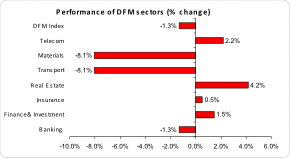
  • Global stocks made further advances, while government bond prices climbed and short-term interest rate futures gained as investors bet the weak jobs market would keep inflation tame and encourage the Federal Reserve to keep lending rates near zero for a long time. The global sentiment was reflected in the regional markets, except in the UAE’s DFM where the index was down 2.8% on last week, pulled down by materials and the real estate sectors.
  • The biggest mover last week was the Japanese Yen after the new finance minister’s calls for a weaker currency sent markets on a rollercoaster ride; the minister retracted his statement later, helping the currency to regain ground. The weak dollar story continues – it plunged against the euro on Friday after unexpectedly weak US jobs report.
  • Commodity prices are on the rise: oil was up 4.3% and gold rose 3.2% from last week.

Global Developments
America:

  • In December 85,000 jobs were cut, sapping expectations that the labor market was stabilizing. The unemployment rate held steady at 10%, but it did not increase sharply only because a surprisingly large number of jobseekers decided to drop from the labor force deeming that finding a job was virtually hopeless.
  • The ISM manufacturing index made a new high for the cycle in December, rising to 55.9 and beating consensus (54.1) expectations. The details are generally supportive, with new orders making a new cycle high of 65.5 and the orders/inventories gap widening anew to 22.1. The outlook for manufacturing is stronger than expected and hence industrial production should show healthy growth in Q1 2010.
  • The minutes of the Dec 15-16 FOMC meeting contain more comments about the likely fragility of the US recovery and lack of upward inflation pressure than opposite concerns of potential inflation problems. This suggests that an exit strategy is not even on the horizon.

 
Europe:

  • Euroland PMI survey continued to rise although at a more measured pace from 51.2 in Nov. to 51.6 in Dec. Among the subcomponents, it is noteworthy the stability of the Orders index in the last 3 months. The key national data were also encouraging: German Manufacturing PMI rose to 53.1 after 52.4 while its French counterpart was stable at 54.4. In Services, the German index rose to 53.1 after 51.4 while the French index fell to 59.3 after 60.9, a mild correction of the 11.6 point increase since August. These figures are consistent with GDP growth of 0.5% qoq in Q4 2009.
  • Euroland inflation rose to 0.9% yoy in Dec from 0.5% in Nov. due to energy-related factors.
  • Both business confidence and consumer confidence in Euroland increased slightly in December to -17 and -16 respectively, another sign of normalization in the real economy.
  • German industrial orders disppointed again in November edging only 0.2% mom higher after -1.9%. The weakness of foreign orders is difficult to explain in light of the strength of the global industrial recovery.
  • Germany’s industrial output increased 0.7% mom in Nov after -1.7% in Oct, broadly in line with consensus. Despite the recovery the index is still around the same level as ten years ago.

 
Asia and Pacific:

  • Singapore GDP grew 3.5% yoy in Q4 2009, however when seasonally adjusted this figure translates into a contraction of 6.8% qoq (seasonally-adjusted; annualized), versus the strong expansions of 14.9% qoq ann. and 21.7% qoq ann. in 3Q2009 and 2Q2009 respectively. The manufacturing sector’s output which contracted by 38.4% qoq ann. in Q4 was the main culprit for this slowdown.
  • Boosted mainly by demand from China, Taiwan’s exports increased by 46.9% yoy in Dec, after increasing 19.4% yoy in Nov. much above consensus expectations.

 
Bottom line: The global economy ended 2009 with a broad based rebound, stronger in Asia, and weaker in mature economies. Pockets of weakness remain in countries such as Spain, Russia, Baltic and Eastern Europe.
 
Regional Developments

  • A single Gulf currency could be launched in 2015 if GCC States speed up the process, according to Mohamed Al Mazroui; GCC Assistant Secretary-General for Economic Affairs, in the first such comment after the monetary union was endorsed last month.
  • Muhammad Al-Jasser, Governor of SAMA estimated total GDP of the 4-member GCC Monetary Council at about USD 751bn, underscoring the monetary council’s potential to strengthen GCC and boost their economic and commercial relations.
  • Kuwait’s parliament approved a bailout bill of up to KWD 6.7 bn for its indebted citizens, despite the government’s opposition. It was estimated that the government would have to use up 33.5% of total deposits, or KWD 2.9bn to fund the plan.
  • Oman has started the implementation of the new tax law – a tax rate of 12% was made applicable to all companies incorporated in Oman, irrespective of the nationality of the shareholders.
  • Higher oil production alongside record public spending boosted Oman’s economy by 3.7% in 2009, according to the country’s minister of national economy. Oman’s foreign trade surplus fell 32% yoy to OMR 4.4bn in 2009.
  • According to the Omani Ministry of National Economy, Oman’s budget spending for 2010 is estimated at OMR 7.2bn, with revenues at OMR 6.4bn, resulting in a deficit of 800 mn (3% of GDP) based on an estimate of USD 50 per barrel.
  • Saudi Arabia has re-imposed 5.0% customs duty on steel bars and cement imports following an oversupply in the domestic market but the duty will only be levied on imports from non-GCC countries.
  • Saudi Arabia’s oil sector GDP plunged 40% to SAR 647bn riyals in 2009, as income from oil production fell to 46.7% from 60.7% in 2008. GDP from the non-oil sector increased 5% to SAR 723bn, according to data released by the General Statistics Bureau.
  • Saudi Arabia’s foreign assets dipped by nearly 12% in the first 11 months of 2009 as Saudi’s massive investment plans gained speed. From about SAR 1.7trn at the end of 2008, the assets of SAMA tumbled to SAR 1.5trn at the end of Nov09.

Market Intelligence on the UAE

  • Dubai approved its 2010 budget with a larger deficit – at AED 6 bn (2% of GDP) – up from the estimated AED 4.2bn for 2009 due to reduced revenue estimates. Expenditure at AED 35.4bn was down from AED 37.7bn budgeted for 2009 while revenues were set at AED 29.4bn.
  • UAE consumer confidence took a hard hit in a global survey after Dubai World’s call for a debt standstill led to a negative outlook. The reading for Dec09 fell 10 points to 92, the biggest drop of the 29 markets in Nielsen’s worldwide survey.
  • A decree exempting companies operating in Dubai from all fines imposed on them for not renewing their licenses on time was applauded as it reaffirmed the continued support for the business community in Dubai.
  • Dubai hotels RevPAR (revenue per available room) dropped to $163.4 in the Jan-Nov09, a decline of 32.3% yoy while hotel occupancy rates dropped to 69.2%, according to the Deloitte analysis of STR Global data of hotel performances in the Middle East.
  • DP World announced that it had paid coupon and profit obligations on its Sukuk and a bond issue on time. DP World also took the decision to list on the London Stock Exchange to boost liquidity, after shareholders called for the secondary listing as a means to ease trading opportunities on the global ports operator. This decision is a serious blow to Nasdaq Dubai where DP World accounts for over 90% of daily transactions.
  • The UAE did not witness cancellation of collective residences in 2009 due to the impact of international financial crisis, according to the Ministry of Interior’s Assistant Undersecretary of Naturalisation, Residency and Exits Affairs. It was stated that some 21,065,229 people entered into UAE via air, land and sea outlets in 2009. The figure is higher than the one registered in 2007 and 2008. The number of people who went out the country last year totaled 20,682,623.


Weekly Economic Commentary – November 22, 2009

Markets

Until recently market reacted cheerfully to bad news and good news. Now the mood is more somber and risk reduction in the face of uncertainty is prevailing and all major indices concluded the week sharply down. It is unlikely that those who decide to join the party later will find much to cheer until the end of the year. Regional markets were mostly down, with the exception of Oman and Qatar; DFM index was dragged down by the telecom and financial sectors. The dollar recovered towards the latter half of last week, after the recent rally in global asset prices appeared to run out of steam. Commodities continued to gain, with the gold’s run helping other metals like copper, silver and platinum reach 2009 highs. Oil remains stable at around 77$/b.

Global Developments

America:

  • Retail sales grew 1.4% mom in Oct, while “core” retail sales (excluding vehicles, building materials & gasoline) rose by 0.5%. Given downward revision of previous months’ data, this means that earlier estimates of Q3 GDP will be also revised down.
  • Oct industrial production was up 0.1% mom, while capacity utilization rate edged up 0.2%.
  • Producers’ prices rose 0.3% mom in Oct on the back of rising energy prices but still remain muted; consumer prices were up 0.2% mom (-0.2% yoy), driven by vehicles and energy prices, while rental indexes remained flat, and apparel prices fell 0.4%.
  • Housing starts disappointed, contracting by 10.6% mom in Oct (falling for the first time since April) as high vacancy rates are discouraging construction. This raises questions on the “recovery” of the US housing market.
  • Initial jobless claims were unchanged, at 505k. The 4-week moving average fell to 514k, and is on a downward trend since early September of 30k per month. At this rate employment could turn positive in Q2 but it will not be enough to stabilize the unemployment rate until end 2010.

Europe:

  • UK retail sales were up 3.4% yoy in Oct; this should translate into positive consumption and GDP growth in Q4.
  • Spain GDP fell 0.3% qoq in Q3, better than the 1.1% drop in Q2, but yet a reminder that the European periphery remains weak.

Asia and Pacific:

  • Japan’s economy grew at a stronger-than-expected annualised rate of 4.8% in Q3, as the fiscal stimulus supported consumer spending and net exports rose.
  • Japan’s government announced that the economy was back in deflation, the announcement coming after the Bank of Japan kept interest rates near zero and upgraded its economic assessment.
  • Singapore’s Q3 GDP grew by 0.6% yoy, after a 3.3% contraction in Q2, with improvement in both domestic demand (through government consumption) and trade.

Bottom line:

The data last week did not add much to the patterns of global improvement. Once again Asia surprised somewhat on the upside, while in developed economies, especially the US data were lackluster at best, especially in the construction sector.

Regional Developments

  • The planned Gulf single currency was ratified by the Bahraini Parliament, while the Kuwaiti Parliament delayed voting on the monetary union to December 8. Saudi Arabia is also steadily approving a series of measure to prepare for the currency union.
  • Qatar has revised the corporate income tax on foreign companies setting a rate of 10% from 2010.
  • Qatar’s $7 bn global sovereign bond issue was assigned ‘AA-‘ senior unsecured debt rating by S&P. Proceeds from the four-times oversubscribed bond will be used as contingency funding for state owned/controlled entities and for infrastructure investments.
  • German transport minister Ramsauer announced that Deutsche Bahn is set to sign a 17 billion euro contract with Qatar, to build a rail network and the Doha metro.
  • Aggregate earnings of GCC companies continue to show a decline – GCC corporate earnings fell by 23% in Q3, with 58% companies having announced results. (Source: Markaz)

Market Intelligence on the UAE

  • The UAE Central Bank has announced that lenders will need to start complying with the Basel II regulations on capital adequacy for banks from next year.
  • The exposure of UAE banks to the Saad and Algosaibi groups amounts to $2.9 bn, between 13 national banks and 7 foreign bank branches, according to the UAE Central Bank.
  • Several Dubai Government-related entities are preparing new bond issues, Standard Chartered said. They could include companies such as Emirates Airways, the Roads and Transport Authority and the Dubai Electricity and Water Authority. Emirates NBD, however announced its decision to put off a planned bond sale till Q1 2010 hoping for improvements in pricing.


Weekly Economic Commentary – November 15, 2009

Markets

The main theme on global stock markets is risk reduction. Regional markets were down, except for the UAE markets which gained from Monday’s speech by Sheikh Mohammed bin Rashid al-Maktoum; DFM was up 3.3% from last week. Dollar fell through key levels to fresh 15-month low on Wed. Gold hit a record high on Thur and was up 2% from last week. Crude oil prices came under pressure after US inventories data indicated a broad weakening in demand conditions. The Baltic Dry index, the global benchmark for freight costs for dry bulk commodities, outshined all other commodity indices by rising 21.2 % to 4,111 points over the week.

Global Developments

America:

  • The latest quarterly Fed loan officers survey points to continued tightening in lending conditions but at a much slower pace than in the past and there are also signs of credit demand slowing at a much slower pace than before. Almost 60% of the responding banks saw unchanged or rising credit demand, the highest reading since July last year
  • Initial jobless claims continued to recede at a modest pace, falling 12,000 in the week ended Nov 7 to 502,000.

Europe:

  • Germany Sep industrial production (IP) was up 2.7% mom, much higher than expected; Italy’s IP fell 5.3%, the worst reading since the series began in 1990. Eurozone IP rose 0.3% on German IP strength.
  • Eurozone GDP turned positive in Q3 (+ 0.4% qoq), though the rebound was less strong than in the US. Exports were the main driver, while private consumption remained fragile. Q3 GDP for Spain (-0.3%), Italy (+0.6%), France (+0.3%), Germany (+0.7%).
  • Rise in UK unemployment was flat in Q3 at 7.8%. Bank of England forecast uplift in growth and is widely expected to keep interest rates low. Fitch warned the UK government debt could risk losing its triple A rating.

Asia and Pacific:

  • Chinese data releases for Oct confirm strong growth led by credit fueled domestic demand. Chinese industrial production grew 16.1% yoy, the fastest in 19 months. Growth in retail sales (16.2%) and fixed asset accumulation (31.8%) continue at their recent trends; growth rate of new bank lending has slowed significantly since mid-year, with Oct lending only +0.6% mom.
  • Hong Kong’s Q3 GDP contracted by 2.4% yoy (Q2: -3.6%), weakened by exports of goods, while private consumption and service exports rose. GDP was up +1.6% qoq – the second quarter of positive growth after four consecutive quarters of contractions.
  • Japan’s current account surplus grew +0.2% mom to JPY 1,567.9 bn in Sep. Sep’s core machinery orders were up 10.5%mom.
  • Indian industrial production grew a strong 9.1% yoy in Sep, helped by growth in the capital goods (+12.8%).
  • Indonesia Q3 real GDP growth came in at 4.2% yoy, higher than the 4.0% in Q2 but in line with the consensus.

Bottom line:

The data flow has not produced any major surprise. Global recovery was broad based in Q3 with Germany picking up strongly among Euroarea countries. Unemployment and commodity price increase represent the main concernsD.

Regional Developments

  • Creditors get an average of 10.2 cents on the dollar if a company in the UAE files for bankruptcy, as per data from the World Bank. In MENA, only Mauritania has a lower rate of recovery, at 6.7 cents while Bahrain has the highest recovery rate, with creditors getting 63.2 cents on the dollar. A review of insolvency systems in the MENA region by A review of insolvency systems in the MENA region by Hawkamah showed they were “substandard” compared with international best practice.
  • A Moody’s report estimated that global sukuk issuance surged by more than 40% in the first 10 months of this year compared to the same period in 2008. They also expected corporate entities less likely to be major issuers of new sukuk in current conditions.
  • Saudi Arabia has started construction of an ambitious light-rail project in Riyadh; in the first phase a 25-km north-south route will be built. In the second phase it will add a 14 km East West route.
  • Qatar and Bahrain are both contemplating new sovereign issues: Bahrain plans to issue a two-year BHD 55mn bond paying an interest of 2.75%, according to the Central Bank of Bahrain; Qatar’s bond issue is expected to target as much as $5bn.

Market Intelligence on the UAE

  • Dubai government announced the repayment of a $1 bn sukuk from the emirate’s civil aviation authority which matured on Nov 4.
  • Nearly three million passengers have used the Dubai Metro in the first two months at an average of 57,000 trips per day, about 40% higher than the authorities’ estimates.
  • Consumer confidence rose 13 points to 102 in the UAE over six months in the latest Nielsen Global Consumer Confidence Index. Job security remains the main concern in the UAE though the focus on job security has eased. Overall consumers in the UAE maintain thrifty spending habits by cutting down on new clothes and switching to cheaper grocery brands.
  • Data released by the Inter-Arab Investment Guarantee Corporation showed that the UAE maintained its position as the second largest FDI destination, after Saudi Arabia in the Arab region, attracting more than $51 bn in FDI in the past four years till 2008.
  • According to Mergermarket data, M&A activity in the UAE has declined to $14.8bn at the end of Oct from $20.9bn during the corresponding period of last year. This data shows that UAE firms have been more active than their international counterparts, as global M&A activity was down more than 46% though Middle East was up 18%. (Source: Business 24/7)


Weekly Economic Commentary – November 08, 2009

Markets

The main theme on global stock markets is risk reduction. Investors seem to be satisfied with the rally and investment banks are near their fiscal year close. The dollar came under renewed pressure after a series of policy decisions from the world’s leading central banks boosted investor confidence. Regional equity markets have witnessed a sharp drop last week, with Dubai falling by more than 5% on Tuesday with property stocks the biggest losers. Q3 earnings have failed to sustain Gulf markets. Gold hit a fresh peak above $1,100 an ounce, but crude oil prices fell as the rise in US unemployment fuelled concerns about the recovery prospects.

Global Developments

America:

  • The US ISM index surged in October as production catches up with orders.
  • The index of pending home sales rose further in September, to a level that is 37.2% above the lows reached in January. The homebuyer tax credit was a main factor, but normalization in mortgage credit played a role as well
  • Nonfarm productivity was up 9.5% in Q3, while labor costs fell more than expected, reflecting weakness in labor compensation.
  • Job losses in October were almost 200,000 and the unemployment rate rose to 10.2% a sign that the recovery is fragile.

Europe:

  • The European Commission revised up its economic growth forecasts for the first time in two years. It sees euro area growth at -4% in 2009, 0.7% in 2010 and 1.5% in 2011. The European Central Bank left the refi rate unchanged at 1.0%.
  • German manufacturing orders in September rose by 0.9%mom, thanks mostly to foreign orders.
  • Euroland PMI in manufacturing reached 50.7 showing that the sector is posed to post positive growth in the next months.
  • UK PMI in manufacturing recorded the strongest reading in 2 years; the subindex for new orders was the strongest for 5 years.

Asia and Pacific:

  • Korea exports continued to recover in October declining 8.3% yoy. Seasonally-adjusted, qoq growth stood at 21.6%
  • Purchasing Manager’s Index from China strengthened in October; Singapore’s PMI slipped to 50.2 in Oct, down from Sept (50.6) and a recent peak in August (54.4).

Bottom line:

Manufacturing production worldwide has almost fully recovered and financial intermediation despite further losses from major banks such as UBS and RBS is in the process of normalization. The risk comes primarily from rising unemployment which saps consumption and from stock markets that might have reached a level out of touch with underlying economic reality.

Regional Developments

  • The IPO market in the Middle East has declined to $1.97 bn in the first three quarters of the year, compared to $12.44 bn in the same period last year, according to Ernst &Young. A total of four companies listed in the Middle East in Q3 2009 raised $871.79 mn in Q3 2009, while 14 IPOs had raised $3.74 bn in Q3 ’08.
  • The global financial crisis has not hit Islamic finance industry thanks to its sound and strong systems as Gulf Islamic investment firms still have $235 bn worth of combined assets, according to leaders at the 3rd Fiqh Conference for Islamic Finance Institutions.
  • According to the Central Bank of Oman, a decline in oil sector output led to a 25.2% drop in Oman GDP in the first half of 2009.
  • Oman’s revenues dropped by 27% in Jan-Aug09 to OMR 4.24 bn, largely due to a fall in oil earnings. Government expenditure increased by 1.7%, owing mainly to an 18.8% rise in investment spending.

Market Intelligence on the UAE

  • Abu Dhabi will spend US$1 trillion (Dh3.67tn) on major infrastructure, property and manufacturing projects, over the medium term, the Minister of Economy Al Mansouri said. He added that UAE growth this year would reach 1.3% thanks in part to projects underway valued at more than $100 billion.
  • The IFC (part of the World Bank) listed a sukuk on Nasdaq Dubai and  Bahrain Exchange on 4th Nov, making it the the first time that a non-Islamic financial institution issues a Sharia compliant security for term funding.
  • Moody’s downgraded five Dubai government-related issuers, citing the tighter conditions under which the government is likely to extend financial support.
  • Abu Dhabi grew a 30% in 2008 as GDP touched AED 520bn, according to a report by the Department of Economic Development. Record oil prices boosted the emirate’s oil and natural gas sector by 37%, leading to a contribution of 64% to GDP.
  • The final draft of the UAE company law, which allows foreigners to fully own a company outside free zones, will be placed before the Cabinet for approval within a month, as stated by Minister for Economy Sultan bin Saeed Al Mansouri (Zawya).


Weekly Economic Commentary – November 02, 2009

Markets

Equity markets fell last week, despite better than expected figures on the US GDP. Europe was severely beaten (-5%) while Japan pared the losses (-1%). Emerging markets lost more than 5% with the GCC index only marginally better. Some of the regional indices (Qatar and UAE) recovered on Monday part of the loss which had intensified on Sunday. The dollar regained some strength as risk appetite is waning. Oil prices dropped to around 77$/b and gold lost some ground, but remains well above 1000$/on.

Global Developments

Americas:

  • US Real GDP grew 3.5% in Q3 (qoq, annualized), but was still 2.3% lower than a year ago. The figure was better than expected, due mainly to a stronger contribution from inventories and resilient consumer spending.
  • The labor market picture was mixed: initial claims for unemployment were unchanged but long term claims were lower.
  • Home prices, as measured by the S&P Case Shiller Index, increased by 1% in August, the third consecutive gain of this magnitude. October consumer confidence fell (to 47.4 from 53.4) as attitudes about job availability/ labour market conditions reached a new low. The Richmond Fed index also reported setbacks in both manufacturing activity and service sector revenues.
  • Durable goods orders for Sep were up 1.0% mom (-17.4% yoy), the gain coming from less volatile components – bookings for nondefense capital goods other than aircraft — a key indicator for future business equipment spending, rose 2%.

Europe:

  • Eurozone bank lending declined for the first time signaling a weak recovery, strengthening the case for the European Central bank to keep the policy rates low. Business and consumer confidence in September continued to increase slightly.
  • Germany’s yearly inflation was flat in October, not surprisingly given that retail sales were down 0.5% mom in September.

Asia and Pacific:

  • South Korea’s Q3 GDP grew 2.9% qoq, a seven-year high, also the first growth after three consecutive quarters of yoy decline. Private consumption and export growth rebounded to positive terms, while equipment investment remains the biggest drag.
  • Japan industrial production for Sep grew by +1.4% mom, with government policies such as tax cuts and recovery in external demand driving production. Deflation is still pronounced with CPI down 2.3% yoy in September.
  • The Reserve Bank of India left rates unchanged but hiked the statutory liquidity ratio by one percentage point to 25%, surprising the market and signaling the end of policy easing.

Bottom line:

The effect of the emergency stimulus is waning, without having had much effect on employment. As a consequence consumer confidence is sagging, which raises serious doubts on the sustainability of the recovery. Markets are extremely nervous as the gloss from corporate earning is less shiny looking forward. The world economy probably will enter 2010 in a somber mood.

Regional Developments

  • The SHUAA GCC Investor Confidence Index rose 3.8 % in Oct, with Saudi Index recording the biggest gain (11.7 %).
  • Merger and acquisition deals in the Middle East until Oct23 stood at $15.66 bn, below $15.8bn in 2008, as per Mergermarket data. M&A activity remained subdued in H1 09, but with 30 deals worth more than $11bn registered in Q3, the trend has reversed.

Market Intelligence on the UAE

  • The Dubai government unveiled a fund-raising initiative for $6.5bn through a combination of $4bn euro medium-term note and a $2.5bn sukuk issue, and this may be listed on the London Stock Exchange and Dubai Financial Market.
    • Dubai sold $1.25bn of dollar-denominated, five-year fixed rate Sukuk, priced to yield 6.39 % and AED 2.5bn in local-currency floating-rate Islamic notes priced to yield 5.65%. This attracted more than $6.3 bn in orders, according to the official statement.
  • The UAE Government approved the 2010 budget, with a 3.4% rise in outlay to AED 43.6bn. Social development received a boost with 22.5% of the budget to be spent on education. Infrastructure projects took a further 17.5% of spending and 6.4% will go to health.
  • Emirates NBD income was up 24% to AED 8.3 bn for the first 9 months of 2009 compared to AED 6.7 bn for the same period in 2008.
  • Abu Dhabi has launched a set of socio-economic indicators to provide reliable data as it moves to boost its appeal to investors.
  • Abu Dhabi Commercial Bank and National Bank of Abu Dhabi set aside AED 810mn and AED 284mn respectively in provisions for losses. Emirates NBD announced that it had slowed provisioning, but warned that non-performing loans had not yet peaked.


Weekly Economic Commentary – October 26, 2009

Markets

Equities in most leading economies touched highs for the year, but the positive mood seems to have been replaced by caution by Friday. Regional markets were mostly down following downbeat earnings while Kuwait’s index suffered its largest one-day reverse for more than three months yesterday. Dubai DFM on Sunday has paired last week’s losses on the wake of Emirates NBD stellar Q3 earnings, and KSA has reached today a 12 month high. The dollar recovered on Thur from a 14-month low as weakness on global equity markets dented risk appetite; the pound slid after UK GDP showed an unexpected fall. Crude oil prices crossed $80/b and hit a 2009 high on Wed, in a week when other commodities like gold, cocoa, corn, soy beans, and wheat also rallied.

Global Developments

Americas:

  • The Fed Beige Book reports that most districts show stabilization or some improvement. However, it is clear that the economy is operating at a low level, with hardly any improvement in the labor market and frozen wages. Consumer spending is flat, improvements in manufacturing are modest, improvements in residential are notable but uneven, lending remains anemic.
  • Housing starts rose less than expected, with the multifamily sector dropping 15.2%, almost to its worst level ever.
  • Initial unemployment claims increased 11,000 to a seasonally adjusted 531,000 in the week ended Oct. 17, after two consecutive previous weeks of decline, indicating the labor market remains fragile, despite signs of economic revival.
  • Brazil introduced a tax on capital inflows to stem the flow of hot money into the local financial markets.

Europe:

  • Euroland’s purchasing managers’ index for Oct09 showed output expanding for a third consecutive month, suggesting the growth rebound seen in Q3 is posed to continue.
  • German Ifo showed a slight rise in business sentiment index – to 91.9 in Oct from 91.3 in Sep. This was the highest since Sep08 but was driven largely by businesses’ hopes of better times ahead rather than a better assessment of current conditions.
  • UK economy shrank by 0.4% qoq in the third quarter, with the negative surprise coming from ‘Distribution, hotels and catering’, which accounts for 15% of the economy.
  • Russia’s GDP rose 0.6%qoq (but was down -9.4%yoy). Russia has begun to recover, but at a feebler than expected pace.

Asia and Pacific:

  • China’s Q3 real GDP growth accelerated to 8.9% yoy from 7.9% (Q2), while industrial production continued to surprise on the upside, rising 13.9% (Sept). CPI for Sept was -0.8%, as a result of government’s control on money and credit supply. Nominal retail sales (Sept) was up 15.5%, pushing Q3 real retails sales +17.8%, the highest in a quarter since the start of the series in 1996.
  • Taiwan Industrial Production grew 1% yoy in Sep, supported by strong IT export orders.

Bottom line

Data this week displayed some negative surprises in mature economies, (UK GDP, US initial claims) and positive ones from Asia (where the economic recovery is sustained by the rebound in world trade), lending additional credibility to the paradigm of shifting growth from West to East. The positive news from China are pushing up commodities prices, while equity markets have probably reached a plateau, as investors are awaiting to see what happens when the effects of emergency stimuli wane.

Regional Developments

  • Business people across the GCC displayed increasing confidence about the outlook for their companies in Q3 according to the HSBC Gulf Business Confidence Index (which shot up from 75.9 in Q2 to 81.4 in Q3, the highest since Oct08).
  • KSA Vice Minister of Water and Electricity, Al-Awaji, stated that the first phase of the GCC-wide power grid has been completed.
  • OPEC has warned that oil prices above $80 per barrel would hurt economic recovery possibly hinting that part of its 6 to 7 million barrels of spare oil production capacity could be put into the market.
  • Proleads Global reported that 30% of Gulf’s hydrocarbon projects (by value) have been put on hold or cancelled, but the GCC remain the most active market in the world for oil, gas and petrochemical industries with projects budgeted at more than $690 bn.

Market Intelligence on the UAE

  • The repayment of a $1.2bn securitised bond a month early by Nakheel strengthened investors’ confidence in the ability of Dubai entities to service their debt. Dubai officials are on an international roadshow to offer investors conventional bonds and Sukuk; Dubai CDS spreads fell to their lowest this year.
  • The IFC will list its first Islamic bond in the Middle East on Nasdaq Dubai and in Bahrain. The operation, worth $100 million, is the first by a non-Islamic financial institution and the first Sukuk to be listed and cleared exclusively in the GCC markets.
  • Dubai International Capital managed to borrow $550 mn from international banks, providing the latest evidence that a growing appetite for risk among global investors may be easing the cash crunch facing Dubai. (Source: The National).
  • Dubai International Airport recorded an increase of 19.5% in passenger traffic in September, the highest monthly growth rate since Oct07 when passenger numbers jumped 25.9%. It is also the fourth consecutive month of double-digit growth.
  • Abu Dhabi Future Energy has showcased the plan to build the world’s first green city dubbed Masdar at a total cost of $22 bn.


Weekly Economic Commentary – October 18, 2009

Markets

Surging oil prices and buoyant world equities, boosted by positive corporate earnings, helped the Saudi and UAE markets to make some gains last week (DFM was up 1.1%), while the rest of the GCC markets declined. The dollar weakened further, while crude oil reached a fresh peak for 2009 (above $78) and gold prices eased after hitting a record high earlier last week.

Global Developments

USA:

  • Retail sales in September dropped 1.5% mom, (-5.4%yoy) dragged down by the auto sector where stimulus programs ended. Excluding vehicles, sales rose a modest 0.5%, consistent with a slow but steady recovery.
  • Initial jobless claims dropped slightly to 514K providing some hope that the labor market may be slightly improving.
  • The repayment by banks of most emergency liquidity borrowings from the Fed is now almost complete, signaling the end of the most acute phase of the financial crisis.
  • Inflation rose 0.17% in Sep (mom, -1.3% yoy), higher than expected, but industrial production posted its third consecutive strong increase in Sep (+0.7% mom -6.1% yoy), supporting the view that the recession is ending.

Europe:

  • German investor sentiment slipped unexpectedly in Sep as optimism about the recovery in Europe’s largest economy faded.
  • UK September inflation fell to a five-year low of 1.1% on flat gas and electricity component, leading to speculation that interest rates would stay on hold until 2011, further weakening the pound.
  • French inflation was negative on the month (-0.2%) and on the year (-0.4%), mirroring the deflation process in Germany.
  • Industrial Production in Euroland was up 1.0%mom in August, below expectations but higher than levels predicted by the confidence surveys.
  • The negotiation over the new German government is taking time to bridge differences over tax cuts and deficit reduction in 2010.

Asia and Pacific:

  • China’s Sep trade showed a rebound in exports (-15.3% yoy from Aug -23.4%) and imports (-3.5% from -17.0%), underlining the improving growth momentum, on continued strength of the domestic economy as well as signs of external demand recovery.
  • India’s industrial production registered a strong 10.4% yoy growth in Aug, with a significant 8.3% rise in the capital goods index (compared to the average 1.4% growth in Apr-Jul), while the consumer durables index was up 22.3% (largely due to a lower base).
  • Singapore’s advanced 3Q GDP growth (provisional) shows an improvement of 0.8% yoy, implying an expansion of 14.9% qoq, sa, due to higher pharmaceutical production and consumer electronics.
  • Japan Consumer Confidence stagnated in September while producer prices continued to decline due to weak demand.

Bottom line

The first phase of the crisis, i.e. the deleveraging and the recapitalization of the banks is close to completion. The second phase, i.e. corporate bankruptcies, downsizing and rising unemployment is still displaying its effects and will take longer to sort out.

Regional Developments

  • The IMF predicts 5.2% growth for the GCC in 2010, and praised the governments of the region for the skillful cycle smoothing fiscal measures and the precautionary measures taken in the banking sector. However it added that structural reforms need to be accelerated to strengthen the economic fundamentals.
  • Saudi Arabia has called on the European Union (EU) to reconsider its attitude in the negotiation of a free trade agreement.

Market Intelligence on the UAE

  • Fitch Ratings lowered its long-term issuer default rating on Etisalat by one notch, citing the weakening of the Emirate’s credit profile and mentioning that this was not related to Etisalat’s operational performance or financial standing.
  • UAE banks have seen the strongest growth (34% yoy) in the GCC in terms of retail banking revenues for H1 2009, according to the Boston Consulting Group’s (BCG) Middle East Banking Performance Index report.
  • Following the resignation of Damas CEO on accusation of carrying out unauthorized transactions, the shares closed 13.51% down on Tuesday, taking the market valuation of the company to $316.5mn.
  • The $5 billion Borouge-II petrochemical project of the Abu Dhabi Polymers Co. in Ruwais with annual capacity of 1.5 million metric tonne is now 90% complete and will be on stream by the middle of 2010.
  • Standard & Poors wrote in a report that the Government of Dubai will quite likely be required to provide extraordinary financial support to some enterprises. Given the limited resources available, S&P believes that the government may be required to select carefully potential recipients.


Weekly Economic Commentary – October 13, 2009

Markets

Equity markets were mostly up last week, boosted by positive Q3 profit reports. The DFM was the best regional weekly performer (+4.8%). However in the first three days of this week regional markets have retrenched and a more negative mood seems to prevail. The dollar continued to slide, but some Asian central banks intervened heavily in the currency markets on Thursday to stem the appreciation of their currencies against the US dollar. Oil and gold were generally stable around the top of their trading range.

Global Developments

USA:

  • Survey of purchasing managers in the services sector activity rose above 50 in Sep (first time since Aug08), signaling the resumption of growth, as indexes for new orders and business activity advanced.
  • Initial jobless claims continued to show a modest improvement as it fell 33,000 to 521,000 in the week ending on Oct 3. Continuing claims also showed a similar movement.
  • Trade deficit narrowed unexpectedly in Aug09.

Europe:

  • German manufacturing orders continued to improve in August (+1.4% mom), though the levels are still low. Since the trough in the Feb09, orders are up 17.1% (with foreign orders growing +19.1% since Feb compared with domestic orders up +15%).
  • Italy industrial production increased 7% mom in August, although it is still 18% lower than a year earlier. Strong performance was recorded also in France (+1.8% mom) and Spain (+1.1% mom).
  • The European Central Bank and the Bank of England held their reference interest rates unchanged.

Asia and Pacific:

  • Taiwan trade data for Sep09 showed an exports recovery alongside slower recovery in import growth; data also showed exports to China gaining momentum.
  • The Reserve Bank of Australia raised its main cash rate by a 25 basis points to 3.25%, reflecting the relative strength of the economy and becoming one of the first major nations to tighten policy rates post-Lehman.

Bottom line

The data released last week have been in line with the view that the world economy was coming out of the recession in Q3 and momentum is strong as we enter Q4.

Regional Developments

  • UK paper The Independent reported that Gulf Arab states were in secret talks with Russia, China, Japan and France to replace the U.S. dollar with a basket of currencies in the trading of oil. Many analysts doubted it would occur any time soon. The Independent said U.S. authorities were aware of the meetings but had not discovered the details and were “sure to fight this international cabal.”
  • The growth in KSA money supply fell in August, but its foreign assets were up for the first time since Nov08 according to SAMA.
  • Middle East mergers and acquisitions (M&A) activity for the third quarter of 2009 is up 27% yoy, with 27 deals worth $3.14 bn in Q3 (until Sep 25) compared with 49 deals worth $2.47bn in Q3 2008. The region’s private equity firms are estimated to have up to $15bn in un-deployed funds, which could change the M&A landscape once the financial environment improves.
  • KIPCO, the Kuwait Projects Company, has announced the completion of the issue of a $500mn bond under its $2bn Euro Medium Term Note Programme. This is the first international bond issue by a private sector corporate from the MENA region in 2009.

Market Intelligence on the UAE

  • The Central Bank Governor has called for a regional financial market to be established for the Middle East and East Asia to offer a safe haven in times of crisis. He added that Middle Eastern countries need more developed bond markets to reduce their dependence on external financing.
  • A federal law has been issued to set up a nuclear regulatory body to monitor the peaceful use of atomic energy. The UAE’s first nuclear reactor is expected to come online by 2017.
  • The Higher Corporation of Specialized Economic Zones (ZonesCorp) in Abu Dhabi has announced the drastic reduction in time taken to obtain an industrial license from 90 days to 11. This will help improve the ease of doing business in the Emirate.
    • UAE inflation for the first eight months of the year touched 2.7%, according to the latest release by the Ministry of Economy. Prices fell 0.2% yoy in Aug, on lower food and housing costs.
    • Abu Dhabi Commercial Bank announced that it has agreed to issue $1 bn of bonds as the initial tranche of its $7.5 bn global medium term note programme. The bonds will mature on October 8, 2014.
    • The Central Bank Governor criticized a Saudi government panel that last month brokered a debt settlement deal between Saad Group and Saudi banks only, raising fears among international creditors they could be sidestepped, Reuters reported. He declined to answer questions on whether the central bank would buy a second tranche of Dubai’s $20 billion bond.


Weekly Economic Commentary – October 04, 2009

Markets

Markets worldwide registered a slump last week, but emerging markets had a slower decline than the advanced economies. Among regional markets, only KSA was up over the previous week. The telecom and real estate sectors were the two gainers on the DFM, which registered a decline of 0.1%. Gold crossed the 1000-mark yet again last week, alongside higher oil prices – but retreated slightly after the release of weak US data on Friday. The dollar and yen gained after the announcement of weaker US jobs/payrolls data.

Global Developments

USA:

  • US unemployment rate touched a high 9.8%, with 263,000 jobs being lost in Sep, a higher than expected figure, which caused investors to question the strength of the recovery.
  • The Conference Board consumer confidence, fell in September contributing to upset market expectations.
  • The Case-Shiller U.S. house price index jumped 1.2%m/m, sa, (1.6%m/m, nsa) in July, to be down 13.3%yoy. In the last 3 months, the seasonally adjusted index is up an annualized 8.7%.

Europe:

  • The E.U. measure of economic sentiment rose another 2 points, to 82.8, and is now up18.2 points from the dark days of March. The main gains came from consumer confidence and the service sector. Manufacturing sentiment did not improve much, and the construction sector remains depressed.
  • Consumer and business confidence in Euroland continued to improve in September, the first by one unit and the latter by two.
  • German inflation for Sep declined to -0.3% yoy another sign that deflation pressure is not abating.
  • Russia and Romania cut rates 50bp, to 10% and 8%, respectively.

Asia and Pacific:

  • China’s private sector PMI was 55 in Sep, slightly lower than August’s 55.1. The employment subcomponent strengthened, to 53 (Aug: 51.8).
  • Japan’s industrial production was up 1.8% mom in Aug while Korea’s was the only one in the region which fell 1.3% mom.
  • Japan’s Tankan survey showed a significant improvement in business sentiment for manufacturers (-33 in Sept from June’s -48).

Bottom line

Data flow was mixed, but markets which were looking for stronger signs of improvement, were disappointed and are entering into a volatile phase. The atmosphere could be cheered up by U.S. corporate reports Q3 to be released this month, but it is palpable the feeling that the rally in equities might have been overstretched.

Regional Developments

  • Governor of Central Bank of Kuwait (CBK) Sheikh Salem Abdulaziz Al-Sabah said that inflation rate for the last months of 2009 will keep on slumping to reach less than 5%.
  • The governor of the UAE central bank was reported by The Saudi Gazette to have said that Arab central bankers, tackling the global financial crisis and a corporate debt scandal in the GCC want a global “early warning system” for financial institutions,

Market Intelligence on the UAE

  • Seven UAE banks were downgraded by Fitch which cited doubts about government support in case of insolvency.
  • Provisions for non-performing loans (NPLs) in the banking sector are rising, according to Central Bank figures. Total provisions are about 3.2% of gross loans, roughly only 1% higher than last year, but NPLs might continue increasing over the next 12 months.
  • Although DIFC office space continued to be leased at high rates, new free zone areas such as Jumeriah Lakes Towers and Dubai Silicon Oasis have seen a significant decline in rents, of up to 70% according to CB Richard Ellis Middle East.
  • Passenger traffic at the Dubai airport jumped 10.7% yoy to 3.7 million in August, a double-digit growth for the third consecutive month, underscoring the resilience of one of the key sectors of the Emirate’s economy. DIA is the only airport among the top 10 airports in terms of international passenger traffic to still record positive growth.
  • Thirteen UAE banks have exposure to the troubled Saad and Algosaibi groups, according to the Central Bank Governor speaking on the sidelines of the 33rd meeting of the Council of Governors of Arab Central Banks and Monetary Agencies (Zawya).
  • It is not inconceivable” that the regulatory minimum capital ratios for some banks do come under threat. Based on the disclosed asset quality and capital ratio data Dubai Islamic Bank is the most under threat,” Robert Thursfield, Director in Fitch’s Financial Institutions, told Emirates Business; Emirates NBD is the  next followed by Abu Dhabi Islamic Bank and ACDB.
  • The UAE Central Bank stated it would soon set a minimum limit of provisions to be allocated by banks against bad debt as part of an intensifying post-crisis strategy to strengthen their financial position (Zawya).


Weekly Economic Commentary – September 27, 2009

Markets

Markets are continuing in a phase of consolidation, but generally weaker as investors assess the strength of the recovery in the last part of the year and early 2010. The GCC markets have been an exception having recorded a 1.4% weekly gain with the DFM up almost 3%. Oil and gold retrenched substantially, hit by the uncertainty over the medium term macro picture. Currency markets were broadly stable with the yen gaining strength. The Pittsburgh G20 Meeting agreed to some mild regulatory reforms and the final communiqué declared that “Our forceful response helped stop the dangerous, sharp decline in global activity and stabilize financial markets.  Industrial output is now rising in nearly all our economies. International trade is starting to recover”, but warned that this success should not led to complacency, as ”the process of recovery and repair remains incomplete”.

Global Developments

USA:

  • A spate of indicators confirmed that the US economy is emerging from the slump. The Leading Indicators rose by 0.6% in August, the NY Fed Empire State survey for early September posted another healthy rise in business conditions index (+18.88), with a stronger reading in the new orders component. The Richmond Fed survey remained at 14 in August unchanged from a month earlier. Nominal U.S. retail sales were strong in August, rising 2.7% mom (+0.7% ex-auto sales).
  • The Fed noted an improvement in economic conditions in its statement after the FOMC meeting, but did not change its policy stance. Both the 0-25bp range for interest rate and the commitment to “exceptionally low levels of the federal funds rate for an extended period” remain in place. The targets for the purchases of government bonds and other assets were also confirmed. The paragraph on economic conditions was more upbeat, noting that economic activity “has picked up”. It also noted that long-term inflation expectations are stable.
  • Initial claims fell to lowest level since the turn of the year. Continuing claims also improved spreading cautious optimism that the labor market might be stabilizing.
  • Sales of existing homes in August gave back part of the large increase reported for July (+7.2%), falling 2.7%. House price are still stagnant for the whole of 2009 and down 4.2% yoy.

Europe:

  • PMI Manufacturing index in Euroland increased to 49.0 in September from 48.2 a month earlier, which means the sector is still contracting. Employment indices were up both in manufacturing (42.3 after 39.9) and services (47.8 after 44.3) but underscore that both sectors are still shedding labor. PMI Services index on the contrary was strong at 50.6, driven by a surge of sentiment in Germany (54.1 after 48.1), while other countries, notably Italy and Spain, are still struggling.
  • The German IFO in September rose to a level of 91.3 after 90.5; compared to the PMIs the assessment of the current situation in the Ifo is less upbeat. In any case the German economy in Q3 should grow by 1% qoq. 

Asia and Pacific:

  • Taiwan export orders and industrial production declined 12% yoy and 9.6% yoy respectively in August as a result of the typhoon.
  • Singapore’s August Industrial Production increased 12.3% yoy, having increased 17.0% yoy in July. Taking away the volatile pharmaceutical production, the index rose by 0.2% mom in August, after increasing 7.0% mom in July.

Bottom line

Data confirm the picture of a gradual recovery in the world economy. Over the last 18 months, both economies and markets have moved in a remarkably synchronized fashion as the contagion spread sooner or later to every major country. In the expansion phase the synchronicity might break because of the different underlying strengths (current accounts, fiscal position, bank health) and the different policy actions, leading to a more pronounced decoupling of emerging markets from developed economies.

Regional Developments

  • Kuwaiti money supply growth was steady in August from the month earlier at 18.7%.
  • Saudi Arabian Oil Minister Ali al-Naimi said $75 a barrel was now the baseline price for oil and that OPEC will not change production targets between now and the next meeting in December, according to a transcript of an interview with a U.S. television channel reported by Reuters.
  • Saudi Finance Minister Ibrahim al-Assaf said a government programme to invest $400 billion over five years would not be halted when the economy recovers and financial stimulus is withdrawn.

Market Intelligence on the UAE

  • The DIFC updated the Companies Law and Insolvency Law. The new regulations will help the insurance industry in offering innovative new products and services out of the financial district.


Weekly Economic Commentary – September 13, 2009

Markets

Markets are in a phase of consolidation, with a few leading equity indices setting 2009 highs. Regional markets were mostly down, with the exception of the Saudi and UAE markets. The DFM was up 4.2% from last week, with the transport and real estate sectors gaining around 6% each. The Euro scored another record high for the year over the dollar at above 1.46, although the US currency recovered some ground later in the week. The weakness of the dollar helped gold close above $1000/ounce, while oil closed the week just under $70.

Global Developments

USA:

  • Fed’s Beige Book report noted that the US economy is stabilizing. However, there is a cloud of “soft” consumer spending and a weak employment situation.
  • U.S. core capital goods orders were up 23.8% in July over Q2, a leading indicator of expected recovery in industrial production.

Europe:

  • German manufacturing orders, a leading indicator of economic activity, were surprisingly strong, with monthly orders up 3.5%, led by intermediate goods, suggesting an improvement in economic activity over the next quarter. However, current manufacturing production data fell on a monthly basis, with capital goods being the weakest sector.
  • UK manufacturing output increased strongly for the three months ending in July, suggesting a recovery in industrial production.
  • The European Central Bank in its revised forecast is projecting a weak recovery of growth for Europe in 2010.

Asia and Pacific:

  • Recovery in Japan is weak: Machinery orders were weak in July, down 24.5% from the Q2 average and Q2 GDP was revised down to 0.6% qoq.
  • A whole bunch of Chinese data releases confirmed a strong recovery story – August industrial production was up 12.3% yoy; Auto production was up 90%, cement 24% and steel 22% (all yoy); retail sales growth continued to accelerate (Aug:15.4%) while Aug fixed asset investment was up 33.6%.

Bottom line

A major shift in inventory accumulation has driven the powerful upturn of the last few months. An important consequence of this phenomenon is a revival in world trade induced by global supply chains and commodity exports. This will be extremely beneficial to a major global trade hub like Dubai. For the rest of the year further stockpiling and additional fiscal stimulus will pull the US economy, parts of Western Europe, and most of Asia out of the recession.

Regional Developments

  • Bahrain’s Central Bank is tightening its liquidity rules, in response to troubles at two Saudi-owned banks (AWAL and TIBC). Under the proposed changes, banks need to raise the amount of their liquid assets, submit to frequent checks and ensure that their long-term lending obligations do not heighten the risks of a liquidity crisis.
    • Oman’s government is expected to post a surplus in 2009 thanks to oil prices above the budget assumption of $45 per barrel.
    • Kuwait’s Finance Minister Mustafa Al-Shimali said on Tuesday that the GCC Custom Union was near completion. One pending issue is the calculation of custom revenues – either as percentages to member states or all revenues transferred into a special fund.

Market Intelligence on the UAE

  • A public debt management unit has been created within the Ministry of Finance to streamline all the front office and back office functions related the nation’s debt issuances.
    • The UAE Government is expected to issue a revised company law, a new industry law and an investment law soon, according to Sultan Bin Saeed Al Mansoori, the Minister of Economy. Under the modified Company Law, the ratio of the partnership between foreign and the Emirati investors would be modified.
    • The Dubai Metro launched on 09.09.09 is expected to generate revenues of over AED 17bn over the next 10 years, according to Mattar Al Tayer, Executive Director of the RTA. Sources of income will include fares, advertising, stores and station naming rights (sold for AED 1.8bn). About 10% of the total Dubai population (110,000) rode the Metro in its first two days of operation as per RTA’s statistics.
    • UAE climbed eight places to 23rd and second in the region, according to the Global Competitiveness Report, mainly due to a more favourable assessment of institutions, combined with higher technological readiness and innovative capacity.
    • The global UAE ranking in the Doing Business 2010 report by the World Bank improved strongly from 47 to 33, due to the abolishing of the minimum capital requirement for setting up a business along with other reforms. The World Bank cited the country as one of the top ten reformers in 2008-09.


Weekly Economic Commentary – September 06, 2009

Markets

Markets are in a phase of assessment waiting for more confirmatory news concerning potential global recovery, as illustrated by the downbeat reaction to good news, especially the US ISM. Equity prices are generally weak while bond prices are consistent with rather subdued expectations. The better than expected US jobs report on Friday enabled some equity markets to compensate their earlier losses. Regional markets witnessed a similar trend with both UAE bourses almost unchanged over the week. The yen hit its highest level in nearly two months against the dollar. Commodities prices fell to one-month lows on Friday with Dubai Fateh oil around 67$/b. Gold however closed the week up 4.2%, reaching a six-month high of almost $1000/ounce.

Global Developments

USA:

  • Consumer and business sentiment as measured by the University of Michigan and the Conference Board surveys remained subdued. Retail sales were also weak.
  • The ISM survey reported the first expansion in industrial activity since Jan 2008, with orders up sharply due to inventory liquidation and a boost to auto production. Pending home sales and the  residential component of construction spending were also up significantly
  • Unemployment rate reached 9.7%, the highest since 1983, but the news about fewer job cuts than expected in August, overshadowed the news about the higher unemployment rate.

Europe:

  • The European Central Bank left the policy rates unchanged, but sounded a note of caution on the Eurozone’s economic rebound, forecasting only a “very gradual recovery”. August inflation data showed a smaller decline (-0.2% yoy) compared to July’s -0.7%.
  • Euroland’s PMI survey increased in July, but despite the improvement of the past few months the survey still indicates recession. France is the first country with a reading above the recession threshold while Italy, Ireland and Spain are lagging. The figure in the UK was also disappointing declining again into recession territory.
  • Euro area unemployment rate was up a tick to 9.5% in July. Since April the increase has moderated largely thanks to German unemployment which fell again in August after declining in July. German employers are waiting until after the election to fire workers. The unemployment situation is likely to worsen in Euroland, because so far strong labor protection laws have held back lay-offs.

Asia and Pacific:

  • India’s Q2 GDP is the latest from Asia to register positive growth – up 6.1% yoy (Q1: 5.8%), with an increase in government consumption along with a decline in trade components.
  • July industrial production data from Japan, Korea and Thailand show a strong start to Q3, up by about 2% mom in all three countries.
  • China’s PMI reading was up in August (the highest reading since Apr 08) and confirms that the recovery remains on track. Likewise, the PMI was up in India and Taiwan, showing an upbeat mood.

Bottom line

China’s performance (and its impact on the rest of Asia) and the US consumption data have become the main focus lately. The removal of loan policy accommodation by the Chinese central bank which was  more forceful than expected has led to a decline in the stock market (because it restricted credit to buy shares) but is unlikely to affect  real economic growth. US consumption, which is key for global recovery remains weak. In this environment equity markets need genuinely new information to move up.

Regional Developments

  • The Algosaibi and Saad distressed loan is casting a shadow on the GCC credit markets. They owe Saudi banks about US$5bn, according to Standard Chartered. HSBC estimated in July that Saudi lenders were owed between $4 and $7bn by the groups, and banks worldwide were owed $15.7bn. Standard & Poor’s said last month that a sampling of 30 GCC-based banks it rated revealed exposures of about $9.6bn, which it called “significant but manageable”.
  • Shuaa’s August GCC investor confidence index climbed to 126.3 points from 123 points in July. The UAE investor confidence index showed the steepest gain of all the indices, rising by 4.3 per cent to 118.8.

Market Intelligence on the UAE

  • The Central Bank has cut the Tier 1 capital adequacy ratio (by 4 percentage points) to be no less than 7% and amended the overall capital adequacy ratio to 11% by Sep 09. Additionally, the interest rate on the central bank’s liquidity support facilities for the banks was cut to 1.5% from 2.5%. Fitch Ratings has announced that they might have to reassess banks’ ratings if the CARs are lowered to the new levels.
  • Minister of Economy Sultan Bin Saeed Al Mansouri stated that the UAE had come out of the global crisis with minimal losses and that economic growth would be back on track by Q4 2009 – Q1 2010. Consumer confidence was up, inflation has declined and the Federal government’s efforts have produced “tremendous results, even over the traditionally slower summer months”.
  • Hundreds of businesses and residential areas continue to experience power outages in Sharjah due to a fault in the production unit caused by heavy summer demand.


Weekly Economic Commentary – August 30, 2009

Markets

Equity markets worldwide, in spite of some volatile trading sessions, ended largely higher over the past week. All regional stock markets were up, reflecting global sentiment, with the real estate sector rallying on the Dubai Financial Market. The dollar was weak, hitting multi-week lows against the yen and euro before recovering slightly on Friday. Sterling fell this week to an 11-week low to the euro and a one-month trough against the dollar, in spite of revised GDP numbers, given the rising levels of UK debt. Commodities prices were mixed during the week, with oil and gold prices posting small declines compared to the previous week.

Global Developments

USA

  • In Jackson Hole, Bernanke, who was confirmed for an additional 4 year term as Fed president, expressed optimism that the U.S. economy has bottomed but “the recovery is likely to be relatively slow at first, with unemployment declining only gradually.”
  • The recession in the US house market is easing with the Case-Shiller house price index for June up 0.8% mom, sa. Additionally, new home sales were up 9.6% mom in July, to 433k, up a cumulative 30% from the March low.
  • ·     U.S. durable goods orders jumped 4.9% mom in July, led by car and vehicles demand.
  • The Congressional Budget Office released new estimates showing that the 10 year deficit would be $2.7 trillion higher than calculated in March to reach over $ 7 trillion.
  • U.S. first-time jobless claims fell 10k to 570k in the week ended Aug. 22, with the 4-week moving average falling to 566k; continuing claims plunged by 119k in the week ended Aug. 15 to 6.13 million, a sign that the job losses are moderating.

Europe

  • Q2 GDP data showed German consumer spending rising 0.7% qoq (the old car swap scheme was the main contributor to private consumption), while government spending rose 0.4%. Deflation persists with CPI down 0.3% yoy in August.
  • The German IFO survey for August rose (again) to 90.5 from 87.4 in July –with market improvement in current expectations.

Asia and Pacific

  • China’s goods exports ($521.7 bn) edged ahead of the world’s largest exporter, Germany ($521.6 bn), for the first time ever during H1 09, according to the World Trade Organisation.
  • Singapore’s industrial production rebounded strongly in July, increasing 12.4% yoy, following a 9.0% yoy decline in June.
  • Malaysia GDP declined by 3.9% yoy, after declining 6.2% yoy in Q1, a solid improvement in line with other Asian economies.

Bottom line

The data have confirmed the broad improvement in the macroeconomic picture of stabilization in Q2; most likely forecasts for Q3 will be revised up all over the world as the stimulus plans in the US and part of Europe display their effects.

Regional Developments

  • Algosaibi & Brothers’ in a complaint filed with New York courts asserts that a loan from Mashreq Bank was used by Al Sanea “in favour of companies under his control.” Algosaibi filed the lawsuit as a counterclaim after being sued by Mashreq over a failed $75 million currency exchange deal in May. Mashreq asked a New York state judge last month to freeze $222 million of Algosaibi’s and other assets. Mashreq argues that the complaint is completely without merit. (Source: Gulf News).
  • The Saudi Arabian Monetary Authority’s monthly report showed a cut in foreign reserves by SAR 27bn in July.
  • According to Dealogic, only $22.8bn of syndicated loans, project finance and corporate bonds have been issued in the Middle East (compared to $85.5bn in 2008 and a peak of $126.9bn in 2007). Saudi banks were the most active syndicated lenders this year,

Market Intelligence on the UAE

  • Dubai World owed 59 billion dollars in debts at the end of 2008, its property subsidiary Nakheel said in a financial exchange filing to NASDAQ Dubai (Source: Zawya)
  • The total value of mortgages issued in Dubai rose 14.3% to AED 8bn in Q2, up from AED 7bn in Q1, as banks made it easier for real estate buyers to get credit, according to a property industry report, conducted by online real estate information company REIDIN.com, in partnership with the Dubai Land Department and RERA). However, the value of mortgages was downby 77% compared to a year earlier.
    • Data released by the Central Bank showed a decline in both bank lending and money supply in July – bank lending fell 0.2% mom to AED 1.01trn, while M1 (currency in circulation + bank deposits) contracted 13.5%, reflecting lower consumer spending.
    • The Ministry of Economy reported that the consumer price index rose by 2.9% in the first seven months of this year (i.e. an almost 6% yearly rate), while it edged up by 0.28% mom in July.


Weekly Economic Commentary – August 23, 2009

Markets

Fluctuations in risk appetite continue to generate volatility in all markets, but stock indices and exchange rates stayed within limited ranges. On Wall Street the S&P 500 passed the 1000 psychological threshold and most other markets were broadly up, despite sharp fluctuations in China equity markets (down 5% one day up 4.5% the next) affecting all emerging markets, which recorded losses for the week. All regional stock markets were down, with the real estate sector weighing heavily on the decline in the DFM index. However, Saudi closed higher yesterday, following the US market rally and the oil price surge Friday. In fact, oil rallied above $70/b as a big decline in U.S. inventories ignited a rush to cover short positions. Gold continues to fluctuate mostly in tandem with the dollar which weakened marginally against major currencies.

Global Developments

USA: The real estate market remains weak with new house starts down 1% mom in July, and 37% yoy. The small recovery seen in June did not last. Initial jobless claims increased to 576,000, indicating that labor market conditions are still broadly depressed.  The only silver lining for the US this week came from the leading economic indicators which were up 0.6% mom for a fourth consecutive month.
Europe: Surveys data were upbeat with the PMI recording the second sharpest rise on record for the services index driven by a positive surge of sentiment in Germany. The manufacturing index was also up but more moderately. The ZEW index which gauges economic expectations in Germany rose in August, taking the indicator to its highest level since April 2006. Based on past experience the data are consistent with Euroland GDP rising by about 0.2%qoq in Q3, after a drop of 0.1% in Q2.
UK inflation was flat on the month and up 1.8% yoy, a notable difference with the euro area where prices are decreasing. Retail sales increased in July confirming the resilience of consumers even in these testing times.
Asia and Pacific: Japan’s GDP increased by 0.9% in Q2 as a result primarily of the stimulus package which boosted consumption. Singapore’s July non-oil domestic exports fell by 8.5% yoy but the pace of decline has significantly slowed compared to large drop in January-February. Taiwan GDP fell 7.5% in Q2 which is much less than in Q1, largely thanks to a surge in domestic demand offsetting the weakness of the export sector.
Bottom line: The flow of data was scarce last week and it has not dramatically changed the global picture. Q2 saw an overall global improvement in economic conditions, but with striking diversity. Emerging Asia recorded generally double-digit q/q, saar, GDP growth rates, while North America continued its slump, driven by deep ongoing adjustments in the U.S. (especially the labor market) and a weak auto sector (GM and Chrysler). Europe was in the middle, with economies that resemble the U.S. (U.K., Ireland, and Spain) and countries following in the wake of Asia driven by Industrial Production (Germany, France, Poland). Q3 will see the crucial test for the global economy, i.e. whether the stabilization in Q2 will be followed by a recovery. The equity markets are heavily betting on this outcome while the bond markets foresee a continuation of easy monetary policy and weak growth. They cannot be both right.

Regional Developments

  • According to the Alroya al Eqtissadia newspaper Algosaibi & Brothers’ (Ahab) senior staff met creditor banks’ executives in Dubai apparently to show falsified documents used by The International Banking Corporation (TIBC) to obtain loans and money transfers.
  • The GCC countries are likely to invest as much as $50 billion in power projects between 2009 and 2015, according to the Economist Intelligence Unit (EIU) due to buoyant economic growth, coupled with increases in population.
  • Moody’s gave a negative credit outlook for Bahraini financial institutions, with a likely increase in non-performing loans and exposure to construction and real estate sector raising concern.
  • The GCC bond and Sukuk market is recovering, with volume reaching $18.4 bn in H1 09, increasing 37% compared to the same period last year; sovereign issuances dominated the majority of the amount raised while most Sukuk issuances were from Bahrain.
  • Kuwait’s budget surplus for the fiscal year ended Mar09 fell by around 70% to $9.6 bn from last year’s $32.4 surplus. Though high oil prices in H1 08 boosted oil revenues to a record high, the spending of $63.6 bn reduced the surplus substantially.

Market Intelligence on the UAE

  • Independent reports by EFG-Hermes, Colliers and Landmark Properties put the drop in Dubai real estate price in a range between 44-60% depending on location and characteristic of the property (Source: Zawya). Some positive signs are nevertheless detectable for example on Palm Jumeirah, where prices are crawling up.
  • The National reported that public prosecutors are investigating or bringing to court 11 cases of corruption and fraud in Dubai with 34 executives in at least 8 major firms (6 of which owned by the Dubai Government) have been indicted. The documents specify that AED 3.58 billion had allegedly been stolen or used as bribe money. The biggest case involves Dubai Islamic Bank, which officials say has been defrauded of AED 1.82bn. Analysts expect the investigations will improve investor confidence.
  • A study released by Dubai Chamber of Commerce & Industry based on the first half of the year showed total export in Q2 09 was 6.5% higher than the total exports of AED 43.7 bn in Q1, with Saudi Arabia the largest market among the GCC countries.
  • To lower borrowing costs, the Central Bank has allowed banks to borrow at a rate of 1% rate for up to a month against certificates of deposit compared with a limit of a week until now.
  • The Ministry of Economy reported that per capita income in 2008 rose by nearly 16% to Dh196, 100.


Weekly Economic Commentary – August 16, 2009

Markets

Equity markets were mixed this week – Asian markets were down mid-week following a significant sell-off and rebounded after the US Fed upgraded its assessment of the economy and pledged to keep interest rates low. All seven Gulf markets were down on Wednesday, with DFM recording the biggest one day loss since June. The dollar declined 0.6% on the week against the euro, as growth in Eurozone’s two largest economies boosted sentiment. Commodities rose in line with the rising equity markets; oil has jumped above $70 on evidence of growth and recovery.

Global Developments

USA: The Federal Reserve sounded more optimistic on the economy (mentioning that “economic activity is leveling out”), maintained the dovish stance on rates (“economic conditions are likely to warrant exceptionally low levels of the Federal Funds rate for an extended period”) and extended the $300bn program to buy Treasury bonds until October. July retail sales were marginally lower due to a drop in building materials and gasoline. Industrial output increased in July supported by a 20% rebound in production of motor vehicles and parts. The positive news was overshadowed by a decline in consumer confidence in August.
Europe: Eurozone’s June industrial production was down, due to weak production of consumer durables (-25% yoy), weaker than suggested by the earlier published country data earlier. Provisional second quarter GDP data released by Germany and France both rose 0.3% qoq, with consumption, public expenditures and net trade the key drivers in France. However, the Euro zone flash GDP estimates suggest stabilization, with growth easing by 0.1% qoq, less than in Q1 2009.
Asia and Pacific: Growth signals strengthen. China’s outstanding loans and money supply moderated in July, coming a few weeks after officials cautioned against accelerated loan growth. Other data releases for July showed strong retail sales and 10.8% yoy growth in industrial production. India’s industrial production for June registered the highest growth since Feb08, supported by strong growth in capital goods. This rise is in line with earlier reported PMI and motor vehicle sales data. Hong Kong GDP registered +3.3% qoq in Q2, after 4 consecutive contraction quarters (pickup in consumption and trade). Singapore’s final Q2 09 real GDP fell by 3.5% yoy but there were improvements in both domestic demand and trade, with improvement in retail sales. Japan’s June machinery orders increased strongly, with manufacturing up while non-manufacturing turned positive for the first time in four months.
Bottom line: A host of data from the US and Europe seem to indicate a stabilization – the Fed acknowledging that a “leveling” has happened; France and Germany registering positive GDP growth for Q2. Our reading is that the worst is over even if some data on retail sales and GDP (e.g. Spain) are disappointing. On the other hand, private consumption (aided by government stimulus) and trade are helping Asia recover and grow, with Hong Kong being the latest to release positive growth for Q2, suggesting that the trading nations (Singapore, Hong Kong) are recovering.

Regional Developments

  • The Central Bank of Oman has announced an issue of government development bonds worth OMR 50mn, with a three-year maturity period and a coupon rate of 4% a year. We are seeing the beginnings of a GCC debt market with more governments issuing bonds and Sukuk.

Market Intelligence on the UAE

  • An amendment to the Federal Law No 8 of 1984 abolished the minimum capital requirement of AED 150,000 for the establishment of a limited liability company in the UAE and also allows new businesses to determine the capital required for the establishment and sustainability of their companies. This provides incentives for SMEs, will lower the cost of doing business and will encourage new business formation, spur entrepreneurship, increase domestic investment and promote foreign investment.
  • The Payments System Settlement Finality Law enacted last week is the first in the MENA region and paved the way for the launch of high value, Real-time Automated Payments at DIFC (RAPID), which will help financial companies and their customers in undertaking secure payments with settlement finality.
  • Details about the Dubai Support Fund were announced last week, including information about the composition of the board as well as the role of the fund. An independent legal entity, the Support Fund is authorized to invest in, hold and manage debt instruments on behalf of the Government of Dubai, to collect loan repayments and also re-invest these revenues. It can also provide loans and credit facilities on a commercial basis to Government and GREs. The announcement comforted the markets and allayed uncertainty concerning Dubai’s finances.
  • Moody’s has placed four UAE banks on review for possible downgrade – Emirates Bank International, National Bank of Dubai, Mashreq Bank and Dubai Islamic Bank – due to their exposure to the real estate sector and overall challenges facing the financial sector including rising corporate defaults and an increase in delinquencies from retail and personal lending.
  • Dubai hotels and hotel apartments received 3.85 million guests in the first half of 2009, up 5% yoy. Figures released by the Dubai Department of Tourism and Commerce Marketing also showed an average occupancy of 90% in the first week of Aug09. This suggests strength in the tourism sector, supported by demand-encouraging pricing.
  • Private gross fixed capital formation shot up to a record AED 217.3bn in 2008, boosting the private sector’s share of total investment to around 72%, from a low AED 47.2bn in 2005. A breakdown showed investments in the real estate sector touched AED 32.2bn in 2008 (2005: AED 13.8bn).


Weekly Economic Commentary – August 09, 2009

Markets

Friday proved to be a good day for the markets, with two sets of data encouraging an increase in stock prices – rise in German exports and the fall in US unemployment rate. The positive news also led to the dollar gaining against the yen and the euro. Asian markets were mostly up, reflecting the trend of positive corporate earnings results that have buoyed most financial markets recently. Most regional markets were up last week, with the real estate sector pushing the Dubai Financial Market index. Oil fell from six-week highs on Friday, pressured by gains in the dollar following better than expected US data.

Global Developments

USA: Unemployment rate fell to 9.4% in July and US non-farm payrolls showed the economy lost 247,000 jobs in July, after a sustained drop in initial claims was reported the previous day. June Personal Consumption Expenditure core index data came in with a small increase, with a sharp fall in income (as transfers from the economic stimulus package tapered off), slightly improved spending and the saving rate falling to 4.6% of disposable income. Signs of recovery were visible in July’s ISM survey, which reported significant improvement in manufacturing conditions. Construction spending grew faster than market expectations, with more spending in residential , less in private nonresidential  and evidence of increased public spending (+4.6% mom).
Europe: There was a mixed set of data releases: German exports showed an unexpected surge and July manufacturing orders rose. But June data for industrial production in Germany increased slightly, for Italy declined (-1.2% mom) and Italy’s Q2 provisional GDP figures disappointed. German retail sales for June declined 1.8% mom leading to a flat Q2 number, disappointing the upbeat sentiment among retailers. Euro zone June Purchasing Manager Index (PMI-manufacturing) showed improvement, with the ‘orders’ components rising to 49.8, its highest reading since Mar08.
Asia and Pacific: China’s Central bank has ordered state banks to slow lending after new loans in the first half almost tripled from a year ago. Taiwan’s July exports continued to rise with exports to the US and Europe showing strong improvements. Indian trade balance showed small improvements, with exports higher for June, while imports fell. However domestic demand continues to be relatively strong – June motor vehicle sales were up 13.5% yoy and July PMI indicating further expansion ahead.
Bottom line: It has been a quiet week in data terms, especially from the Asia Pacific where the strong recovery signals were very visible. Data from the advanced economies are still giving mixed signals, though “green shoots” are now more evident. We expect that data for the 3rd quarter will confirm stabilization and start of recovery in the advanced countries

Regional Developments

  • Central Bank of Oman has reported that commercial banks’ total assets increased by 13% in Jun09 compared to a year ago driven by 20.8% growth in credit. Domestic credit growth slowed in Saudi Arabia in June, expanding by just 4% yoy, down from more than 35% a year earlier.
  • Saudi Arabia’s gross national income was the biggest in size, while Qatar had the highest per capita income of $59,000, with Kuwait second with $38,400 in the Arab world, according to the World Bank’s report on 2008 per capita income. UAE’s per capita income was not mentioned in the report.
  • The GCC hospitality industry witnessed a sharp fall in occupancy rates and revenue per available rooms (RevPARs) in 1H09, according to a Smith Travel Research (STR) Global report. The maximum decline in occupancy rates was in Oman (-19% yoy) while UAE had the worst fall of 28.8% in RevPARs.

Market Intelligence on the UAE

  • The UAE Central Bank moved to establish an official Emirates Interbank Offered Rate (EIBOR) to serve as a benchmark for dirham denominated loans. This positive step will help lower the rates and improve liquidity. The day after this news, a few key banks (Emirates NBD, ADCB and NBAD) in the country reduced their offered rates (between 5-25bps).
  • A circular issued by the UAE Central Bank on structured products requested banks to obtain a special permission to market structured financial products to their retail customers. This move will help in making such products more transparent, with investors more knowledgeable of the risks associated with structured products as these have to be described in writing to the Central Bank.
  • Moody’s placed the A1 ratings of DP World, DIFC Investments and Dubai Electricity & Water Authority on review for possible downgrade, because of “the still limited transparency on government policy and criteria towards the provision of support to government-related issuers in Dubai”. The ratings of Jebel Ali Free Zone were downgraded by one notch to A3 from A2 and also placed on review for further possible downgrade.
  • Dubai International (the third busiest cargo airport in the world) recorded only a minimal drop in cargo volumes (0.76% yoy) during the first half of this year, with smaller consignments and trans-shipment cargo helping to maintain the volume.

According to the latest passenger statistics by Centre for Asia Pacific Aviation, Dubai handled 3.36 million passengers in Jun09 (+10.3% increase), while over the past six months, passenger traffic was up by 5%.


Weekly Economic Commentary – August 02, 2009

Markets

Broadly positive corporate earnings boosted Asian equities last week and the weak US GDP report (i) marginally damped enthusiasm for stocks, (ii) led the dollar to its lowest for the year and (iii) caused crude oil to surge almost 4% on Friday. Meanwhile, weak oil (through most of the week) sparked selling across most GCC markets; GCC Q2 company earnings figures reported so far show a 36.25% yoy decline in net profits, with Qatar performing the best of the GCC markets, mainly as a result of the government’s banking interventions.

Global Developments

USA: The Fed’s Beige book reported that the pace of economic decline had moderated or stabilized, with manufacturing, residential property and even employment showing some signs of improvement. There are positive signs of activity in residential construction with new home sales posting a sharp increase in June. Additionally, home prices (May) showed further stabilization – the S&P Shiller home price index was up, the first monthly increase since July 2006. However, the Conference board issued a disappointing confidence index affected by perceptions of weak labor market conditions. Real GDP declined 1.0% qoq in Q2 2009, confirming moderation in the pace of decline in US output – with strong government spending offset by low consumer spending and significant declines in both residential and business fixed investment.
Europe: The European Central Bank reported that Euro area money and credit growth continued to slow sharply in June, at 3.5%and 1.5% yoy respectively. This implies continued recession.  Lending to private sector shows an increase mom, reflecting mostly stronger loan growth for private households. Eurozone business and consumer confidence surveys indicated upbeat sentiment, mirroring the individual country reports. However, inflation falling into negative territory (Jul: -0.6%) stoked fears of a deflationary period ahead.
Asia and Pacific: Korean consumer confidence rose to a 7-year high (Jul) and June industrial production was up. India’s Central Bank left policy rates unchanged, but explicitly warned about rising inflation given the government’s huge borrowing and spending program. Singapore’s government fund, Temasek, announced a fall in the value of its portfolio by at least USD 27.7 bn in the year to March (a decline of 15% yoy) and was considering bringing in outside investors for the first time, providing an insight into the magnitude of losses made by sovereign wealth funds. Japan set a new record for core consumer price deflation in Jun (-1.8%) and unemployment hit a six-year high (5.4%)
Bottom line: Data from advanced economies continue to indicate move towards stabilization, with some sectors showing positive signs (US housing market, European bank lending to households etc).  Meanwhile, among their Asian counterparts, higher growth (China, Korea etc.) has resulted from government stimulus. Reassured on the growth front, Asian policy makers are raising concerns about inflation:  the Korean Central Bank has highlighted rising asset prices, the Indian Central Bank flagged concerns about inflation, while Chinese officials expressed concern about the risk of stock and property bubbles inflating because of an unprecedented surge in bank lending, even though the central bank announced it would maintain a loose monetary policy to support the economy.

Regional Developments

  • GCC investor confidence index (Shuaa Capital) declined in July, the fall resulting mainly from decreasing confidence in the region’s financial markets.
  • The Bahrain Central Bank introduced a new regulation capping Bahraini banks’ exposure to real estate markets (effective Aug. 1) under which the maximum share of real estate financing would be 30% of total lending, with real estate investments by banks for their own account capped at 40% of their capital base.
  • The Bahrain Central Bank announced that it has “assumed control” of the administration of Awal Bank and the International Banking Corp, after both lenders’ parent companies missed debt repayments earlier this year.
  • Data released by the Saudi Arabian Monetary Agency showed that new letters of credit opened by commercial banks to finance private sector imports fell by 35% to SAR 61.2 bn in 1H09. But, money supply recorded the highest growth rate in the previous 5 weeks because of increased government expenditure.

Market Intelligence on the UAE

  • The Ministry of Economy’s revised GDP data showed nominal GDP for 2008 at AED 934bn, up 23% yoy. The contribution of oil and gas sector to the GDP remained dominant at 36.8%.
  • The UAE annual inflation rate was 3.4% for the first half of the year, substantially lower than in 2008, largely due to the decline in housing and food prices, and turned negative in June (-0.03%) for the first time since 1990. Announcement of a reduction in food prices (up to 60% on more than 200 food items) during Ramadan will also leave a significant impact on inflation rates for the months of Aug-Sep.
  • Moody’s issued a report on Dubai’s real estate sector highlighting oversupply in the residential property market and noted that the downward trend was unlikely to stabilize before Q2 2010, due to the seasonal summer, Ramadan slowdown and outflow of expatriates.
  • According to Proleads Global research, over 400 projects worth more than $300 billion have been placed on hold or cancelled in the UAE due to the global financial crisis.. The report identified a slowdown in new projects in the commercial and retail sector, a slowdown in leisure and entertainment and an increasing rate of cancellations in the residential sector.
  • Retail sales estimates, as released by Business Monitor International, show a pick-up in retail sales per capita in 2009 to $ 26,417 from an estimated $ 23,151 in 2008. According to industry experts, a bounce back is expected in Q4 09 with consumer confidence and tourism expected to improve after Ramadan.


Weekly Economic Commentary – July 26, 2009

Markets

Broadly positive corporate earnings reports, signs of stabilization in the US housing and labor markets and positive economic reports from the emerging markets added to the bullish mood in equity markets last week. All regional markets continued to rally, and the DFM reacted positively on Thursday to the announcement of the creation of the “Dubai Financial Support Fund”.  The dollar had a volatile week, inching up before Bernanke’s cautiously optimistic testimony, but rising stocks and renewed recovery hopes led traders to seek riskier higher-yielding assets. Oil and gold prices were up from last week, rising 4.7% and 1.5% respectively.

Global Developments

USA: In his testimony to US Congress Bernanke’s did not reveal any new element although the discussion of the economic outlook was more pessimistic than the policy statement issued in June. Bernanke was particularly concerned about lower household spending. The US Leading Indicator increased by 0.7% in June, lower than the 1.3% increase in May, but still a level that reinforces the expectations of stabilization.
Europe: Pace of decline in manufacturing order in the Eurozone decelerated in May for the first time since September; however the level is still 28.5% lower than a year ago. Lower energy prices pushed down Germany’s yearly inflation to -0.2%. In France May households manufactured goods consumption posted a negative -0.2% mom, suggesting some underlying weakness in consumer demand. The Purchasing Manager Index for the Euro area in July rose to 46, from 42.6 in June and the same sentiment was reflected in July’s German IFO survey where the current conditions component scored the largest monthly increase since the end of 2006. Not all news was positive though: UK GDP fell by 3.1% qoq, sapping hopes of recovery, and French consumer confidence slipped in July.
Asia and Pacific: Japanese Prime Minister Taro Aso dissolved Parliament and called early elections for late August. All polls predict a defeat for the ruling Liberal Democratic Party which, except for 11 months, ruled since World War 2. On the data front, signs of recovery continue – Taiwan and China’s IP and export data continue to rise; increase in Japan’s exports for June; Korea posted 2Q GDP up 9.7% qoq, seasonally adjusted, led by a 37.3% qoq gain in manufacturing output. Singapore’s June IP however was weak,
Bottom line: The stabilization of the world economy in Q2 and the reduction in systemic risks, led primarily by Asia, has been confirmed by the latest spate of data, including encouraging signals from Europe. Essentially the global economy has moved from steep contraction to something closer to zero growth, but the important issue is whether this stabilization will give rise to sustainable growth. The data so far suggest that the demand will be weak for some time in the US, Eurozone and Japan, but that growth is likely to be significantly stronger in large emerging markets such as China and Brazil.

Regional Developments

  • A poll of 1,200 people in KSA and the UAE conducted by Booz & Co. found that 28% of consumers curbed spending over the past six months, while 26% increased it. Overall, consumer sentiment and spending was better in the Gulf than elsewhere.
  • Annual inflation in Bahrain slowed to 2.7% in June, its lowest level in at least 23 months, and Kuwait’s annual inflation fell to 5.9% in February.
  • Kuwait and Qatar have synchronized their power networks as they move towards the launch of a four-nation Gulf grid, the Saudi news agency SPA reported. The UAE is due to join the grid in 2011.
  • Kuwait’s central bank reduced its overnight repo rate is now 0.75% and similarly cut weekly and monthly rates by 0.25%.
  • Committee on Payment and Settlement Systems in BIS added KSA’a SAMA to its members.
  • The SAMA deposits with banks abroad decline by 21.5% QoQ ($18 billion) to support government expenditure.

Market Intelligence on the UAE

  • DoF Director Abdulrahman Al Saleh said the second tranche of a $20 billion bond program by the Government of Dubai will be open to local and foreign banks, Reuters reported. The government has set up the Dubai Financial Support Fund to manage the orderly and optimal allocation of the money raised from the bond.
  • Money supply growth slowed to 13.5% in Q2, its lowest level in more than 6 years, according to the central bank data which also showed the gap between bank loans and deposits increased between May and June to AED 47.3 billion from 31.2 billion.
  • Central Bank data for 1Q09 showed that the UAE Government boosted its deposits with local banks by nearly AED 28bn.
  • The Chamber of Commerce reported that exports from Dubai declined by 16% to AED 90.3bn in the first half of 2009 compared to a year earlier. However the data point to a gradual improvement as June recorded the highest monthly export volume (AED 17bn) while February recorded the lowest (AED 14.4bn).
  • The Abu Dhabi Investment Authority may begin investing in the local market by buying bonds issued by the UAE Government and other institutions, a key Saudi bank stated to Emirates Business 24/7.
  • Several real estate analysts interviewed by Reuters concurred that erratic real estate regulation, weak property rights and unclear visa rules will not help Dubai to develop a mature property market and therefore will hamper a recovery in prices.


Weekly Economic Commentary – July 23, 2009

Markets

Global stock markets continued to rally in the second half of this month after broadly positive corporate earnings reports dominated the scene: of 107 companies in the S&P500, 78% are now beating earnings expectations; 7% meeting the expectations; and only 16% falling short. The few macroeconomic data releases broadly confirmed the inception of an economic stabilization phase. Regional markets continued to gain: the Dubai Financial Market index lifted after news that the UAE central bank may subscribe to the second bond issue by the government of Dubai, but from last Tuesday it has lost some ground. A positive response is expected to the announcement of the creation of the “Dubai Financial Support Fund”.
The dollar weakened after news of strong Chinese growth and positive earnings surprises boosted risk appetite, pushing investors away from greenback and into riskier assets. The weakness of the dollar also led to a rise in gold and oil prices.

Global Developments

USA: Retail sales rose and producer prices were up in June, with the- transportation sector being the biggest driver. The budget deficit in June was $94 billion and year-to-date, the deficit is $1.086 trillion, with outlays up 20.5% and receipts down 17.9%. It will take several years to make up for this kind of fiscal laxity.
Europe: Eurozone industrial production increased mildly in May, the first expansion in industrial activity since Aug08, largely from a rebound in capital goods production. The ZEW financial markets indicator rose strongly in May indicating a better outlook for the second half of 2009, while the assessment of the current situation remained broadly unchanged.
Asia and Pacific: More positive news from Emerging Asia. China grew at an annual rate of 7.9% in 2Q09 from 6.1% in 1Q09, fuelled by the stimulus program. Government-led infrastructure investment projects continue to be a main driver of the acceleration of fixed asset investment (in China), which accelerated 35.2% in June. Advance GDP growth estimates for 2Q09 in Singapore declined less-than-expected, at -3.7% yoy (largely contributed by the rise in biomedical manufacturing output and electronics inventory restocking), compared to the 9.6% drop in the previous quarter.
Bottom line: The last few months have been dominated by the stabilization in the global economic cycle and reduction in systemic risk through massive government intervention. We continue to take the view that global economic recovery depends on recovery in Asia and particularly China. The positive news on Chinese growth confirms our view. We are looking for signs over the next few months to confirm sustainability of the recovery. But until hard data become available in 2 to 4 months the horizon will remain clouded with expectations likely to shift quite wildly. The summer holiday over the next few weeks is expected to bring some lull in the markets, although one should remember that major crises (Russia, Thailand, Mexico, invasion of Kuwait) tend to erupt in August and September.

Regional Developments

  • Oman’s slow progress on diversification was underscored in the Central Bank of Oman’s Annual Report, given brisk activities in the petroleum sector and improvement in its GDP share to 51.3% in 2008 from an average 46.3% share in the previous four years.
  • Negotiations are expected to resume between the GCC and European Union over the next few months to discuss the free trade agreement and other issues. Given that the EU is a top trade partner for the GCC, a successful agreement would be a win-win for both regions.
  • Abdullah Sadiq Dahlan, Saudi Arabia’s representative to the International Labour Organisation, was quoted in the Arab News paper suggesting that the country should reform the citizenship system to open the way for long-term legal residents to acquire naturalisation.

Market Intelligence on the UAE:

  • The United Arab Emirates central bank may buy into the second tranche of Dubai’s $20 bn bond programme and “start trading these bonds very soon” if the Board so decides, according to the UAE Central Bank Governor Sultan Nasser al-Suweidi (as told to Bloomberg). He also mentioned that he was reassured about the dollar by U.S. Treasury Secretary Timothy Geithner and hence “we emphasise that we will continue to peg the dirham to the U.S. dollar”.
  • According to a report by the Samba Financial Group, potential investors in the new UAE sovereign bond issue could include UAE’s sovereign wealth funds (SWFs), since this would potentially open up a new source of long-term corporate finance; also meaning that the region’s SWFs could potentially depart from its long-standing tradition and begin investing in the local market.
  • A report by CB Richard Ellis placed Dubai as the second most expensive office market in the Europe, Middle East and Africa region, but expected rents to fall further when more supply hits the market. The report also mentioned that occupiers of older office buildings were withdrawing from commitments to move into premium office space due to economic uncertainties in Abu Dhabi, while weakened demand from the banking sector was affecting demand for office space in Bahrain.


Weekly Economic Commentary – July 20, 2009

Markets

Last week market sentiment was up, rallying after positive earnings news from US corporates (Goldman Sachs and Intel registering major upside surprises) and global recovery hopes from Chinese growth. Regional markets turned bullish on Wednesday, with all the indexes registering gains amid positive expectations on corporate second-quarter earnings; the Dubai Financial Market index lifted after news that the UAE central bank may subscribe to the second Dubai bond issue. The dollar weakened after news of strong Chinese growth and positive earnings surprises boosted risk appetite, pushing investors away from greenback and into riskier assets. The weakness of the dollar also led to a rise in gold and oil prices.

Global Developments

USA: Retail sales rose and producer prices were up in June, with the- transportation sector being the biggest driver. The budget deficit in June was $94 billion and year-to-date, the deficit is $1.086 trillion, with outlays up 20.5% and receipts down 17.9%. It will take several years to make up for this kind of fiscal laxity.
Europe: Eurozone industrial production increased mildly in May, the first expansion in industrial activity since Aug08, largely from a rebound in capital goods production. The ZEW financial markets indicator rose strongly in May indicating a better outlook for the second half of 2009, while the assessment of the current situation remained broadly unchanged.
Asia and Pacific: More positive news from Emerging Asia. China grew at an annual rate of 7.9% in 2Q09 from 6.1% in 1Q09, fuelled by the stimulus program. Government-led infrastructure investment projects continue to be a main driver of the acceleration of fixed asset investment (in China), which accelerated 35.2% in June. Advance GDP growth estimates for 2Q09 in Singapore declined less-than-expected, at -3.7% yoy (largely contributed by the rise in biomedical manufacturing output and electronics inventory restocking), compared to the 9.6% drop in the previous quarter.
Bottom line: The last few months have been dominated by the stabilization in the global economic cycle and reduction in systemic risk through massive government intervention. We continue to take the view that global economic recovery depends on recovery in Asia and particularly China. The positive news on Chinese growth confirms our view. We are looking for signs over the next few months to confirm sustainability of the recovery. But until hard data become available in 2 to 4 months the horizon will remain clouded with expectations likely to shift quite wildly. The summer holiday over the next few weeks is expected to bring some lull in the markets, although one should remember that major crises (Russia, Thailand, Mexico, invasion of Kuwait) tend to erupt in August and September.

Regional Developments

  • Oman’s slow progress on diversification was underscored in the Central Bank of Oman’s Annual Report, given brisk activities in the petroleum sector and improvement in its GDP share to 51.3% in 2008 from an average 46.3% share in the previous four years.
  • Negotiations are expected to resume between the GCC and European Union over the next few months to discuss the free trade agreement and other issues. Given that the EU is a top trade partner for the GCC, a successful agreement would be a win-win for both regions.
  • Abdullah Sadiq Dahlan, Saudi Arabia’s representative to the International Labour Organisation, was quoted in the Arab News paper suggesting that the country should reform the citizenship system to open the way for long-term legal residents to acquire naturalisation.

Market Intelligence on the UAE:

  • The United Arab Emirates central bank may buy into the second tranche of Dubai’s $20 bn bond programme and “start trading these bonds very soon” if the Board so decides, according to the UAE Central Bank Governor Sultan Nasser al-Suweidi (as told to Bloomberg). He also mentioned that he was reassured about the dollar by U.S. Treasury Secretary Timothy Geithner and hence “we emphasise that we will continue to peg the dirham to the U.S. dollar”.
  • According to a report by the Samba Financial Group, potential investors in the new UAE sovereign bond issue could include UAE’s sovereign wealth funds (SWFs), since this would potentially open up a new source of long-term corporate finance; also meaning that the region’s SWFs could potentially depart from its long-standing tradition and begin investing in the local market.

A report by CB Richard Ellis placed Dubai as the second most expensive office market in the Europe, Middle East and Africa region, but expected rents to fall further when more supply hits the market. The report also mentioned that occupiers of older office buildings were withdrawing from commitments to move into premium office space due to economic uncertainties in Abu Dhabi, while weakened demand from the banking sector was affecting demand for office space in Bahrain.


Weekly Economic Commentary – July 12, 2009

Markets

After the euphoria of the second quarter investors are focusing on labor indicators and discount good news on those sectors (e.g., industry) which are improving. There is a general sense that stocks valuations are overstretched. The onset of the US corporate earnings season heightened the growing sense of unease about the global economic outlook. Equity markets in the region were sharply down for the second week in a row; the financial sector in the Dubai Financial Market suffered heavy losses after the S&P downgraded major banks while real estate sector continued to slide down. Oil suffered a sharp correction, falling below $60 a barrel for the first time since mid-May, as bearish US supplies data took its toll on investor sentiment. Rising risk aversion also led to a volatile currency market with erratic daily movements.

Global Developments

IMF sees the global economy emerging from the recession “but stabilization is uneven and the recovery is expected to be sluggish.” Economic growth next year may be 0.5% higher than projected in April 2009 which means 2.5% growth, but in 2009 contraction will reach 1.4%, worse than previously estimated. Emerging markets will slow sharply, growing by only 1.5% in 2009 before rebounding to 4.7% in 2010. China will see growth of 7.5% in 2009 (8.5% in 2010) and India 5.4% (6.5%).
The most concrete outcome from the G8 summit was a $20 billion aid package over 3 years for a “food security initiative”. A diverse set of topics ranging from financial regulation to a new economic stimulus were discussed, but views remained divergent on actions.
 
USA: ISM index of non-manufacturing activity grew by 3 points, with most major components rising in tandem. At 47, the index still implies contraction, but at a slowing pace. U.S. first-time jobless claims dropped 52k in the week ending July 4th, while continuing claims rose 159k – partly as a result of the auto-shutdowns in May-June. The labor market remains fragile.
Europe: Germany’s Industrial Production rose 3.7%mom in May, a lot stronger than expected and, confirming the rebound, manufacturing orders data posted a strong 4.4%m/m rise in May. The momentum in the industrial sector has swung decisively through the first half of this year and May data from France, Sweden and Emerging Europe echoed this recovery: Hungary’s Industrial Production was up 2.6%m/m, sa, Turkey’s IP was up by an estimated 2% mom sa, Romania’s industrial sales rose 4.9%m/m. French exports were up 4.5%m/m the strongest monthly gain since the onset of turmoil in 2007. On the negative side, UK Industrial Production was contracted by 0.6% mom in May, Italy’s was flat, Holland’s was down by 1.8% qoq.
Asia and Pacific: The strongest rebounds are evident in Asia: Taiwan exports were up 4.8%m/m in June, and were up 96%, sar, from Q1. In Q1, they had been down 60%, ar, from Q4. China reported for June a $8.25bn trade surplus, with imports jumping $12bn on the month, and exports $7bn. Imports growth is a reflection of the stronger-than-expected acceleration in domestic demand growth. India’s budget for FY2009-2010 had a significant negative impact: the Sensex fell 5.8%, led by financials. The rupee was down 1.3%. Investors worry about the high borrowing levels in the new budget with deficit forecast at 6.8% of GDP for FY09/10, up from 6% in FY08/09 (and an initial estimate of 2.5% of GDP). Risks of downgrade loom if fiscal discipline proves to slip further away.
Bottom line: Economists are revising up growth estimates for 2010. However, they remain divided about whether the recovery will begin in the latter half of 2009 or be delayed until 2010. Consensus suggests that the U.S. economy might bottom in H2 2009 and that Chinese acceleration in H2 2009 could be more pronounced.  The outlook remains weak for Europe (especially the East) and Japan.

Regional Developments

  • MEED’s annual survey of the top 20 banks in the GCC by asset size reveals that despite the difficulties caused by the global financial turmoil, their combined assets grew by 15% last year to $752.6bn. With three exceptions – Arab Banking Corporation, Gulf International Bank and Gulf Bank – all banks on the list increased their assets in 2008.
  • The Middle East economies will expand by 2%, compared to 5.2% in 2008, according to the IMF. The growth forecast for 2010 was raised 0.2% to 3.7%.
  • OPEC’s World Oil Outlook 2009 forecasts that consumption of crude would not return to 31 million barrels per day (the level it averaged in 2008) until 2013, because of economic weakness and slowdown in demand.
  • IPO activity in MENA declined by 87% during the first half of 2009 (1H09) compared to 2008 according to data from Zawya. IPOs raised $1.21 billion in 1H09, down from $9.3bn during the same period last year.
  • According to report released by HSBC (and picked up by Reuter and Bloomberg) Saudi banks may have between USD 4-7 bn in lending exposure to troubled conglomerates Saad Group and Algosaibi. Zawya reported an unconfirmed total exposure of $40bn by the banking sector to the troubled groups.

Market Intelligence on the UAE:

  • S&P revised the credit ratings on Emirates Bank International, National Bank of Dubai and Mashreq bank down by one notch to A-minus from A. It also revised down the rating on Dubai Islamic Bank by one notch to BBB-plus. Banks’ asset quality is still expected to deteriorate significantly, however, the rating agency said.
  • Dubai’s second-largest property developer Deyaar expects to close a 500 million dirham distressed debt fund by year-end, the firm’s chief executive said on Tuesday.


Weekly Economic Commentary – July 05, 2009

Markets

Global financial markets completed a second quarter that showed changes wholly consistent with an upturn in the global cycle: the S&P rose 22%, the MSCI EM index was up 51%. U.S. 10-year yields rose 63bp; and the spread of EM bonds narrowed by 239bp. Oil and other commodities have rebounded strongly. Investors are divided over the prospect that Q3 will see stabilization or a further jump up. On currency the role of the US dollar has been questioned and the green back is generally down compared to Q1 also because of fears over long term fiscal sustainability. But People’s Bank of China Governor Zhou emphasized that dollar stability was the right policy for now. A significant development came from the IMF board which approved last week a large issuance of bonds to members. The main buyers will be emerging market countries (especially in Asia) looking to diversify (slightly) away from USD.

Global Developments

USA: Consumer Confidence fell to 49.8 in the month of June, following two months of recovery, with insight into some labour market deterioration (respondents stated that jobs were harder to get). The pace of job losses quickened in June, with unemployment rising to 9.5% in June (May: 9.4%) as 467,000 jobs were lost in June (more than 100,000 worse than expected). Some good news came from PMI rose to 44.8 (42.4 in May), with the production component rising to 52.3, its strongest reading since Jan08.
Europe: The European Commission reported that its eurozone “economic sentiment indicator” rose substantially in June. Optimism rose among consumers, in the service sector and somewhat less in industry. The predictive power of these surveys is under scrutiny, as “hard” data are still weak. Euro area unemployment rate for May was up two ticks to 9.5%. Inflation in June was negative for the first time since records started, highlighting the risk of prolonged Japanese style deflation. The ECB remained on hold, but Trichet hinted to possible new rate cuts. The Riksbank cut rates 25bp, to 0.25%.
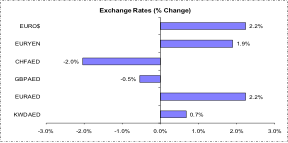
Asia and Pacific: Data are generally more upbeat: Japanese industrial production was strong in May, up 5.9%mom for the second straight month. The revised manufacturing production estimate for June also posted a 3.1%m/m gain. Assuming this holds, production would end up 40%qoq, sa in Q2 (having been down 38%, saar, and 63%, saar, in the previous two quarters). Korean IP rose another 1.6% mom, sa, in May. Production has now climbed 19% since December (not annualized) with exports in June up 17% mom. PMI indices from China are above the 50 mark, confirming the return to global growth as the mature markets struggle.
Bottom line: Three elements will drive the global economy in the second half of 2009: a) the slow healing of Western financial institutions (with some problems likely to resurface in Europe); b) the lagged reaction of the real economy to the credit crunch, in terms of unemployment, defaults and restructuring; c) the long term reconfiguration of the economic landscape with the baricenter shifting to Emerging Markets. Last week’s data essentially confirm these trends (and our long held view) that growth will strengthen in EM especially Asia leading the rebound.

Regional Developments

  • UAE banks have “significant” exposure to Saudi groups Saad and Al Gosaibi, the UAE central bank governor said, adding that the issue of frozen accounts should be resolved in a transparent way. According to UAE banks involved in the deals, the total exposure is more than $3 bn. The vicissitudes could raise fears by international lenders on exposures to Saudi Arabia and the Middle East.
  • Bahrain has endorsed a law to treat GCC nationals as citizens in running their own businesses, to attract investment and improve the business climate. Gulf nationals will be treated on par with Bahrainis in business privileges, rights and fees payments.
  • Qatar’s 1Q09 GDP shrank 17.5% y/y at current prices in the first quarter, soon after Oman reported a similar decline last week.
  • Among GCC countries, UAE topped the Worldwide Governance Indicators (WGI) in government effectiveness; it was in the 80-90 percentile for the control of corruption, but came in low, next to Saudi Arabia on the voice and accountability parameter.
  • June’s GCC Investor Confidence Index, by Shuaa Capital, showed that confidence in UAE jumped by 15.7% mom. Looking forward, investors see Saudi Arabia, Qatar and the UAE as the economies most likely to improve over the next six months.

 Market Intelligence on the UAE:

  • Dubai leadership has launched a plan culminating in the bid for the 2020 Olympic Games and the World Expo.
  • Abu Dhabi has been selected to host IRENA the UN agency for renewable energies which could spur a growth of alternative energy sector in the UAE and foster a market for carbon trading in the GCC.
  • Dubai’s inflation rate slowed to 5.4% in the first five months of 2009, compared to 8.7% a year earlier, the head of Dubai Statistics Center (DCS) was quoted as saying.
  • A federal law guaranteeing the bond sales of local banks has been passed by the Federal National Council; this would allow financial institutions to tap cheaper funds, improve investor confidence in new issuances and help develop the bond market.
  • Standard & Poor’s revised down the credit ratings of DP World and Jebel Ali Free Zone by two levels to BBB+ while Dubai Multi Commodities Centre rating was cut to BB, two levels below investment grade. Similarly Moody’s announced that “The Baa1 rating of Emaar was placed on review for downgrade,” while Dubai Holding was revised down to A3 from A2. Standard & Poor’s (on Mon) revised the CreditWatch implications for ‘BBB+’ long-term credit ratings on Emaar to ‘developing’ from ‘negative’ following the merger talks with Dubai Holding’s property subsidiaries.
  • Abu Dhabi’s International Petroleum Investment Company (Ipic) has signed a USD5 bn syndicated loan, increased from a launch amount of $3.5bn, banking sources revealed. It is the first major new loan in the Gulf this year. Also Abu Dhabi based developer Tourism Development & Investment Company’s $ 1bn bond issue was oversubscribed 6 times over. Both news highlight the global appetite for regional issuances, the confidence of investors and the need to speed up the creation of a debt market in Dubai.
  • With the exit of private shareholders from Emirates Industrial Bank the way is open for the merger with Emirates Real Estate Bank (EREB) to create Emirates Development Bank (EDB), with a capital of Dh10 billion. Approval of the draft bill on EDB’s establishment however has been stalled by the Federal National Council which asked to conduct more studies.
  • Emirates NBD has announced the conclusion of the issuance of AED 4bn Tier 1 debt securities (sole investor: Investment corporation of Dubai), enabling the bank’s Tier 1 capital adequacy ratio to exceed 11% and the overall capital ratio to exceed 17%. As per the UAE Central Bank, overall capital adequacy ratio of the UAE banking system was 16.2% as of Mar09.
  • Bottom line: The authorities are putting in place safeguards to allay fears in the financial markets while starting a process of consolidation and restructuring in key economic areas, which is entirely justified by the downgrades of key companies in Dubai.


Weekly Economic Commentary – June 14, 2009

Global Developments

USA: A mixed picture emerges from last week’s data: these indicate that the US economy is stabilising. May retail sales rose 0.5% month-on-month, but mainly as a result of the rise in gasoline prices during this period. Excluding this and auto sales, the retail sales reading was flat. New jobless claims continue to fall gradually, recording 601k in the week to June 6. US consumer confidence rose in June to its highest level in nine months. A sign of normalization in the financial sector came from ten large financial groups that have asked to repay a combined $68bn to the US Treasury.
Europe: We continue to hold a negative outlook for Europe. German industrial production dropped 1.9% mom in April, with similar results from France and Spain driving Euroland IP to fall 1.9%mom. In Europe the only improvement has been recorded in business surveys like the PMI or consumer confidence, but positive sentiment is yet to translate into better economic data. Additional worries emerged after German retailer Arcandor filed for insolvency, having failed to secure state aid. Ireland credit ratings were cut for the second time in three months (to AA with a negative outlook), amid rising worries over the cost of bailing out the country’s banking sector. The Swedish Financial Supervisory Authority’s stress tests showed the nation’s four largest banks could absorb more than SKr150bn in losses from the Baltic region over three years. The European Central Bank has provided a EUR 3bn loan to increase the reserves of the Riksbank in order to safeguard financial stability.
Asia and Pacific: There are some mixed data releases from China. On a positive note, China recorded a big rise in investment on factories, property and roads, thanks to its CNY 4 trillion stimulus package. But trade data for May show a decline in both imports and exports. Industrial production in both China (May) and India (Apr) registered an upward tick (8.9% and 1.4%yoy respectively).  Our view is that global economic recovery will be lead by the emerging markets (Brazil, China and India) increasing domestic demand to offset the decline in exports.
Bottom line: The world economy is still in intensive care with signs of improvement being more visible in Asia and to a lesser extent in the US. The G8 summit, held over the past two days in Italy, had world leaders cautiously hinting that the worst might be over given the “signs of stabilization” and moving forward to discussing “exit strategies”. Meanwhile worries on the effect of oil prices on this recovery process are spreading: China has increased oil imports by 5.5% yoy in May and the speculative long positions on oil futures in New York are at their highest since last July (when prices peaked at 140$/b) and commodity funds are recording record net inflows.

Regional Developments

  • Moody’s confirmed Kuwait’s Aa2 sovereign ratings but has applied a negative ratings outlook on local and foreign currency government bond ratings and its country ceiling for foreign currency bank deposits.
  • A study by Mercer has revealed that 73% of companies across the GCC have set targets for higher or similar growth in 2009 compared to 2008 and 94% believe it is “very likely” or “somewhat likely” that these targets will be met. The survey also found that 60% of companies planned to increase manpower during 2010 – some of those by up to 10%, in a powerful sign of improving business confidence levels in the GCC.
  • While the Saad group is announcing its debt restructuring plans, there are reports from SABB and Gulf News making references to another family business (Al Ghossaiby) in KSA facing financial difficulties and failing to repay bank loans availed to them. This raises questions about the extent of difficulties faced by family businesses in the region and underscores the need for better corporate governance and transparency.
  • Bahrain has priced a $750mn five-year Islamic bond at 340bps over U.S. Treasuries, according to an official at one of the lead managers. The issue is larger than the earlier announcement of $500 million bond issue.
  • Bottom line: the GCC economies are recovering, supported by higher oil prices and government intervention. However, structural reforms are required to improve corporate governance and modernize and reform the framework for dealing with insolvency and creditor rights.

Market Intelligence on the UAE:

  • The UAE Ministerial Committee’s risk survey undertaken to support the banking system in developing their risk management agenda concluded that the “UAE banking sector is stable and firmly on the growth path”. Additionally, the committee announced the approval by the Cabinet on the revision of the bankruptcy law, the public debt law and the set up of a credit bureau, all measures aimed at strengthening the banking sector
  • The refinancing of Nakheel’s US$3.5 billion Islamic bond later this year will be the litmus test for how credit ratings agencies assess Dubai government-controlled companies, a Moody’s analyst said during a conference.


Weekly Economic Commentary – April 26, 2009

 Global Developments

  • IMF’ has forecast US$4.1 trillion in losses ($3.1 trillion in the US) from the financial crisis in the banking sector worldwide, and in its new World Economic Outlook downgraded world growth to -2.5% for 2009.
  • The US Leading indicator index fell by 0.3% in April after 0.4% in March. Meanwhile the initial jobless claims are still increasing by more than 600,000 and durable goods orders contracted by 0.8% mom in March.
  • Secretary Geithner assertion in Congress testimony that US banks are adequately capitalized helped diminish stress test concerns and gave a temporary boost to the stock markets.
  • US real estate remains weak: existing home sales in March fell 3.0% mom and new home sales fell 0.6% mom.
  • The six leading German economic institutes cut GDP growth forecasts to -6% for 2009.
  • The expectations component of the German ZEW index rose in April, indicating an improvement in sentiment, reflected in a slight increase in the IFO.
  • Eurozone flash Purchasing Managers’ Index (PMI) showed a substantial upwards rebound in April, indicating a slower pace of contraction. The French and German flashes for manufacturing and services PMI and the Belgian Manufacturing Survey also showed a similar improvement, but overall this data are still indicating a contraction in output.
  • UK GDP fell by 1.9% qoq in Q1, worse than expected, indicating that in 2009 GDP could fall by 6% or more.
  • The U.K. labor report showed another rise in unemployment rate in March (to 4.5%). That measure of unemployment is now trending up at a rate of 3 ticks per month. Meanwhile UK budget deficit for the fiscal year 2009-10 has been estimated to reach 12.4% of GDP.
  • Korea GDP for first quarter of 2009 showed a slight growth of 0.4% quarter on quarter, strengthening from the previous quarter fall of 18.9% qoq.
  • The Reserve Bank of India cut the reverse repo and repo rates by 25basis points (bp) each, making a total of 425bp cuts in the repo rate and 275bp cut to the reverse repo rate since the rate-cutting cycle began.
  • Singapore Industrial Production plunged by 34% in March yoy, much worse than expected and particularly worrisome considering that IP plummeted 24%yoy in Jan-Feb compared to the same period in 2008.

Regional Developments

  • Kuwait recorded a preliminary budget surplus of KWD 6.1billion for financial year ending Mar09, from higher oil sales. Oil revenue was 70.6% higher than budgeted while non-oil revenue was 22.2% above budget during this period.
  • In an effort to accelerate economic integration, Saudi Arabia has removed previous restrictions on all GCC citizens wanting to work, buy property or study in the Kingdom.
  • SABIC said it would look to cut costs as it reported a loss of 974 million riyals ($ 259.3 million) compared to a net profit of 6.92 billion riyals in the first quarter of 2008.

Market Intelligence on the UAE:

  • Lower CDS spread (fell to a low of 565 basis points from 660bps a month ago) for Dubai on rising confidence in the Emirates’ finances among international investors.
  • Cityscape Abu Dhabi held last week witnessed the launch of a host of projects like a housing scheme for  middle income Emiratis by Aldar Properties and a multi-faceted project in Abu Dhabi with a first phase development value of Dh4 billion. However, the number of visitors was estimated at 27, 000 compared to over 50,000 participants in the previous edition.
  • According to the Dubai Roads and Transport Authority (RTA), 3 major road projects worth Dh2.9 billion have been approved by the Ruler of Dubai. Additionally, work has begun to expand the combined passenger capacity at Dubai’s two airports to 240 ml, from the 190 ml initially planned. All this reaffirms the commitment of the government to support infrastructure growth to sustain job creation and boost the capacity of the economy.
  • Amlak and Tamweel will restart functioning as independent Islamic mortgage lenders, before the merger comes into effect. This is to bridge the vacuum in Islamic home finance firms as these two companies represented more than 60% of Dubai mortgage industry
  • Etisalat added only 41,000 new mobile subscribers in Q1 2009 compared to 251,000 in Q4 2008.


Weekly Economic Commentary – April 19, 2009

Global Developments

  • US Retail Sales in March fell by 1.1% and ex auto by 0.9%, on the month versus expectations of a slight increase. This figure pours water on the optimistic sentiment that was taking hold in the market.
  • US core PPI remained unchanged on the month confirming that deflation is not a major worry for now. The same trend was confirmed by core CPI up 0.2% mom, and 1.8% yoy.
  • US Industrial Production fell in March by 1.5% mom and capacity utilization to 69.3% close to an all time low.
  • Concern over credit card default is mounting in the US after Capital One announced that credit card losses have outpaced the level of unemployment. The rate of charge-offs has reached 9.3%, an all time record.
  • S&P Rating Services announced that 29% of junk rated European companies could default on their debt by the end of the year due to the credit crunch and deteriorating conditions which impact corporate earnings.
  • A reminder that the crisis is far from resolved came from Switzerland where UBS announced a loss of US$1.74bn in Q1 and job cuts of 8,700 employees.
  • Euroland’s Industrial Production was down almost 18% on the year, confirming the prevailing negative outlook.
  • Asian exports may be staging a rebound in Q2. The latest harbinger was the 10.8%m/m rise in Singapore’s non-oil domestic exports in March (this came after a 1.6%m/m gain in Feb). This was not enough to stop another sharp decline in GDP: estimated to have fallen 19.7%qoq in Q1, following a 16.4%qoq, decline in Q4.
  • Bullish data from China on money and credit growth – M2 growth accelerated to 25.5% year-on-year in March, up from 20.5% in Feb and a low 14.8% in Nov08. Also reported was an increase in foreign direct investment in March to $8.4 billion, from an average of $6 billion per month in the previous 4 months.
  • China GDP grew by 6.1% in Q1, while Industrial Production in March rose by 8.3% on the year up from 3.8% in the period January/February. Both figures signal the start of a recovery.
  • Poland announced that it will follow Mexico and draw on the IMF’s Flexible Credit Line

Regional Developments

  • Kuwait’s Central Bank cut its interest rate by 25 basis points to 3.5 % to stimulate the economy.
  • Bahrain’s Central Bank has announced plans of issuing a five-year Sukuk for $500 million on May 27, 2009. Plans of issuing another BHD 250 million three-year government bonds was also revealed, but without specifying a date.  After Qatar, Kuwait and Abu Dhabi, with this move Bahrain will contribute to create an active bond market in the region.
  • Business confidence in Saudi Arabia slipped in Q2 according to a survey by Dun&Bradstreet, but businesses in the non oil sector were rather optimistic on new orders.
  • March inflation in Saudi Arabia slowed to 6.0% from 6.9% in Feb09. Additionally, Saudi Arabia’s central bank cut the reverse repurchase rate by 25 basis points to 0.5% to realign it with short-term rates after the ease in inflation. The benchmark repurchase rate was kept unchanged at 2.0%.

Market Intelligence on the UAE:

  • UAE Central Bank FX reserves fell 32% last year to Dh193.7 billion (US$52.7bn), down from Dh285.9 billion the year before. The outflow was due in all likelihood to the repatriation of speculative capital triggered by expectation of a revaluation of the dirham in mid 2008.
  • Dubai Properties and Sama are not merging according to Hashim Al Dabal Chuaitman of Dubai Properties.
  • Dewa revenues increased by 52% in 2008 on lower production cost and surging demand for utilities.
  • The IMF has lowered its growth forecast for the UAE this year to 2.1% on expectations of lower oil prices and a global recession
  • The Abu Dhabi Judicial Department announced the creation of courts specifically dedicated to contract and construction disputes, medical liability and negligence cases, banking and finance issues, insurance claims and compensation demands in a sweeping effort to modernize the Emirate’s judicial system
  • Moody’s Investors Service has downgraded the long-term foreign currency and local currency issuer ratings of Shuaa Capital by two notches to Ba1 from Baa2 and its short-term ratings to ‘not-prime’. The rating outlook is negative due to deteriorating fundamentals, especially recurring profitability and weakening liquidity.


Weekly Economic Commentary – April 12, 2009

Global Developments

  • With Obama back from the European trip the focus shifts to the domestic front where data remain weak: initial jobless claims fell by 20k for the first week of April, but this only brought it back into the 650k range they had been in for several weeks ago.
  • Euroland retail sales declined again in March by [2.4%] on an annual basis. Additionally, revised fourth quarter 2008 GDP numbers point to a dismal -1.5% quarter-on-quarter growth (the biggest contraction since 1995), with all components, except stockbuilding down, exports plummeting 7.3%qoq and capital expenditure (-4.0% qoq). The large build-up of inventories suggests lower production in first quarter of 2009.
  • German Manufacturing Orders remain in recession territory in spite of the Purchasing Managers Index (PMI) signaling a stabilization in orders. Manufacturing orders in Feb were down 3.7% month-on-month (-6.7% in Jan).
  • Japan on Friday announced a third stimulus package on Friday, of $150 billion – bringing the total amount of “new spending” to around 5% of GDP, also increasing Japan’s public debt (OECD forecast: 197% of GDP).
  • Japan machinery orders (private sector excluding shipping and electric power) posted their first increase in five months in February, rising 1.4% month-on-month (Jan: -3.2%). However, external orders (indicator for capital goods exports) were still showing a decline.
  • China’s March trade data reported a stabilization and modest rise in exports – exports were $90.3 billion, down 17% year-on-year (the Jan-Feb09 average had been -21.6%). The trade surplus for Q1 as a whole ($62.3 billion) was up 53% from a year earlier.
  • Taiwan’s March exports came in at -35.7% year-on-year (compared to -37.2% averaged in Jan-Feb09). A breakdown by country showed that the improvement in exports was mainly contributed by demand from China (-37.6% in Mar09, vs. -44.4% in Jan-Feb09) – in one of the initial signs of a possible turnaround.

Regional Developments

  • Merger and Acquisition activity in the GCC shrank by 55% to USD6.5bn in 2008 according to the Global Investment House. The largest operations were in telecommunication. Most of the decline took place in Q4.
  • The GCC Heads of state are due to decide the location of the Gulf Central Bank in May according to the Head of Oman Central Bank.
  • KSA has spent an estimated $400bn of SAMA foreign currency reserves to sustain its economy and its banking system in Q1 2009 according to economists analyzing the SAMA balance sheet. The effects are already visible in the banks’ profits for the first two months of 2009 which totaled SR 6bn form a SR 95ml in December.
  • The proposals for building Saudi Arabia’s North-South Railway have been reaffirmed with the Saudi Binladin Group earning the SAR 1.7billion contract along with the French defence group Thales to build signaling, ticketing, communications and security systems for the planned 2300km railroad.
  • Kuwait’s Central Bank issued a fifth tranche this year of $275ml of one year treasury bonds. It was oversubscribed by almost eight times according to the central bank.

Market Intelligence on the UAE:

  • Dubai Fly, the low cost airline is due to start operations on June 1st with two Boeing serving Beirut and Amman.
  • Abu Dhabi government aims to issue an additional $7bn in bonds over the next two years according to Hamad Al Suwaidi, undersecretary at the Department of Finance.
  • Abu Dhabi will be investing nearly $10bn into expanding its gas output capacity inspite of other similar projects being shelved in the GCC. This investment is expected to triple the output of Gasco (Abu Dhabi Gas Industries Company) within five years.
  • Dubai jobless rate for 2008 came in lower than the UAE average at 2.4% (2007: 3.45%). However, this indicator is trivial given that (a) expatriates who are unemployed have to leave the country within 30 days and (b) those employees that are fired are no longer counted in the workforce.
  • Dubai Cotton Exchange is planning to start operations on the third week of April.
  • Reclamation work was completed at man-made Al Rajan Island in Ras al Khaimah according to the developer.

Market Snapshot as of 12/04/2009 at 14:30 (all % figures are weekly changes from 05/04/2009)

Optimism is evident in most global stock markets – with most global markets moving to (or towards) multi-month highs. Asian stocks climbed for a fifth week, the longest streak of gains since February 2007 after Japan’s third and biggest stimulus package announcement. Oil and gold prices have both declined over the past with, with gold losing its stand as an alternative ‘safe’ investment.

Source: Bloomberg, DIFC Economics.


Weekly Economic Commentary – April 05, 2009

Global Developments

  • The G20 meeting in London was a rare moment of international cohesion on the measures to tackle the crisis among which 1) trebling of IMF resources to $750 bn, additional funds for $250 bn to support trade finance and $ 100 bn for development banks; 2) establishing a new Financial Stability Board (FSB) with enhanced powers to provide early warnings of financial and macroeconomic instability and reshape financial markets regulations; 3) clamping down on tax havens.
  • The $1.1 tr stimulus is indeed much needed: OECD has downgraded global growth forecast (-4.3% in 2009).
  • The U.S., Euro area and U.K. PMIs rose somewhat (although remain very weak and still signal contraction in output). On the contrary Chinese PMI (private sector, from CLSA) fell, to 44.8 (from 45.1 last month). The Bank of Japan’s Tankan survey was very weak, with the large manufacturers’ diffusion index falling a massive 22 points, to -58. The best performer was India whose PMI at 49.5 is close to enter recovery territory.
  • US Payroll data showed that 663,00 jobs were lost in March, with another 86,000 in downward revisions sharpening the declines already reported.
  • President’s Obama took a tough stance towards the auto industry. His plan gives GM another 60 days, and Chrysler 30 days, to extract more concessions from creditors and workers, or face the prospect of a bankruptcy judge forcing these concessions. The ousting of top managers and the merging between Chrysler and Fiat is a reminder that no solution is ruled out from now on.
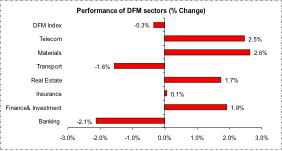
  • The ECB is still hawkish: it cut its reference rate by 0.25% to 1.25% against expectations of 0.5%.
  • German March labour report showed another 69k rise in unemployment, with the rate up to 8.1%.
  • Japan unemployment rate increased to    . The government has swiftly announced an additional stimulus plan after the first tax cuts and new spending for 2% of GDP.
  • Korean industrial production rebounded sharply in February up 6.8%m/m. Also Korean trade continues to show some signs of stabilization: exports rose in March (nsa basis), to their highest level since November.

Regional Developments

  • Qatar is projecting a slight budget deficit for the next fiscal year starting on April 1according to the Qatar Advisory Council.
  • KIA will provide consistent funds to recapitalize the bank and other companies in Kuwait according to the Central Bank Governor.
  • Global Sukuk issuance fell 37% to USD1.8bn in Q1 2009 compared to the same period in 2008 (Zawya)
  • Two projects which would have boosted Saudi Arabia’s daily oil production capacity beyond 12.5 ml barrels face delays, suggesting KSA is not rushing to add capacity as demand slumps

Market Intelligence on the UAE:

  • Abu Dhabi’s USD 3bn bond issue – in one five-year tranche of $1.5bn, and a second tranche of $1.5bn with a tenure of 10 years – was oversubscribed more than two times as investors offered to buy about $7bn of the bonds. This appetite shows the positive investor sentiment in the region and could prove to be the final push for the development of a regional fixed income market to create liquidity.
  • Two Abu Dhabi-based banks First Gulf Bank and Abu Dhabi Islamic Bank have secured a total Dh6.7 billion in fresh capital from the emirate’s government.
  • Al Ghurair Group has signed a $347.2 million Islamic facility – structured in Ijara and Musharaka involving a sale and lease-back of the asset owned by the client – with a group of financial institutions, the largest to a private entity this year.
  • Moody’s dropped by one notch its rating for Emaar to Baa1 from A3, just two points shy of “junk” status. It cut the rating for Dubai Holding Commercial Operations Group to A2 from A1. Moody’s said its negative outlook highlights Dubai’s vulnerability in the current global economy, given its reliance on volatile industries such as real estate, trade, financial services and tourism. It also cited Dubai’s swelling debt and refinancing constraints.
  • The GCC Central Bank governors are set to meet in Muscat (April 6-7) as part of their twice-yearly meeting. The agenda includes the location of the Gulf Central bank and an alternative timetable for the single currency.
  • Dubai’s DLD has announced a new amendment to Law 13 on Real Estate which is intended to clarify the rules on the termination of off-plan contract. A circular on Art. 11 of the Law issued in August had sparked controversy and contributed to the downfall in the real estate sector by sapping investors’ confidence.

Market Snapshot as of 05/04/2009 at 14:30 (all % figures are weekly changes from 29/03/2009)

Source: Bloomberg, DIFC Economics.


Weekly Economic Commentary – March 29, 2009

Global Developments

  • The US government has unveiled another bank bailout plan. Market participants have lost count of how many plans have been already presented, but essentially they all look similar to the one presented in November 2008 under the Bush Administration. Instead of fresh thinking the Geithner-Bernanke team persists in an approach that markets and logics find difficult to appreciate. As Nobel laureate Krugman has pointed out: investors, like hedge funds and private equity funds, have refused to pay more than about 30 cents on the dollar for many bundles of mortgages, even if most of the borrowers are still current. But banks holding those mortgages, not wanting to book huge losses on their holdings, have often refused to sell for less than 60 cents on the dollar. The Treasury hopes to bridge this gap with public money.
  • Meanwhile the US economy, as quickly pointed out by President Obama, is showing sketchy signs of improvement: durable goods orders rose by 3.6% boosted by defense orders, new home sales in February bounced back from a January record low, increasing 4.7% annual rate and existing home sales jumped 5.1%.
  • US fourth quarter GDP (for 2008) was revised downward slightly, to -6.3% from -6.2%. The composition of GDP showed a steeper decline in nonresidential construction, from -5.9% to -9.4% while trade contributed a bit more from a pullback in imports than any increase in exports.
  • US Personal Consumption Expenditure (PCE) core price index indicates a small gain in real spending in the first quarter – revised numbers for real consumption in January showed a jump by 0.7%, with February registering a 0.2% decline. The core PCE price index for February increased by 0.24% (month on month) and the overall PCE index by 0.35%.
  • Belgian manufacturing index, a leading indicator for the whole euro area, rose to -33 from a very depressed -36 a month ago. Despite the improvement the current level is consistent with a 2.0% drop in Euroland’s GDP.
  • Japan exports plunged by half in February on the year the worst dive ever, with cars export dropping 70%.
  • Oil inventories rose 2.8m barrels higher in the week ended March 20, with crude stocks up by 3.3m barrels.

Regional Developments

  • Bahrain is finalising a $500 million Islamic bond and will see economic growth halve to around 3% this year, according to the central bank governor.
  • Kuwait’s government has approved the USD 5.2bn stimulus package despite the dissolution of Parliament last week. The Central Bank estimates that GDP could contract by 1% this year.
  • Qatar government has purchased up to QAR 6.5bn in Qatari companies’ stocks owned by local banks in an attempt to prop up the market and recapitalize the banks.
  • Nasser al Kaud, deputy assistant general for economic affairs at the GCC Secretariat has declared to Financial Times that the Gulf Monetary Union cannot be completed by Jan 1 2010, contradicting a commitment made by Heads of States in their last summit in Muscat three months ago. GCC Secretary General Al Attiyah however later reiterated that the 2010 deadline is still valid.
  • The common central bank planned for the GCC will target price stability but not a specific inflation rate, as per a statement made by the head of the monetary union unit at the GCC General-Secretariat.

Market Intelligence on the UAE:

  • The UAE economy has reported a growth rate of 7.4% in 2008. Data released by the Central Statistics Department announced 2008 GDP at fixed prices came to AED 535.60bn. Additionally, trade surplus of the UAE grew by 23.8% (year-on-year) to AED 184.1 billion in 2008.
  • Dubai projects economic growth of 2% for 2009, as cited in an Executive Council meeting attended by the Dubai ruler (Source: Reuters).
  • Abu Dhabi-based First Gulf Bank has paid off a three-year syndicated term loan facility worth USD 750mn which matured on March 16, according to a public statement from the bank.
  • The Dubai Electricity and Water Authority (DEWA) is completing the refinancing of its USD 2.2bn islamic loan maturing next month. DEWA has announced its plan to invest AED 13bn in new projects this year, in line with their spending plan of AED 75bn to facilitate UAE’s future economic growth.
  • Standard & Poor’s Ratings Services and Fitch have assigned a ‘AA’ long-term senior unsecured debt rating to the Abu Dhabi’s upcoming USD 10bn global medium-term note program.
  • Abu Dhabi’s Aabar has acquired a 9% stake in Daimler reviving the activism of sovereign wealth entities in high profile international deals.
  • UAE national banks boosted their combined net earnings by 6.2% in 2008, to around AED 19.92bn.

Market Snapshot as of 29/03/2009 at 14:30 (all % figures are weekly changes from 22/03/2009)

Stock markets worldwide were positively influenced by the new US plan for the banking sector. Optimism in the global financial markets was reflected in the positive sentiment in the Gulf markets last week, with the Qatar bourse performing the best of the lot – also due to the promised government support. The dollar fluctuated given Geithner’s remarks on the dollar after China commented about a new reserve currency to replace the greenback – the USD gained against the Yen, but remained a shade weaker against emerging market Asia. Oil prices have registered gains on news of better than expected economic data from the US and the Chinese economy. Gold prices are still strong when compared to the prices last year, but looks likely to lose its stand as an alternative investment with dollar strength.
 

Source: Reuters 3000Xtra, DIFC Economics.


Weekly Economic Commentary – March 22, 2009

Global Developments

  • The US Fed took additional quantitative easing measure (promising to buy $300 billion of US Treasuries, $750bn of mortgage backed securities and $100bn agencies’ debt). For the first time in living memory the US Fed has started to operate on the long end of the yield curve having exhausted all the margins on the short end. The final statement in fact depicts a worsening scenario since the last meeting, asserting that rates will remain near zero for an extended period. The good news is that the Federal Reserve is firing all its weapons at the recession. The bad news is that the recession is severe enough that all weapons are needed. The 10-year Treasury yield fell from just over 2.9% before the announcement to under 2.6% afterwards. Mortgage rates should follow Treasury yields down and spark another refinancing wave. All in all the measures will solve the crisis quickly but represent a useful, albeit not decisive, step in the direction of revitalizing the economy.
  • US Industrial production fell more than expected by 1.4% on the month and 11.2% on the year confirming that the sector is still mired in an extremely sharp slump. Capacity utilization is 70.9% marginally lower from a month earlier and approaching the all time low of 1982. A rebound remains a distant prospect.
  • The US Conference Board’s leading indicator fell 0.4% in February, after a 0.1% increase in January.
  • Euroland employment fell by 0.3% in Q4 not a bad figure if compared with the abysmal data from the US but nevertheless a negative sign that the deterioration might just be lagging.
  • ZEW indicator fell sharply to 38 hinting at a deepening recession in Europe. The IMF also raised the alarm over a worsening outlook in Europe.
  • The Bank of Japan (Central Bank) voted unanimously (on Wednesday) to hold its overnight rate target unchanged at “around 0.10%”, but lifted its purchases of government bonds to JPY 1.8trn a month.
  • Singapore export, a widely observed indicator of global activity fell by almost 24% on the year.
  • The IMF is reportedly ready to approve a 20US$ bn bail out plan for Romania one of the large East European countries at risk of defaulting on its debt.

Regional Overview

  • The Emir of Kuwait dissolved the Parliament and called for new elections to be held within two months appointing the Crown Prince as the new Prime Minister. Analysts observe that the polls are likely to return a new Parliament with the same composition as the one dissolved. Another consequence is the likely delay on the ratification of the agreement to form a monetary union in 2010. Moody has warned of possible downgrade as a consequence of political turmoil.
  • A survey by the Saudi British Bank (Saab) for the first quarter of 2009 showed the level of business confidence in Saudi Arabia had dipped below 90 for the first time. Additionally, Saab said the business confidence could have plunged further had the country not adopted record spending for 2009 to mitigate the effects of the global crisis.
  • Car sales in Saudi Arabia have dropped by around 80% in January, sources close to the car industry said.

Market Intelligence on the UAE:

  • President His Highness Shaikh Khalifa Bin Zayed Al Nahyan in an interview with Al Roya asserted that the UAE is working well, and that its decision-making process is dealing successfully with the global financial crisis. He dispelled rumors of disagreements saying “we are members in one entity, and parts in one strong, coherent body”.
  • The UAE economy will contract further in the coming months, due to the impact of the global financial turmoil, according to Sultan Bin Saeed Al Mansouri, UAE Minister of Economy, as reported by Zawya.
  • Standard & Poor’s downgraded the credit ratings of eight Dubai companies on Tuesday, including Emaar Properties, and expressed worries about the health of banks as the economy could shrink between 2 and 4% in real terms this year, as lower oil prices and the global financial crisis take their toll on real estate prices and equities.
  • According to the Governor of the UAE Central Bank, a plan to cut interest rates will soon be introduced by the UAE Central Bank along with a number of other measures to ease the economic slowdown caused by the liquidity shortage.
  • UAE banks launched the one-week Emirates Interbank Offered Rate on Monday, to meet demand for short-term liquidity. The rate was set at 1.51875%.
  • Around $335 billion of UAE construction projects have been put on hold given the global financial crisis, according to the Middle East Economic Digest. The total value of projects under way in the UAE has fallen to $254 billion, according to the same source.
  • A possible merger of the UAE’s largest Islamic mortgage providers, Amlak Finance and Tamweel, is in the final stages, while the liquidation option has been taken off the table, Sultan Bin Saeed Al Mansouri, Minister of Economy, told reporters.
  • Bank debts do not form majority of bounced cheques in the UAE, according to the Central Bank Governor. Only 15% are related to bank debts, while 85% relate to landlords and the business sector.
  • Moody’s has put HSBC Middle East under review for a possible downgrade, based on a weakening UAE economy and worries over the bank’s parent company.

Market Snapshot as of 22/03/2009 at 14:00 (all % figures are weekly changes from 08/02/2009)

Friday proved……. Though improving from last week, oil price rose toward $46 a barrel as bearish forecasts for demand outweighed the potential for production cuts agreement when the OPEC meets today.

Source: Reuters 3000Xtra, DIFC Economics.


Weekly Economic Commentary – March 15, 2009

Global Developments

  • A relatively strong retail sales report for February from the US last week – total sales were down by 0.1%, but ex autos sales increased by 0.7%. However initial jobless claims rebounded and continuing claims pushed higher. Univ. of Michigan consumer sentiment (provisional) ticked upwards in March to 56.6 (Prev: 56.3).
  • Euro area retail sales volumes in January were flat relative to December and were down just 1.4%, relative to the fourth quarter.
  • In Germany the volume of total manufacturing orders plunged 8% month-on-month in January 2009, with capital goods orders down 9.1%.
  • Japan’s current account moved into deficit at Japanese Yen (JPY) -172.8 bn in January, for the first time since January 1996. Net investment income (JPY15.8 trn), which made up 97% of the current account surplus in 2008, declined 31.5% year on year to JPY992.4 bn in January from JPY1.4 trn in Jan08.
  • Weak domestic and external demand were reflected in the revised Q4 Japan GDP (-12.1% quarter on quarter annualized), similar to the preliminary release (-12.7%).
  • Japanese core machinery orders also fell 3.2% month on month but these numbers are in contrast to Chinese fixed asset investment data, jointly released for Jan-Feb 2009, posted a 26.5% year on year gain, broadly in line with the fourth quarter 2008 average.
  • China’s inflation came in at -1.6% year-on-year in February (Jan: +1.0%). This sudden drop is due to base effects largely due to a shift in Chinese New Year (CNY) (last year in Jan, this year early Feb). Another indicator affected by CNY was export growth – which fell significantly by 25.7% year on year in Feb09 (Jan: -17.5%), while imports decline rate slowed (Feb: -24.1%; Jan09: -43.1%).

Regional Overview

  • Kuwait overnight money market rates have fallen to around 0.25% and the interbank markets are flush with liquidity. This prompted Kuwait’s central bank to issue 107 million dinars of one-year Treasury bonds (carrying a coupon of 2.25%) and six-month treasury bills with a yield of 2.125% on Wednesday to drain liquidity.
  • The Kuwaiti government will guarantee 50% of a maximum of 4 billion Kuwaiti dinars ($13.56 billion) bank loans to local companies in a wide range of sectors such as farming, industry, trade, construction, oil, petrochemicals, and services.
  • The Central Bank of Oman reported a surge in 2008 budget surplus to Omani Rial (OMR) 1.58 billion, from strong oil prices and higher crude output. A breakdown showed a deficit of around OMR399 million in Dec from a 42% month-on-month increase in spending in Dec and revenues contracted by 73% in the same period.
  • Qatar’s economy grew 7.8% at current prices in the fourth quarter to 83.2 billion riyals, down from a more than 60% surge in the third quarter. The economy expanded 44% to 372.38 billion riyals at current prices for the full year 2008. Qatar’s government announced on Monday that it would buy the investment portfolios of seven banks with help from the Qatar Central Bank by the end of the month. This sent the Qatar stock market up 8.9%, bolstering overall confidence.
  • Saudi Arabia’s annual inflation fell to 6.9% in February from 7.9% in January, according to the Central Department of Statistics.

Market Intelligence on the UAE:

  • Funds from an emergency $10 billion programme to assist Dubai’s debt-strapped companies will flow to businesses within two weeks in the form of loans or through banks, according to Nasser al-Shaikh, head of Dubai’s finance department.
  • Loans at United Arab Emirates’ (UAE) banks exceeded customer deposits by 110 billion dirhams ($29.95 billion) and the government was looking for a way to bridge the gap, as per a statement by the UAE central bank’s governor. “The current situation requires a stimulus plan for banks and the economy in view of this ‘gap’ which could be bridged in collaboration with the Ministry of Finance,” said Sultan Nasser al-Suweidi, the Central Bank governor.
  • According to the Director-General of the Dubai Naturalisation and Residency Department (DNRD), the DNRD has cancelled the residency visas of about 44,000 people during February and issued more than 66,000 residency visas in the same month.
  • Inflation in the United Arab Emirates is expected to fall to between 5 to 8% this year according to the Economy Minister Sultan bin Saeed al-Mansouri. (Source: Reuters)
  • The merger of the Real Estate Bank and the Emirates Industrial Bank – to form Emirates Development Bank – is estimated to have Dhs 10 billion in capital and is expected to provide credit to the small and medium size enterprises.
  • A draft law on credit information – to regulate bank loans provision- has been approved by the Federal National Council. It calls for the establishment of a company (affiliated to the Central Bank) to collect, file, analyse, classify, use and exchange credit information and reports.
  • Transparency scores of four of the 11 sovereign wealth funds (SWFs) from the Gulf region improved, as per the Linaburg-Maduell Transparency Index created by the Sovereign Wealth Fund Institute. Abu Dhabi’s Mubadala and Bahrain’s Mumtalakat shared the top slots from the region, ranking 13 and 14 among the 45 SWFs tracked.

Market Snapshot as of 15/03/2009 at 14:00 (all % figures are weekly changes from 08/02/2009)

Friday proved good for the markets globally – the rally continues on the back of  announcements made by Citigroup, Bank of America and JP Morgan about earnings in Jan&Feb, improvement in US data – but the recent rebounds in most indices have generally brought them back to where they were a couple of weeks ago (i.e., the end of February). In the regional markets, (update after 2pm). Emirates interbank rate has continued its decline, closing its gap with the policy rate. Though improving from last week, oil price fell toward $46 a barrel as bearish forecasts for demand outweighed the potential for production cuts agreement when the OPEC meets today.

Source: Reuters 3000Xtra, DIFC Economics.


Weekly Economic Commentary – March 09, 2009

Global Developments

  • US Unemployment rate soared to 8.1% in Feb, the highest in 25 years, with 651000 jobs lost last month. Initial claims dipped back down to 639k from 670k last week. Despite the decline, the numbers still point toward a weak labour market. We expect unemployment to exceed 10% in 2009.
  • US ISM Manufacturing Survey for Feb ticked up slightly, with improvement in production and modest signs of inventory correction. But there were sharp corrections in construction sector data, showing continuing decline.
  • Analysta are forecasting US total loan and securities losses to amount to $3.6T, half of which accrue to the U.S. banking system, or $1.8T. Capitalization of FDIC banks is $1.4T, that of investment banks as of Q3 $110bn. If projected loan and securities losses materialize, the U.S. banking system is close to insolvency despite TARP 1 of $230bn and private capital of $200bn.
  • Euroland’s manufacturing PMI is showing signs of stabilising. Germany and Spain, the weakest countries, seem to have stabilised tentatively while deterioration accelerated in France and Italy.
  • Harmonised flash estimate for February’s Euroland inflation was marginally higher at 1.2% from Jan’s 1.1%.
  • ECB projections for Eurozone growth significantly lowered from [-1.0% 0.0%] to a range of [-3.2% -2.2%] for 2009. Accordingly the ECB cut its policy rate by 50 bps to 1.50% and recommitted to providing unlimited liquidity at the policy rate until beyond the end of 2009.
  • Bank of England cut interest rates 50bps to 0.5%, a new historical low.
  • China’s Premier Wen Jiabao promised on Thursday to deliver 8% economic growth and record government spending this year. However, he failed to outline the new stimulus package many global investors had been expecting.
  • Positive data from China included the continuing (3-month) rebound in Purchasing Managers Index (PMI), as export orders saw a large improvement.
  • South Korean economic activity continued to weaken in January, driven by a further contraction in exports (-21.8% year on year) and investment weakness. Industrial output contracted by 25.6% from a year ago and weak durable goods demand led to decline in sales of consumption goods by 3.1%.
  • South Korean CPI rebounded to 4.1% from a year ago in February (3.7% in January) – increase in headline inflation reflects in part an expiration of the gasoline tax relief and a spike in gold prices.
  • Both India and Indonesia cut policy rates by 50bps each – India, for the 5th time since last October.

Regional Overview

  • A recent IMF study put total GCC medium-term investment project investments at $ 2.193 trillion, with evidence of diversification (massive investments in petrochemicals and industry) in the UAE, while Oman and Bahrain were focused on attracting tourism.
  • Saudi Arabia’s and Bahrain’s January money supply growth slowed to the lowest in two years, an early indicator of slowing inflation and slower growth in the region.

Market Intelligence on the UAE:

  • The UAE Central bank is to set up a joint task force with banks in the country to tackle the credit crisis. The bankers also informed the Central Bank board that the recent measures to inject funds into the banking sector had a positive impact.
  • Budgets in the UAE will move to a three-year term and will be based on a “zero-based” format, moving away from the current incremental budgeting.
  • According to the Ministry of Economy, UAE topped GCC in foreign investment in 2008, with 60% of the foreign investment flowing into the GCC (valued at $20bn) coming into the UAE.
  • Abu Dhabi Department of Finance (DoF) announced total foreign trade in 2008 for the emirate increased 37.5% year on year to Dh102.779 billion.
  • Having completed the official (Article IV) annual review of the UAE economy, IMF has estimated that growth surged by around 13.9% in nominal terms and 6.1% in real terms in 2008. The oil sector grew by 24.2% to Dh305.5bn from Dh246bn a year ago, while the non-oil sector swelled by 8.4% to Dh495.5bn. Non publication by the authorities of the IMF’s Article IV will be badly perceived by the international financial markets and be viewed as lack of transparency.
  • To boost the bank’s regulatory capital base and hence improve the capital adequacy ratio, Emirates NBD is planning to seek shareholder ratification to convert half of the deposits it received from the Ministry of Finance last year to Tier 2 capital. We estimate that UAE banks need to increase their capital base by some US$22 billion.

Market Snapshot as of 09/03/2009 at 14:00 (all % figures are weekly changes from 28/02/2009)

Stock markets in Asia and Europe were reeling Monday amid fresh concerns over the strength of the global banking industry as HSBC announced a 70% fall in profits and the U.S. government said it would pump $30 billion into ailing insurance giant AIG. US Stocks tumbled, driving the S&P 500 to its lowest level since 1996 (down 4.3% to 683) and the DJIA fell by 4.1% to 6,594, after Moody’s said it may cut JPMorgan’s credit rating and China quelled speculation the government will add to its stimulus plan. The situation has worsened with news about the near-bankruptcy of General Motors. The weak sentiment globally has rubbed off on the regional markets also; only Qatar has seen a positive change from last week. Oil rose above $45, gaining support from a weak dollar and OPEC meeting later this month. Gold prices have started to rise after falling earlier this week, as investors flocked to gold as a safe haven, on volatility in other assets.

Source: Reuters 3000Xtra, DIFC Economics.


Weekly Economic Commentary – March 01, 2009

Global Developments

  • Fourth quarter US GDP was revised downward to a contraction of 6.2%. The surprise factor was consumption, down to a 4.3% decline from a 3.5% decline (from nondurable goods) while revisions to net exports and inventories confirmed their lower contribution to GDP growth.
  • The Obama budget for 2010 ($1.75 trillion deficit or 12.3% of GDP) called for huge shifts in spending – toward programs like health care, education and energy, and paying for some of it through taxes on the rich, and cuts in farm subsidies.
  • The stimulus package proposed by the US government was defended by President Obama in his first speech to Congress in which he stressed that new funds would be made available to banks and other troubled sectors like the auto industry.
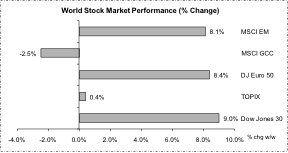
  • More weak data on US durable goods and initial jobless claims – orders sank by 5.2% in Jan, an acceleration from the 4.6% decline in Dec while initial jobless claims increased to 667k from the 630k’s earlier. The only good news was the contraction in inventories, which could set up for increased production from inventory restocking down the road.
  • The German IFO survey in February slipped to 82.6, having risen in January, but future expectations continue rise, which is not more than a silver lining in Euroland, though noteworthy. The Belgian Manufacturing Index recorded another drop to -36.8 from -30.3 as manufacturing orders in Euroland fell by more than 24% on the year.
  • Signs of some stabilization in the public’s mood in Euroland came from French consumer confidence (inched up to 43 from 41) and Italian consumer confidence (gained two points to 104 from a month earlier).
  • The economic downturn hit both Japanese exports (which nearly halved for Jan09) and Hong Kong 4Q GDP (which contracted 2.5%). Hong Kong private consumption declined 3.2% while fixed investment suffered the largest decline among the GDP components (contracting 17.3% year-on-year after growing 3.2% in 3Q 2008).
  • Bank Negara and Bank of Thailand continued rate cuts – policy easing by 50 basis points each – to support worsening growth expectations amidst receding inflationary risks.
  • India rating was downgraded from stable to negative by Standard and Poors on worsening fiscal conditions. Additionally, GDP for Oct-Dec08 showed growth slowing to 5.3% year-on-year versus 7.6% in the previous quarter.

Regional Overview

  • Annual inflation in Saudi Arabia fell to a 12-month low of 7.9% in January after the pace of rise in rents and food prices eased. The Central Bank expects inflation to decline further in the first quarter.
  • Bahrain plans to issue almost $800 million in bonds (in tranches over the next six months) to finance housing projects, as mentioned by the minister of housing, in an attempt to boost public spending during economic slowdown.
  • Kuwait Parliament is still debating the KD1.5bn bailout package, with the final vote to be cast on Mar 3rd.
  • Banks led the Doha index lower in the last two trading days as investors reacted to a Moody’s Investors Service report highlighting a negative outlook for the Qatari banking system.

Market Intelligence on the UAE:

  • The Dubai government issued bond for USD 20bn of which half have been subscribed by the UAE Central Bank, in a move widely interpreted as a support by the federal government to the Dubai government. Dubai entities including commercial ventures, real estate and banking and finance can access this bond fund and as a consequence markets and sentiment rallied.
  • In a press conference by the Dubai Dept. of Finance, it was revealed that $10 billion in bond proceeds from the central bank would be enough to help state-linked firms settle debts and refinancing needs for this year.
  • A strategy report issued by Real Estate Regulatory Agency (RERA) on Wednesday stated that Dubai developers were likely to delay the delivery of about 20% of residential units in 2009 and 40% in 2010.
  • Launch of a gold-backed Islamic security is expected this week by the World Gulf Council, given the backdrop of gold as an alternate investment haven and insurance against potential future inflation.
  • Nasdaq Dubai reverts back to five-day working week in order to re-focus on the Middle East region as opposed to its overlap with the Asian markets earlier.
  • Dubai airport traffic was up 6% in January to 3.3 million passengers in spite of slowing air traffic globally.
  • As a relief to consumers affected by the global slowdown, DP World has announced its decision to maintain 2008 tariffs at Jebel Ali ports and also provide 10 days of free storage time for all local importers starting Mar 1st.
  • Abu Dhabi National Oil Co (ADNOC), the main oil supplier in the UAE, said it will sell customers less of its flagship Murban crude oil and three other main grades in April than in March.  Seen as a possible signal that OPEC will cut output further at its next meeting in March, this led to a rally in oil prices.

Market Snapshot as of 1/03/2009 at 14:00 (all % figures are weekly changes from 22/02/2009)

The widespread mood of equity weakness over the past two weeks has been driven mainly by two factors. One, investors appear less than enthralled with the lack of specificity coming from policy makers about the US Financial Stability Plan. Two, the economic data have been uniformly disappointing. The regional markets mirrored the global markets’ decline and widespread selling dragged all markets into the red except in the UAE where Dubai’s $20bn bond issuance led to a positive sentiment and rally. In commodities, oil showed signs of recovery on speculation about rising demand and further OPEC output cuts in March while gold fell from the previous week’s 11-month high as the dollar held onto gains against the yen. The Eibor has eased even further from last week, though still higher than the repurchase rate set by the UAE Central Bank.

Source: Reuters 3000Xtra, DIFC Economics.


Weekly Economic Commentary – February 22, 2009

Global Developments

  • The stimulus package proposed by the US government is still being mulled over with skepticism by

Market Intelligence on the UAE:

  • The Dubai government issued bond for USD 20 bn  of which USD10bn  have been subscribe by the UAE Central Bank, in a move widely interpreted as a support by the federal government to the Dubai government. As a consequence markets and sentiment rallied.

Market Snapshot as of 22/02/2009 at 14:30 (all % figures are weekly changes from 15/02/2009)

Stock markets in developed countries fell sharply on continued disappointment for the US stimulus package and concerns over Japanese banking sector. Emerging markets fared even worse. GCC markets fared somewhat better, but still with negative signs. DFM displayed a good performance with a broad based recovery led financials. In FX markets the yen was weak, but other currencies remained broadly within range. WTI gained some lost ground, but the Fateh dropped to around $40 p/b. The uncertain economic outlook is favoring gold whose price is close to 1000US$ per ounce. Eibor rates have eased significantly at the front end to near 3.0%, although the longer end remained unchanged.

Source: Reuters 3000Xtra, DIFC Economics.


Weekly Economic Commentary – February 15, 2009

Global Developments

  • The stimulus package proposed by the US government triggered a resounding negative reaction on the markets: Wall Street displayed the worst weekly decline since November. The plan addresses unconvincingly two of the three main issues: (1) toxic assets and (2) u

Market Intelligence on the UAE:

  • Dubai’s biggest government-linked holding companies unveiled a major restructuring, consolidating operations to cut costs as the global downturn hit at the core of the emirate’s financial and property sectors.
  • The UAE and Vietnam signed a trade pact aimed at boosting their economic relations.

Market Snapshot as of 15/02/2009 at 8:30 (all % figures are weekly changes from 05/02/2009)

Stock markets in developed countries fell sharply on disappointment for the US stimulus package and further bad news from the banking sector. Emerging markets fared much better on signs that China’s economy is regaining some traction. Most regional markets were in the green territory except Kuwait, despite the government stimulus plan. DFM saw a broad based recovery led by the construction sector. In FX markets the yen and the pound were weak on the wake of negative data. International oil prices dropped sharply due to downward revisions of future demand forecasts by the EIA, nevertheless the Dubai Fateh gained. The uncertain economic outlook propelled the gold price above the key resistance point of 931US$ per ounce, opening the way for a test of 1000US$ per ounce.

Source: Reuters 3000Xtra, DIFC Economics.


Weekly Economic Commentary – February 07, 2009

Global Developments

  • The IIF warns that after one of the most disastrous quarter for the world economy in the next few months other areas of strain will emerge extending the contagion from the financial sector to the real economy through weaker employment and capital spending; more credit deterioration, in new areas such as credit cards; and reckless push from economic policies.
  • The industrial data over the last week has been encouraging. The ISM, Ifo, UK and Euroland PMI, Chinese PMIs were all higher (albeit by not much). Services sector surveys in Euroland and the US also have stabilized, although at levels that still signal recession.

Market Intelligence on the UAE:

  • Nearly 53% of the UAE’s development portfolio, worth a combined $582bn, has been suspended according to Dubai-based market research firm Proleads. Projects worth $698bn are still in operation out of a $1.3 trillion-strong industry.
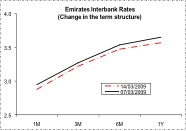
Market Snapshot (as of 07/02/2009 from 30/01/2009) at 8:30am

Fears over prospects in banking and property sectors kept markets in the region mostly down, with the exception of Kuwait and Saudi Arabia. Morgan Stanley’s report which stated that “UAE property prices have fallen off a cliff” led to a decline in the real estate sector – down 9.7% in DFM over the past week. Interbank rates continued to decline alongside the fall in LIBOR. Oil prices continued their slide, down 3.6% week on week, with oil falling below 40 dollars a barrel ; spot gold prices also fell 1.7%, down to 910.6 (as of 6th Feb 09).

Source: Reuters 3000Xtra, DIFC Economics.


Weekly Economic Commentary – February 01, 2009

Global Developments

  • U.S. GDP contracted at a 3.8% (saar) clip in Q4, with real consumer spending falling 3.5% (saar), much better than expected with real consumption holding up better than expected.
  • US consumer confidence dropped to an all-time new low in Jan09 – to 37.7 from 38.6, contrary to market expectations of a slight improvement.
  • The US Federal Reserve FOMC in its statement stated that the Fed “is prepared to purchase longer-term Treasury securities if evolving circumstances indicate that such transactions would be particularly effective in improving conditions in private credit markets.” This is a step closer than studying the option, but underscores that the ultimate objective is lower private-sector interest rates. Ultimately there was no major change in the monetary policy stance.
  • US House of Representatives passed Obama’s economic stimulus package.
  • Ifo (Germany) business climate index went up slightly, rising to 83 points in January from 82.7 in December. Export-oriented manufacturers still predict a “very unfavorable” environment, as the manufacturing sector confidence fell to minus 40.1 in January from minus 39.9 in December.
  • German unemployment, which had been falling for most of 2008, spiked up in January, rising 56k (following 33k in December).
  • Euroland’s harmonised inflation flash estimate for Jan was lower than expected, at 1.1% y/y from 1.6% in December – the surprisingly low inflation points to core prices falling faster.
  • More weak data from Japan and Korea – industrial production for Dec08 – both falling 9.6% m/m.
  • The IMF updated regional growth forecasts last Wednesday. The revised estimates reveals world economic growth slowing to 0.5% in 2009 while economic growth in the Middle East is forecast to cool to 3.9% (from 6.1% in 2008).

Market Intelligence on the UAE:

  • According to DED officials, Dubai’s Preliminary GDP estimate for 2008 is up by between 13% and 16% in nominal terms and 6-8% in real terms. Wholesale and retail sectors, at 37% of the GDP, were the biggest contributors – followed by real estate and manufacturing each at 10% of GDP.
  • The Central Bank, in order to scrutinize asset quality, has asked banks not to publish their audited annual accounts until the CB gives its approval. Additionally, banks have been asked to provide a detailed assessment of every loan above 10 million dirhams.
  • An IMF official was quoted saying that growth in the Gulf states would reduce from 7% in 2008 to 5.1% in 2009. The IMF official update for the Middle East will be announced on Feb 3.
  • Data released by the Dubai Chamber of Commerce has reported a 42% increase in export and re-export, with the total value rising to AED 240billion in 2008.
  • According to the UAE Ministry of Economy annual investments in UAE’s industrial sector rose 6% to AED 77 bn in 2008 from AED 72.60 bn in 2007. The number of industrial units in the UAE grew to 4,219 from 3,852 in 2007.
  • DP World is putting all its expansion plans on hold and freezing new recruitment after the declining performance of the global shipping sector and uncertain 2009 growth. (Source: Emirates Business 24/7)
  • Decline in profits reported by two of Abu Dhabi’s largest property developers – Sorouh real estate and Aldar properties – underscore the hit on the real estate sector, as an effect of the global credit crisis. (Source: The National)
  • According to RERA, the number of property developers registered in Dubai has fallen by 40% in two months. This resulted from two main factors – one, as part of a “clean-up” because certain agencies were unlikely to start their projects and two, due to liquidity worries. Also, a new system is in the pipeline that would rank the developers according to financial stability and market experience. (Source: The National)
  • Central bank has announced that they will collect debit card statistics from banks monthly. Banks should classify the statistics according to purchases inside the country, by both nationals and expatriates, as well as purchases of debit cards outside the country. (Source: Emirates Business 24/7) 

Markets Overview Feb 1st 2009

The markets, both developed and emerging, have stabilized and improved given the better-than-expected earnings season. Across the Gulf all markets closed in the green, with the exception of Bahrain which was slightly down, at -0.3%. Crude oil prices remain under pressure with weakening oil demand, while spot gold prices continued to rise (an alternative safe haven for investment). Interbank rates in the UAE are continuing their fall given the lower Libor rates.

Updated from Reuters3000Xtra, February 1st, 830am.


Weekly Economic Commentary – January 25, 2009

Global Developments

  • The Inauguration of President Obama sparked optimism, but the US stimulus package still needs to be approved and the delay is seriously hitting the hopes of a recovery by year’s end.
  • Global equities were markedly down as economic data continue to disappoint. Markets are likely to remain nervous, as the gloom from both macro data and corporate earnings persists.
  • In bond markets  G3 public debt yields are increasing, since huge fiscal deficits are becoming a concern, as governments talk of “bold” (i.e., large) fiscal expansion plans.
  • Korea’s GDP fell 5.6%q/q, saar in Q4 and 3.4%yoy.
  • Japan export fell again sharply in December -35% yoy, while consumer sentiment deteriorated further to 26.2 from 28.4; all components of the confidence survey worsened but employment was particularly bad, falling from 21.1 to 15.4.
  • China GDP grew by 6.8% in Q4 2008 a worse than expected results that brings average growth in 2008 down to 9%, from 13% in 2007. The Head of the Statistical Bureau argued that the situation has improved given that industrial production grew 5.7% yoy in December up from 5.4% in November.
  • Singapore output fell by 3.7%yoy in Q4 with industrial production recording a 13.5%yoy slump in December.
  • In the U.K. Q4 GDP recorded a decline of 1.5%qoq, (-1.8%yoy), much worse than expected; when seasonally adjusted the decline was a staggering 5.9%qoq. Inflation remained high at 3.1% yoy in December, and unemployment rose to 6.1% from 5.7% a month earlier.
  • US Weekly jobless claims jumped to 589k in the week to Jan 17. The 4-week average was 519k, the same as in mid-November.
  • The European Central Bank warned in its Monthly Bulletin that the crisis could be deeper and more prolonged than previously expected.
  • The Euro area flash PMI report for January (for both manufacturing and services) rose in January versus December, still very depressed (manufacturing 34.5 versus 33.9 in December; services 42.5 versus 42.1 in December), but at least one rare sign of stabilization.
  • Spain unemployment rose to 13.9% in Q3 up from 11.3% in Q2.
  • Brazil’s central bank cut rates aggressively by 100bp, to 12.75%.

Market Intelligence on the UAE:

  • Standard Chartered economists estimate that UAE growth in 2009 will slow down to 0.5%, with inflation at 2.5%. They also pointed out that “the central bank lacks the necessary tools (such as a fully functioning repo window on a business-as-usual basis) to manage liquidity effectively” and this among other things keep the cost of capital for businesses excessively high.
  • The Department of Naturalization and Residency Dubai (DNRD) declined to comment on the figure relative to net residence visa issued, stating that every ministerial department had its own figures and talks were ongoing in order to determine the right number. Reports of average daily visa cancellations in the order of 1500 with peaks of 2000 are stirring worries. Further job cuts are reported in all sectors, with even prominent names like Istithmar and Tatweer downsizing their payroll.
  • Meanwhile, Abu Dhabi’s continues to receive between 400 and 1,000 new visa applications every day, according to a senior officer at the Residency and Naturalization Department, while the number of cancellations remained stable, averaging between 50 and 200 a day.
  • The UAE central bank governor instructed banks not to sell assets in order to stem the markets’ fall.
  • Dubai’s corporate refinancing requirements in 2009 are expected to touch $15 billion (Dh55 billion), according to credit rating agency Moody’s.
  • There is increasing evidence that businesses are refusing to pay their loans in order to force banks to reschedule payments and reduce interest rates.

Markets Overview Jan. 25th 2009

A series of bad news and growing concerns on corporate earnings marked another negative week for stock markets, both in developed and emerging markets. Across the Gulf all markets, with the exception of KSA recorded again heavy losses despite the gains in oil prices. The euro fell on bad economic data and lingering concerns about the public debt of some EMU countries. On the positive side interbank rates in the UAE are continuing their descent in the wake of lower Libor rates and the rate cut by the central bank.


Updated from Reuters 3000Xtra, 8:45am


Weekly Economic Commentary – January 18, 2009

Global Developments

  • Global equities were again hit by a series of bad economic news particularly from the US: US consumer and producer inflation fell by 0.7%mom and 1.9%mom respectively; retail sales plunged 2.7%mom; industrial production fell sharply again by 2.0% mom and initial jobless claim recorded another dismal figure: 524,000 in a single week.
  • The banking sector, despite massive government support worldwide, is still in the midst of a profound crisis: huge losses were reported by Merril Lynch (US$21.5 bn), Citigroup (US$ 8.3 bn) and Deutsche Bank (€ 4.8bn). Barcalys shares fell 25% to less than one pound as investor fear that new injections of capital will be necessary; Commerzbank shares lost more than 30% in a week.
  • The European Central Bank cut again its main rate to 2%, an all time low, amid concerns, reinforced by the EU Commission forecasts, that the eurozone is in a worse than expected recession.
  • German GDP rose only 1.3% in 2008. Industrial Production in the euro area declined 7.7% yoy, the steepest drop since data started to be recorded in 1990.
  • S&P downgraded Greece credit rating hinting that the same could happen to Ireland, Portugal and Spain.
  • Japan core machine orders dropped by 16.2% an all time negative record while its current account balance shrank by 55.3%yoy in November.
  • Chinese exports fell by 2.8% and imports by 21.3% in December, another sign that the recession is hitting also large emerging markets.
  • Oil was generally weak with a widening difference between the two major benchmarks: the WTI fluctuated around 35 $/b while the Brent remained between 45 and 50 $/b.

Market Intelligence on the UAE:

  • In Dubai more than 200,000 new visas were issued in November and December 2008 while visa cancellations are far lees according to the Dubai Naturalization and Residency Department.
  • Residential property prices in Dubai dropped 8 per cent in the fourth quarter of last year, the first quarterly decline since foreign ownership became legal in 2002, according to Colliers International. The report also stated that the numbers of sales dropped 45 per cent in the last quarter of 2008.
  • Moody’s yesterday issued its first negative outlook on UAE banks since it began reviewing them a decade ago.
  • Analysts are concerned that loans to small-scale private developers may pose the single largest threat to the health of the banks, which may suffer in a prolonged property market correction
  • Nakheel has suspended the project to build the tallest skyscraper in the world.
  • Abu Dhabi officials have drafted five laws to establish safeguards for property investors: a strata law, defining the roles of property owners in multiple-occupancy developments; a trust-account law similar to Dubai’s escrow requirements; a law establishing a regulator; a mortgage law to protect financiers; and a law to ensure that developers have acquired titles and permits before selling properties to the public.

Markets Overview Jan. 18th 2009

A negative week for world stock markets both in developed and emerging markets which ended the stabilization phase started at the beginning of 2009. Economic conditions worldwide remain weak and a turn around is not in sight. Across the Gulf all markets, with the exception of Bahrain recorded heavy losses. The euro fell on concerns about the public debt sustainability of some EMU members and oil prices remained under pressure. Interbank rates in the UAE are continuing their normalization process in the wake of lower Libor rates.

Updated from Reuters 3000Xtra: Jan 18th, 8:45am.


Weekly Economic Commentary – January 11, 2009

Global Developments

  • Financial markets have been relatively calm due to the festive period and low volumes. This consolidation together with subdued volatility seems to indicate a willingness to look beyond the most dreadful quarter in decades and focus on the future outlook.
  • The most recent economic data releases are still dismal, as they refer to the past two or three months.
  • Monetary policy

Market Intelligence on the UAE:

  • According to a report by Credit Suisse, the UAE’s banks have the highest exposure to the real estate sector among regional peers. The report reveals that UAE banks have the highest funding gap in the region, with their average loan-to-deposit ratio being 122.8% against the central bank ceiling of 100%. Abu Dhabi Commercial Bank has the highest loan-to deposit ratio of 147.2% followed by Emirates NBD at 121.8%.

Markets Overview Jan. 11th 2009


Updated 845am from Reuters 3000Xtra


Weekly Economic Commentary – January 05, 2009

Global Developments

  • Financial markets have been relatively calm due to the festive period and low volumes. This consolidation together with subdued volatility seems to indicate a willingness to look beyond the most dreadful quarter in decades and focus on the future outlook.
  • The most recent economic data releases are still dismal, as they refer to the past two or three months.
    • US Consumer confidence was substantially weaker than expected, with a drop to an all-time low of 38.0 from 44.7, driven by a very sharp decline in views of the present situation. The pessimism was highest on the labor market, with consumers viewing jobs as very “hard to get”.
    • Purchasing managers’ indices are down again virtually everywhere: U.S. 32.4 versus 36.2 in November; Euro area 33.9 versus 35.6; Japan 30.8 versus 36.7 (the small business survey in Japan fell to 27.8 versus 35.1). Spanish auto sales were down 50%yoy in December.
    • The U.K. housing market continues its plunge, with house price deflation accelerating to the 2%-3%mom range through December.
    • Korean industrial production fell 10.7%mom sa in November, while exports fell 6%m/m (nsa) in December, a 17.4%oya decline (they had fallen 19%oya in November, however). For Q4, exports were down 18.7%q/q (nsa and not annualized) versus Q3.
  • Saudi Arabia will post a budget deficit in 2009 for the first time since 2002. However since 2008 revenues were 144% higher than the original budget estimate, sizeable resources are still available to boost growth. The KSA is set to boost expenditure on infrastructure projects in 2009 a move that will have important spillovers on all other GCC countries.

Market Intelligence on the UAE:

  • The Heads of States of GCC countries approved the blueprint for the Gulf Monetary Union and signed the agreement for the Monetary Council. Despite the fact that the move was hailed as a progress towards GMU, in reality it represents a serious setback for the 2010 deadline. The ratification process could take up to one year and the Statute of the Central Bank has not even been discussed. Moreover a decision on the location has been postponed. The summits gave the green light to the railways project feasibility study along with a nod to the $7 billion (Dh25.69 billion) GCC power grid.
  • The U.A.E. Federal National Council has approved the federal budget for 2009, the largest in the country’s history. The new budget of AED42.2bn represents a 21% increase from the 2008 budget, but it is still a balanced one. The education and services sector have been allocated the largest proportions of the budget, 23% and 37% respectively.
  • The construction sector remains the epicenter of weakness in the UAE. About 50% of property developers have put on hold their plans for lack of financing or doubts about their economic viability.
  • According to Nasser bin Hassan Al Shaikh director general Dubai Department of Finance “In 2009-2010, the supply of housing units would be much less than the earlier anticipated. No more than 28,000 units would turn out to have been delivered in 2008, contrary to estimates of 60-70,000 units.
  • A senior source at the construction giant Arabtec said some 5,000 workers could be laid off in the coming weeks. Delays in payments are reported across the industry.
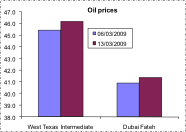
  • The UAE Central Bank said credit growth in the country would shrink from close to 50% in the first half of this year to less than 10 per cent in 2009.
  • Several banks have suspended loans to construction,  real estate companies and the hospitality sector, including their employees.

Markets Overview Jan. 5th 2009

World stock markets continue their consolidation, both in developed and emerging markets. Across the Gulf, stock markets have also rebounded, with the exception of Kuwait and Bahrain. The DFM has displayed a broad based recovery across sectors with the exception of Materials. The Libor rates have normalized, while the UAE Interbank rates still indicate that tensions in the money markets have not completely abated. Exchange rates remain broadly stable and oil is regaining some lost ground in the wake of security concerns after the Israeli aggression on Gaza.

Updated 845am from Reuters 3000Xtra


Weekly Economic Commentary – December 29, 2008

Global Developments

  • Financial markets have been relatively calm due to the festive mood and low volumes. This consolidation together with subdued volatility seems to indicate a willingness to look beyond the most dreadful quarter in decades and focus on the next developments.
  • A quiet week in major markets due to the holiday season in Western countries. In general stock markets are in a consolidation pattern waiting to fathom the policy which will emerge after the new US President takes office. Global equity markets, although on a weak tone, have become much less volatile as December has progressed. This stability however is not yet forming the basis for any sustained rebound especially in the emerging markets, including the GCC.
  • The festive mood has not reduced the flow of bad news: in Euroland data recorded another plunge with manufacturing orders falling 4.5%mom and Belgian business confidence (widely seen as a leading indicator for the entire continent) falling to -36.5 a record low worse than the 1982 recession. Convention al forecast models point to a drop of GDP in Euroland of -0.7%qoq. Reluctance by Germany to provide a robust fiscal boost is sapping the prospect for a solid rebound anytime before well into 2010.
  • In the US final GDP data confirmed the preliminary estimates of a 0.5%qoq drop in Q3. Existing homes sales and new home sales fell by 8.6%mom and 2.9%mom. House sales are fast approaching the lowest level of all times in the early 1980s.
  • China cut rates late on Dec. 22nd, with the 1-year lending rate falling 27bp, to 5.31%. Rate cuts in China now total 216 basis points since mid-September
  • Japan industrial production slumped 8% m/m in November, the worst result since the index started in 1953. Japan reported also very weak November exports (down 13.5%m/m sa) which have fallen by 22.5% from their July peak. Import values were down 11.2%m/m (sa) in November.

Market Intelligence on the UAE:

  • Stock markets are still falling sharply in the UAE, amid low volumes, as a result of uncertain prospects, lower oil prices and lack of good news. Interbank rates are easing as a result of the announced dollar-dirham swap facility set up by the Central Bank.
  • Dubai home rents are decreasing according to anecdotal evidence from real estate professionals. The most hits area the upscale locations on the Palm and Burj Dubai with declines in the order of 30%-40% (to levels which prevailed at the beginning of 2008). On the contrary mid-income locations such as International City are still holding up well.
  • The property market continues to be severely affected by the reluctance of banks to extend loans and pockets of oversupply in upscale units. Investors have declined sharply while demand is mainly composed of perspective end-users, who however find it difficult to obtain mortgages.
  • Consolidation among developers and construction companies is likely in the near future according to the Director of the Department of Finance, while reports that thousands of construction workers are asking for visa cancellation and that some construction companies are not being paid is fueling tension and uncertainty.
  • The EU-GCC FTA negotiations were halted. Resumption is unlikely in the near future.
  • Fiscal Budgets in GCC countries will not be trimmed much in order to stem the effects of the crisis despite drop in oil revenues.
  • The UAE Cabinet has approved the new organizational structure of the Ministry of Economy (MoE) which will encompass 4 departments: economic policies, commercial policies, industrial affairs and corporate & support services affairs.
  • A summit of GCC Heads of States convenes in Muscat today to take key decisions on the GCC monetary union.

Market Overview (updated Dec 29th 8:30am)

Stock markets are still falling sharply in the UAE, amid low volumes, as a result of uncertain prospects, lower oil prices and lack of good news. Interbank rates are easing as a result of the announced dollar-dirham swap facility set up by the Central Bank. In other GCC countries equities have rebounded slightly on the back of rumors that governments are stepping in to sustain prices. Exchange rates are stable, but oil prices have remained generally weak drifting down towards 35 USD p/b. Subdued activity will prevail throughout the first week of the new year.

GCC Stock Markets


Today

A Week Ago

Weekly Pct Chng (%)

Bahrain

1824

1861

-1.99

Kuwait

8043

8394

-4.18

Oman

5212

5942

-12.29

Qatar

6715

6665

0.75

Saudi

4687

4774

-1.83

Abu Dhabi

2282

2576

-11.43

UAE (Nasdaq Dubai)

1156

1370

-15.61

UAE (DFM)

1587

1803

-11.96


Weekly Economic Commentary – December 21, 2008

Global Developments

  • The US Fed cut its rates to a range 0-0.25% to fight the incumbent crisis (all economic data from industrial production to housing markets and surveys fell sharply during the week) and the threat of deflation highlighted by falling consumer prices (-1.7%mom). This move was not followed by all GCC countries as Kuwait and Oman’s central banks cut rates, KSA cut before the Fed, but central banks in Bahrain, the United Arab Emirates and Qatar remained on hold.
  • Oil prices have fallen below at some point below 35USD p/b. OPEC oil basket is today around 40 USD p/b despite the decision to cut supply by a larger-than-expected 2.2 m/b a day.
  • The first step in the bail out of the US car industry cost 17bn USD but guarantees survival only for a few weeks to GM and Chrysler. The total cost might amount to 125bn USD but will be left to Obama’s decision.
  • Meanwhile the incoming US administration has increased the scope of the stimulus package in an effort to create 3 million jobs, up from 2.2 million in the original plan.
  • The Bank of Japan cut its rate to 0.1% in response to a worsening outlook (Highlighted by a large drop in the Tankan business survey) and announced a full-fledged quantitative easing policy with purchases of government bonds and commercial paper.
  • In Europe the economic data are worsening: France business confidence sank to the lowest level ever, the German IFO lost another three points to 82.6, its worst level since 1982. The German government remains hostile to a major stimulus package financed by public debt.
  • China Industrial production slowed to 5.4%yoy in November.

Market Intelligence on the UAE:

  • Dubai has announced that it will seek a rating by mid 2009, while concerns on debt roll over have proven unfounded: all such operations by public and private entities have been completed successfully. Citibank announced that it has arranged credits to Dubai for 8 bn USD this year.
  • However the ratings of several banks and a number of Dubai Inc. firms have been revised down due to worsening economic outlook and fragile conditions on financial markets.
  • Mixed news from the real estate market: further job cuts might come from Arabtec (5000 units) and Tatweer. On the other hand plans at Sport City will be completed and in the controversial Dubai Lagoon the first 8 buildings are due for delivery in March 2009.
  • A survey by HSBC Holdings recorded a 4% rise in quoted real estate prices in the UAE in November, but prices fell 4% in Dubai. The survey remarked that the market might have reached a tipping point as bank credit has dried up. In fact, transactions in real estate have declined, which makes aggregate price signal less relevant to judge the overall situation. In the second week of December in freehold areas were recorded 418 sales transactions, of which 383 were for apartments for a total of 295.37 million and 35 for villas at a total of Dh175.53 million. This relatively healthy figure might be due to a backlog of purchases, but might not necessarily point to a positive outlook.
  • ADIA might have suffered a loss in the order of a few hundred million USD as a result of the Mardoff scam.

Market Overview (updated Dec 21st, 9:30am)

GCC equity markets continued to fall last week notwithstanding some regained stability worldwide (with Emerging Markets gaining 5.5%). As a result of central bank easing, Libor has fallen sharply, but in the UAE interbank rates have actually gone up or remained stable. In exchange markets the euro has climbed against the dollar as result of the Fed move and worse than expected deterioration in economic conditions.


Weekly Economic Commentary – December 14, 2008

Global Developments

Markets remain nervous, as outbursts of optimism are followed by sudden pessimism. Most of this behavior stems from political developments with direct repercussion on the US economic outlook. Earlier last week the speech by President-elect Obama outlining a stimulus package sparked a wave stock market recovery, but on Friday the collapse of the automotive bail out sent indices sharply down. Adding to apprehension there has been the news of a hedge fund fraud with losses estimated at USD 50 billion. Commodity markets were also hit, with oil down $4pb, but the current level $43pb is off recent lows (a consideration that applies to most equity markets, even after Friday’s declines). The dollar has begun to weaken, reflecting some hawkish comments from officials at the European Central Bank and the concerns about the depth of the recessions.
Economic data have been broadly negative with the U.S. economy leading the way to global weakness in Q4. PMI data were below expectations and weekly jobless claims climbed by 58k to 573k. October trade data depict falling exports, which when factored in forecasting models imply a US Q4 GDP contraction by 5% qoq, saar. Industrial production in the euro area was down 1.2% mom and 5.3% yoy. The Q4 data from China continue to look very weak with exports falling 2.2% yoy in November.
Amid the negatives there are a few encouraging signs: the extreme volatility of stock markets in the past weeks is subsiding with the VIX is at 55.7, close to its lowest level since early October. U.S. retail sales were stronger than expected in November: ex autos and gas, sales were up 0.3% mom, (against consensus of a 0.5% drop). Chinese retail sales were up 20.8%yoy. If deflated by CPI, this figure suggests that real spending in China has actually accelerated since the early part of the year
Government bonds have undergone some dramatic developments: negative U.S. bill rates, falling U.S. long-term yields (30s are down to almost 3%) despite staggering longer-term issuance prospects which might be considered as a form of unsustainable bubble triggered by risk aversion and flight to safety. The U.S. Federal deficit in the first two months of the fiscal year has been $402 billion; if the cost of the new stimulus package announced by President-elect Obama is factored in the US deficit could reach 10% in 2009.
Central banks’ easing has continued with Canada cutting rates a surprising 75bp on Tuesday, followed by Switzerland, which cut its 3m LIBOR target by 50bp to 50bp; in Asia Korea cut its benchmark rate 100bp to 3% and Taiwan, by 75bp, to 2%; finally South Africa, reduced rates by 50bp to 11.5%.

GCC Markets

Gulf bourses recorded relative stability in the first 10 days of December after crashing by more than $500 billion (Dh1.8 trillion) since June. With the exception of the Saudi and Bahrain exchanges, the other GCC bourses recovered slightly, though the capitalization of all remained at a three-year low. Saudi stocks reopened on a high after the Eid Al Adha holiday, with the benchmark advancing 4.1% on Saturday. With volatility declining across the GCC markets, the DFM is expected to close above the 2000-mark this week.

Market Intelligence:

A further decline in oil prices and the global financial crisis will reduce GDP growth in the MENA region to 3.9% in 2009 from 5.8% in 2008, according to a recent World Bank report. While the UAE’s GDP growth is expected to slow as well, it is expected to remain above 6-7%, according to the UAE Ministry of Economy, much above the growth rates predicted elsewhere in the MENA region. Dubai’s non-oil foreign trade, including trade via free zones and customs warehouses, surged by 44.5% during the first nine months of 2008 compared to the corresponding period in 2007, according to a Dubai World’s Statistics Department report. The report listed China as the main trading partner in import (AED 40.5bn), with India following at a close second (AED 37.2bn) and the US (AED 24.9bn).
 

Market Overview (updated Dec 14th, 4:30pm)


GCC Market Overview


Today

A Week Ago

Weekly Pct Chng (%)

Bahrain

1933

1924

0.45

Kuwait

8911

8916

-0.05

Oman

6097

6138

-0.67

Qatar

6421

6050

6.12

Saudi

4787

4655

2.85

Abu Dhabi

2733

2754

-0.77

UAE (Nasdaq Dubai)

1391

1429

-2.64

UAE (DFM)

1961

1975

-0.71


Weekly Economic Commentary – November 30, 2008

Global Developments

Two pieces of news dominate world events: the bail out of Citigroup and the terrorist attack in Mumbai.
The Citi bailout was rather generous to shareholders, but it underlines that the financial sector is still in disarray. It must be recalled that Citigroup a few weeks ago wanted to rescue Wachovia (later acquired by Wells Fargo). The Citi deal shifts pressure from US financial institutions, at least for a while.  But markets are pondering who might be next. The indications again point to the eurozone.  Credit default swap spreads indicate increasing differentiation between Germany on the one hand and the periphery, (Greece, Ireland or Italy or Spain) on the other hand. Some countries do not have enough resources to sustain the commitments made to support their banking sector.
The attacks in Mumbai have hit a large economy whose growth is critical for the stability of the world output and together with threats by Al Qaeda have reignited tensions over the security situation. The repercussions are difficult to gauge but considering that Thailand is also marred by civil unrest, and Pakistan is in hanging in a precarious situation, East Asia looks wobbly.
US markets were in a quiescent mood due to Thanksgiving, but on a general upbeat note following Citi’s rescue. The current U.S. and global economic conditions, remain challenging. On the positive side is the appointment by President-elect Obama of an experienced economic team. But the recovery is not in sight yet and most signs still point to a sharply downward trend. The Fed has announced a US$ 600bn plan to buy toxic assets plus US$ 200bn to support consumer credit; meanwhile the EU Commission has approved a 200bn euro expenditure plan equal to 1.5% of GDP.

GCC Markets

Over the week end OPEC decided not to change target output deferring a decision to the December 17th meeting in Algeria. KSA Oil Minister Al Naimi indicated 75 US$ per barrel as a target price over the medium term (following a similar indication given by HH King Abdullah in an interview), but for the time being such a level appears out of reach. WTI oil futures have rebounded to almost 55 US$ per barrel last week and has closed at US$53.5 on Friday more than 7% over the previous week.
The past week saw some rebound in the GCC equities in the wake of a general uplifting mood in stock markets worldwide. On Saturday the Saudi’s benchmark index posted its largest jump of the past 30 months sustained by the hope that a turning point is in sight, and influenced also the markets in Qatar and to a lesser extent the DFM and Oman. Bahrain, Abu Dhabi and Kuwait remain in negative territory, compared to a week ago. However, trading is dominated by retail investors ready to cash in on short term bets. In other words these movements lack depth as foreigners and institutional investors are still wary. For example DFM disclosed that foreigners were net seller for about 20 ml US$ in the past week.
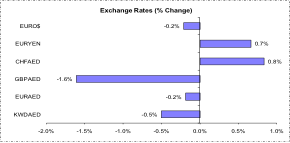
Saudi Arabia’s Finance Minister pledged to boost public spending in 2009 despite the decline in oil prices. Earlier this month King Abdullah of Saudi Arabia said that he expected investment by the public sector and state-controlled oil sector to exceed US$ 400bn over the next five years. Meanwhile in Abu Dhabi the government has committed over US$ 100bn over the next 4-5 years for infrastructure projects.

Market intelligence

In the UAE the last few days saw a glimmer of hope as the authorities have expressed strong optimistic views and the refinancing of sizeable loans calmed marked nervousness. The banking sector is stabilizing, but continuous news on layoffs is contributing to uncertainty.
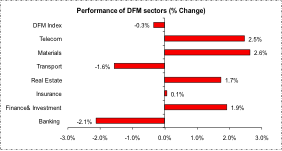


Weekly Economic Commentary – November 19, 2008

Global Developments

The G20 meeting last week end failed to inject much confidence in global markets. In a nutshell, the leaders over-focused on issues related to crisis prevention (i.e., stopping the next one), rather than paying attention to measures aimed at resolving the present one. Markets took this as a sign that leaders are out of ideas and frozen until Obama takes oath. Hence global equities continue to fall in reaction to any news: for example corporate layoffs (e.g., Citi’s yesterday) are being viewed with gloom. Asia remains downbeat after the short lived enthusiasm sparked by China’s stimulus package and the GDP numbers from Japan confirmed a drop of 0.4%, qoq saar, after a Q2 down by 3.7% qoq, saar. Across Asia trade data indicate a deepening slump in exports across the board. Markets in Emerging Europe and Euroland are generally weak with the DJ Euro 50 down more than 4% reflecting downbeat expectations on the Old Continent.
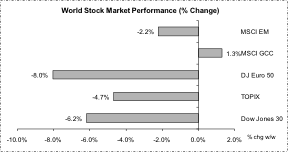
No catalyst for a rebound seems in sight. Essentially the transmission of the credit crisis to the real economy has just begun, so investors are uncertain on the depth and the duration of the recession. Hopes that the markets have stabilized have thus far proven premature while additional tensions might arise in the credit card market. The IMF has unveiled an estimate of 1.2 trillion USD as the magnitude of the fiscal stimulus for the world economy (2% of global GDP) required for rekindling growth. Earlier the IMF has worked out a series of programs with Pakistan, Serbia, Armenia and Iceland, in addition to those for Ukraine and Hungary negotiated earlier. Japan announced a commitment to provide an additional $100 billion to the IMF resources, and invited others to help to double the Fund existing liquid reserves to $500 billion.

GCC Markets

All the GCC stock indices continued to reel under the heavy selling pressures from last week. A rebound on DFM on Sunday was sparked by rumors that the government of Abu Dhabi intended to buy shares in large Dubai based companies, but has since faded. Markets across the GCC had mixed performances this week but on a generally weakish note as the losses from last week are hardly compensated by some small rebounds. Apart from global uncertainty, falling crude oil prices and confused authorities messages (including a court order to close the Kuwait market) have contributed to deepen negative sentiment.

Market intelligence

In the UAE despite evident resilience, a number of factors are contributing to nervousness. First, the lack of solid up to date figures on the state of the economy, its debt and its refinancing which has given way to a series of gossip and innuendos likely to have magnified negative news (such as the lay offs or hiring freeze by prominent companies like Damac and Tamweel). Second, the steep increase in interest rates by banks to clients: despite a drop in central bank rates and injected liquidity, banks are not reflecting monetary easing to their corporate and retail clients. Anecdotal evidence suggests that even prime clients have been asked a 200 bp increase on their exposure. Such behavior threatens to push on the verge of bankruptcy a score of SMEs, exacerbating the difficulties of the Dubai economy. Last a major concern regards the real estate market: media have reported house price falling by about 30% in prime locations and land prices dropping even more in sites destined for new developments such as the Waterfront. A major blow to the sector was inflicted by the “interpretation’ of the law by RERA which imposes investors to pay 30% of the value of the contract in case they renege their contractual obligation on real estate purchases. This dubious handling of a key legal aspect risks undermining the reputation of Dubai as an investment destination for years to come.

Policy Implications

The GCC region is facing the current turmoil from a far stronger position than in the past. However, balancing the expected growth slowdown and addressing financial stress in certain segments of the banking sector, while attending to the region’s development needs, will be a challenge. Lack of data is the first aspect to tackle decisively. Second, debt management should become the primary economic policy concern with a consolidation of debt exposure by the public sector and key corporations a priority. This streamlining could be more efficiently achieved by planning a strategy of bill and bond issuances (including Sukuks) over a few years. Furthermore the public utilities projects and infrastructure financed through government bond issues should be subject to a clear identification of revenues (fee, charges) for repayment and appropriate cost benefit analysis.