Panelist at the Investment Conference 2025 session “Shaping the Future – GCC Economies in Transition”, 10 Feb 2025

Dr. Nasser Saidi participated as a panelist in the discussion titled “Shaping the Future – GCC Economies in Transition” at the Investment Conference 2025 by Kamco Invest, held in Kuwait on 10th February 2025. 

The session covered the broad headings of cyclical growth vs. structural transformation, fiscal policy and government spending, monetary policy, capital markets, productivity challenges & overall resilience.


View the session below (original link)


“Central Bank Digital Currencies’ Impact on MENA Economies”, Council Views in The Middle East Council on Global Affairs (ME Council) Afkar, 4 Jul 2024

Dr. Nasser Saidi. contributed his expert opinion on as part of Council Views related to the topic “Central Bank Digital Currencies’ Impact on MENA Economies”. Council Views  is a ME Council (The Middle East Council on Global Affairs) article series that brings together our experts’ insights on headline issues facing the Middle East and North Africa region. The original, complete article is available on the ME Council website (link) and Dr. Saidi’s opinion is posted below. 


This contribution and discussion stemmed from a ME Council’s Roundtable Discussion on Central Bank Digital Currencies (CBDCs) held in Turkey on 10th May 2024.


How MENA Countries Can Benefit from CBDCs

Nasser Saidi

CBDCs can be the cornerstone for secure and efficient monetary, financial, and market digital transactions. For the MENA region, socio-economic benefits from the roll-out of CBDCs would be two-fold:

First, for developing nations, a retail CBDC could lead to greater financial inclusion. Only 48% of adults in the MENA region—excluding high-income nations—have a financial account, around 23 percentage points lower compared to the developing economy average. CBDCs designed to operate offline could be used by the unbanked and large populations of immigrants, refugees and displaced individuals. Moreover, interoperability is a vital feature that would enable greater adoption and usage of CBDCs. Data derived from CBDC usage can be used to establish credit profiles, improving access to finance including for small and medium-sized enterprises (SMEs), as this would lower disparities in lending arising from a lack of information on credit risk.

Second, for wealthier countries like those in the Gulf Cooperation Council (GCC), CBDCs would facilitate trade and financial transactions through faster, cheaper, more transparent, and more inclusive cross-border payment services, while reducing the risk of cross-border payments and increasing settlement efficiency.

Importantly, CBDCs need to be supported by secure, inclusive infrastructure, including digital public infrastructure to enable digital identities. This could be along the lines of a national digital ID (such as India’s Aadhaar), real-time payment systems (Brazil’s Pix or Egypt’s InstaPay), or integrated payment systems (e.g. China’s e-CNY pilot program and integration with Hong Kong), among others. Digital inclusion needs to be one of the pillars of CBDC rollouts, with financial literacy and data protection integrated into the process. There should be a holistic—not a silo—approach to designing and rolling out CBDCs.


Keynote address at Thomson Reuters “Future of MENA” 150-year Anniversary event, 17 Apr 2017

Titled “Future of MENA: through the looking glass“, the keynote address at Thomson Reuters “Future of MENA” 150-year Anniversary event looked at understanding the MENA regions’ complicated landscape amidst shifts in the global economic and financial geography. While the GCC continues to adjust to the New Oil Normal via economic policy and structural reform, it is time to glance through the looking glass into 2026. What would be the growth drivers? What are the investment opportunities?
Link to coverage from Gulf News.


"The Impact of Financial Crime on Global Economies", Keynote at EastNets Annual Conference, 8 Mar 2017

The presentation titled “The Impact of Financial Crime on Global Economies” was delivered as a keynote address at the EastNets 14th Annual Conference held on 8th March 2017 in Amman.
In the keynote, the focus was on economic crime and its impact on economic growth. With the rise of the digital economy and associated disruptions, the presentation looks at the growing risks of cybercrime across the globe, and also at the regional level. Another interesting point of discussion centres around where there is a FinTech/ RegTech revolution around compliance. The presentation ends with an outlook on financial crime in today’s world as well as a few key takeaways.


Economic Outlook, Governance, Regulation and GCC Risk Mitigation, Closing Keynote at Euler Hermes GCC Banking Dialogue event, 25 Jan 2017


The presentation titled “Economic Outlook, Governance, Regulation and GCC Risk Mitigation” was delivered as the closing keynote at Euler Hermes GCC Banking Dialogue, held in Dubai on 25th January 2017.
The presentation looks at key global and regional risks that could affect the region going forward, while also discussing the changing regulatory landscape post-GFC and also given the implementation of Basel III.


The Role of Solar in Combating Climate Change & How to Deploy this in MENA, Opening keynote at CEBC 5th Annual MENA Forum, 14 Dec 2016

The presentation titled “The Role of Solar in Combating Climate Change & How to Deploy this in MENA“, was delivered at the Clean Energy Business Council’s (CEBC) 5th Annual MENA Forum, held in Dubai on Dec 14, 2016.
Next year will be critical to the long-term success of the energy diversification strategies across the Middle East, as we close in on the 2020 milestone. What we see from markets such as Saudi Arabia in particular during the early part of 2017 will be a key indicator of renewed momentum – beyond 2017 – leading a major shift in the regional dynamic for renewables for the next decade and beyond.
The presentation discussed results from the COP21 and COP22, while also highlighting how MENA continues to rank poorly in the Climate Change Performance Index. Renewable energy commitments in the MENA were outlined, and the increasing momentum for solar and wind were underscored. Solar is MENA’s road to decarbonisation; but, implementation of a carbon tax could generate substantial revenue, increase energy efficiency and drive decarbonisation strategies.


Central Bank Governance: Governing the Fourth Estate, Keynote at the IMF-Hawkamah Central Bank Forum, 13 Dec 2016

The keynote address and presentation titled “Central Bank Governance: Governing the Fourth Estate“, was delivered at the IMF-Hawkamah Central Bank Forum, held in Dubai on Dec 13, 2016.
The Global Financial Crisis has radically changed the size, composition and risk characteristics of central banks’ balance sheets. Central banks now yield enormous discretionary power to intervene in financial markets through QE and unconventional monetary policy, with a wide mandate and objectives encompassing both price stability and financial stability. These structural changes require reform in the governance arrangements of central banks, new institutional design to constrain the use of authority and a heightened emphasis on accountability, disclosure and transparency.


Panel Discussion on Renewable Energy at UNEP FI Global Roundtable, 26 Oct 2016

The panel discussion was one of the sessions at the UNEP FI Global Roundtable held in Dubai towards end-Oct, 2016. The session titled Innovative Tools for Sustainable Finance: Renewable Energy focuses on innovation – what is new and relevant to financial institutions, what are the new market and investment opportunities? What are new financing models?


Financial Inclusion through FinTech, Presentation at FIS's FinTech2020 Dubai, 11 May 2016

The presentation titled “Financial Inclusion through FinTech” was delivered at the FinTech 2020 event organised by FIS, held in Dubai on May 11, 2016.
The presentation focuses on how Fintech has gained significant momentum and moved leaps and bounds from being just an “emerging” financial services sector. It also highlights concerns like access to finance in the wider Middle East region and how Fintech could help in the regard; last, but not the least, how regulations need to change (amidst increased security) with the moving times is also explored.


New Oil Normal and the Impact on Renewables: Global Lessons Learned, CEBC Conference, May 2016

The presentation titled “New Oil Normal and the Impact on Renewables: Global Lessons Learned” was delivered at the Clean Energy Business Council’s “Project Financing Renewables & Clean Energy MENA 2016” event, held in Dubai on May 3, 2016.


Mediterranean Leadership Summit, Malta, 28 Apr 2016

Presentation on Infrastructure as a “growth-lifting” strategy for the Mediterranean region was part of the infrastructure panel at the Mediterranean Leadership Summit, organised by The Economist, held in Malta on 28-29 April, 2016.


Challenges to Financing Middle-Income Countries Facing Crises – Panel Discussion @ IFI, AUB 11 Jun 2015

The event titled “Challenges to Financing Middle-Income Countries Facing Crises”, was held on 11 June 2015, as a public panel event at the AUB, co-hosted by UN Lebanon together with the Issam Fares Institute.
The purpose of the panel was to understand the global policy discussions around new approaches to development financing in the context of the post-2015 agenda (SDGs) and then explore its relevance and particular challenges for conflict-affected states under stress which are not typically eligible for the modalities and magnitude of funding required to overcome shocks or recover their stability. The panel also explored the challenges (from aid accountability to legislative obstacles) and opportunities (new hybrid financing options such as diaspora bonds) of such an approach in Lebanon, including how to leverage investments into the private sector for public good.
The panelists were:
Sigrid Kaag, United Nations Special Coordinator for Lebanon
Rayya El Hassan, Former Lebanese Minister of Finance
Erik Solheim, Chair of the Development Assistance Committee of the OECD
Ferid Belhaj, World Bank Regional Director for the MENA Region
Nasser Saidi, Former Minister of Economy & Trade and Minister of Industry & First VG of BDL
The audio of the panel discussion is available at this link: http://yourlisten.com/ifi.aub/challenges-to-financing-middleincome-countries-facing-crises#ixzz3cpaJpzzz


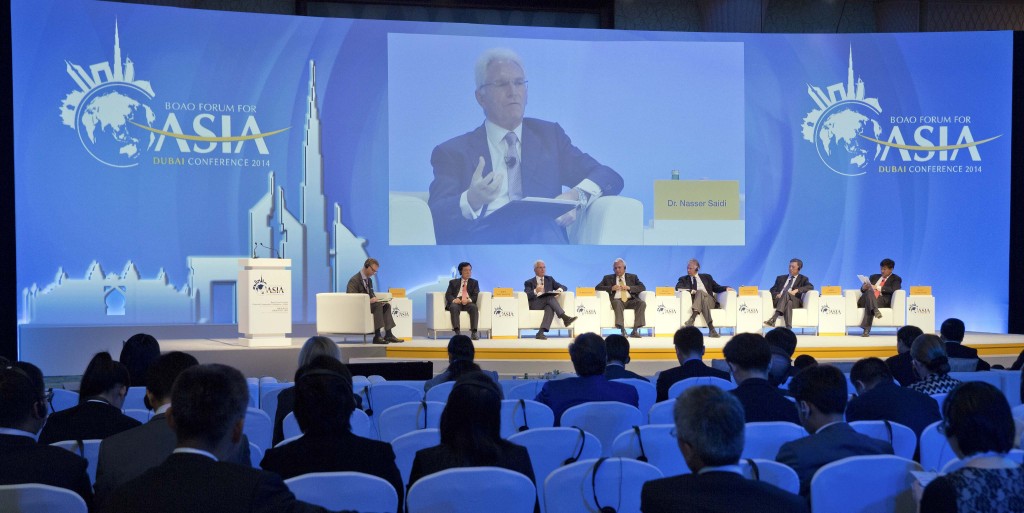
Comments from the Boao Forum for Asia Financial Cooperation Conference, 25 Nov 2014

[The link to the original article is: http://vision.ae/en/articles/boao_forum_between_yuan_and_sky; an excerpt of this article was also published – http://www.prnewswire.com/news-releases/boao-forum-renminbi-internationalisation-and-infrastructure-issues-on-the-cards-284594721.html]

Boao Forum: between Yuan and sky

The internationalisation of Renminbi, as well as solving infrastructural issues, were on the cards at the Boao Forum for Asia Financial Cooperation Conference this year
Currency and infrastructure were the two main topics that panellists and attendees chewed over during the Boao Forum, held in Dubai this week.
Solving the issues around these central tenants was deemed imperative to both successful Chinese cooperation, and economic growth – although there was diverse thinking as to how each should be ‘fixed’.
On currency, Zeng Peiyan, Vice Chairman of Boao Forum for Asia and Former Vice Premier of China, noted that financial cooperation should be used as a way to boost the Asian economy, using bilateral currency swaps as an example of a measure that would reduce trade risks and help maintain regional financial stability.
The Chiang Mai Initiative – which started as a series of bilateral swap arrangements in 2000 and has, over the last 14 years, developed into a multilateral currency swap arrangement – was the obvious way to improve cooperation, although it had its skeptics.
Dr Nasser Saidi, President of Nasser Saidi and Associates, suggested the Chiang Mai Initiative has been underused and should be extended to other countries, in particular the GCC states. He also highlighted the heterogeneity of Asia to state that the idea of a standardised Asian market is unrealistic and that instead, China must be the driver behind the development of Asian bond markets.
Of China’s power, HE Dominique de Villepin was certain. The Former Prime Minister of France, and President of UCRG International Advisory Board, pointed out that Asia represents one third of world output; with China holding almost $4 trillion of reserves.
“The wealth and growth is there. In order to go forward in terms of reforms, we need new global governance. The dollar has limited capacity to serve the world economy and all the thinking about a basket of currencies might be helpful in terms of finding a new balance.”
On infrastructure, new projects were celebrated, but there was serious discussion at the disparity between different regions of Asia. Shaukat Aziz, Former Prime Minister of Pakistan, pointed to the creation of the Asian Infrastructure Investment Bank, a major landmark development for the world, which, he said, would be an important means for financing infrastructure projects in Asia and all over the world.

V Shankar emphasised the discrepancy between wealth of infrastructure from country to country in Asia. However, the current imbalance in infrastructure development in Asia did not go unnoticed. “You have places in Asia and the Middle East that have fantastic world-class infrastructure,” said V Shankar, CEO of the EMEA region for Standard Chartered. “Yet, there are pockets of our continent which have abysmal and really poor, creaking infrastructure.”

Statistics from the Asian Development Bank state that the annual demand for infrastructure in Asia is $730bn – this, compared to the $30bn a year made by multilateral organisations, is a huge chasm.
But, this problem seemingly has a fixable solution. Francisco de Paula Coelho, Director of the Lending Department for Asia and Latin America for the European Investment Bank, emphasised multilateral finance institutions (MFIs) need to be more humble in the role they can play. “EIB and its peers have to be instrumental in bringing in much bigger private sector investors into infrastructure projects in Asia.”
“Developing infrastructure takes place over a long cycle,” concluded Cao Honghui, Vice President of the Research Institute at the National Development Bank. “It needs stable economic and social conditions, otherwise it will be difficult to secure funding.”


Fiscal Sustainability & Reform: Challenges for MENA & the GCC – Presentation at the Fifth Meeting of the Middle East/North Africa Tax Forum, Riyadh, 12 Nov 2014

Click here to download the presentation titled “Fiscal Sustainability & Reform: Challenges for MENA & the GCC, delivered at the Fifth Meeting of the Middle East/North Africa Tax Forum held in Riyadh, Saudi Arabia during 10-13 November, 2014.


"Expo 2020: What Can Dubai Look Forward To?": Presentation at Julius Baer 10th Anniversary event, 30 Oct 2014

Click here to access the presentation titled “Expo 2020: What Can Dubai Look Forward To?” which was delivered at the Julius Baer 10th Anniversary event held in Dubai on 30 Oct 2014.


Growth, Transition & Transformation in the MENA region: Keynote Presentation @ FundForum Middle East, 22 Sep 2014

Click here to download the keynote presentation made on 22 Sep 2014 at the FundForum Middle East event held in Dubai.


Presentation at the G24 Technical Group Meeting on Financing for Development – Sep 5-6, 2014

Click here to download the presentation delivered at the G24 Technical Group Meeting on Financing for Development @ Cairo Sep 5-6, 2014.


Dubai Expophoria 2020 – Keynote presentation at the PMI Global Congress, 5th May 2014

Click here to download the presentation titled “Dubai Expophoria 2020: A Message from the  Desert on Mobility, Sustainability &  Opportunity”, delivered at the PMI Global Congress EMEA edition  in Dubai on 5 May 2014.


Keynote Presentation at EY MENA Tax Conference, 19 Mar 2014

Click here to download the presentation titled “MENA Fiscal and Tax Reforms: Imperative but Challenging”, delivered at the EY MENA Tax conference in Dubai on 19 Mar 2014.


Financial Crises & New Economic Geography: Emerging Alternative Finance, 2 March 2014

The role of non-bank financial intermediation is covered in the presentation titled “Financial Crises & New Economic Geography: Emerging Alternative Finance”, which was delivered at the Annual Falcon Group Trade and Corporate Finance Forum held in Dubai on March 2, 2014.
Click here to download the file.


Reforms and Re-Invention are the Way Forward for Europe: No to Bailouts, No to Austerity

The presentation titled “Reforms and Re-Invention are the Way Forward for Europe:No to Bailouts, No to Austerity” was delivered at the 4th Limassol Economic Forum on Nov 26, 2013. It is available for download here.
http://nassersaidi.com/wp-content/uploads/2013/11/Reforms-Re-Invention-Are-the-Way-Forward-for-Europe-No-to-Bailouts-No-to-Austerity-4th-Limassol-Economic-Forum-26-Nov-2013.pdf


Economic Issues at the Heart of “Arab Firestorm”: Presentation @ MEI, Singapore

This is a blog post from the Middle East Institute at Singapore’s NUS,  following a presentation made to them about the Arab Firestorm on 19th Sep, 2013 (link to the original post is here).

According to Dr. Nasser Saidi, Founder and President of Nasser Saidi and Associates, the phrase ‘Arab Spring’ is a misnomer. Since 2011, the Middle East has been embroiled in a series of events that seem to increase in intensity and destructiveness; therefore, the “Arab Firestorm” is more apt. This unique take hints at the different perspective Saidi would provide during his talk. He calls for more emphasis on economic factors than socio-political elements, as any successful political transition requires economic reforms.

Prior to delving into the policies and reforms that need to be implemented, Saidi informs the audience of the challenges that the region has been facing, amongst them the strikingly uneven distribution of wealth and resources between oil importing countries and oil exporters, youth unemployment at 35%, and low female labour force participation rates—MENA being the lowest—in spite of the fact that women in MENA attain higher education than the men. Given the demographics and ‘youth bulge’, job creation is the top policy priority for Arab countries.

While the GCC countries are comparatively better off than the rest of the region, Saidi is quick to point out that they are not free from problems either. Their high dependence on oil threatens their fiscal sustainability, which can only be achieved if they diversify their sources of government revenues and partner with the private sector for job creation. Also, the GCC is faced with the urgent task of carrying out reform and structural change in order to reduce the likelihood of consumption and production patterns from being further distorted by energy subsidies.

In order to attain stability, Saidi proposes a number of transformations that the region needs to undergo in various sectors, such as education, empowerment of women, an orientation towards Asia and Emerging Market Economies in trade, investment and financial policies, and the establishment of an Arab Bank for Reconstruction and Development that would focus on infrastructure investment. He also recommends Singapore to take on an active role in this process by organizing forums on the politics and economics of transition so that MENA can draw lessons from the experience of Asian countries and emerging financial centres in the GCC can network with its Asian counterparts.

Despite the economic focus of the talk, Saidi was not gainsaying the relevance of other factors in the Arab uprisings. This is apparent from the inclusion of socio-demographic and political concerns in the MENAT (MENA + Turkey) Vulnerability Index that he introduces during the second half of his presentation. This chart “captures [most of the] factors in a quantitative index, measuring the magnitude and the differences in vulnerability and risk exposure across the countries in the region”. Turkey is included as it has a shared history with the rest of the Middle East, despite following a different trajectory after the fall of the Ottoman Empire. The results from the MENAT Vulnerability Index reveal that Saudi Arabia is next to high-risk states like Syria and Egypt, indicating that being relatively financially stable does not protect a country from being vulnerable to political discontent.


Asian Financial Transformation: Developing an RMB Zone & Redback Market

The presentation titled “Asian Financial Transformation: Developing an RMB Zone & Redback Market” was delivered at the Seoul Asian Financial Forum on May 27, 2013. It is available for download here.
http://nassersaidi.com/wp-content/uploads/2013/05/ASIA-COMING-FINANCIAL-TRANSFORMATION-Asian-Finance-Forum-27-May-2013.pdf


Experts outline challenges and solutions for SME financing

Economists, financiers, bankers and business owners met late last week to debate the state of small and medium-sized enterprises (SMEs) in the GCC region, and considered various alternative models for financing SMEs in light of the need for cheaper and more available growth capital.
The panel of SME experts was hosted by AlixPartners, the global business advisory firm, in coordination with Hawkamah, the Institute for Corporate Governance. Moderated by Dr Nasser Saidi, Founder and Managing Director of Nasser Saidi & Associates and former Chief Economist of the DIFC, and Claudio Scardovi, Managing Director at AlixPartners, the roundtable examined the importance of SMEs to the economy and considered new opportunities for funding to help these businesses grow.
Opening the seminar Dr Saidi set the agenda by highlighting the importance of growing and supporting the SME sector in the region:  “With 60 per cent of the region’s population under the age of 26 years old and unemployment at 40 per cent, the requirement to grow the SME sector to support GDP growth and develop employment opportunities could not be more important.  In the GCC, banks need to increase the flow of capital into the sector.  Currently the percentage of bank loans to the SME sector as a proportion of their total loan book is approximately two per cent versus 15 per cent for more developed nations.  This needs to be addressed as a priority and new sources of capital need to be developed.”
Eugenio Berenga, Managing Director and Head of Middle East, AlixPartners commented, “There is huge interest in supporting the development of the SME sector, but how to provide those companies cheaper and faster funding still remains far from clear.  For banks, the cost to serve SME clients remains high due mainly to the breadth of risk and experience required to assess that risk.  This is an opportunity for the private sector, if they identify ways to manage risk by segmenting the market by value chain. It is much easier to evaluate and manage risks if the focus is on a specific industry value chain.”
Dr Nasser Saidi added, “One of the most pressing areas to address is in the provision of financial support for start-ups and micro businesses.  Businesses of this type struggle to find growth capital, and although angel investing and venture capital play an important role, new concepts such as crowdfunding, which encourage wider investor interest, will help meet the increasing demand.  This is where new technology platforms can make a significant contribution.”
The event’s panellists included representatives of the Dubai Department of Economic Development, NASDAQ Dubai, banks such as ADCB, Standard Chartered and Noor Islamic Bank, and financial services firms including Gulf Finance, a subsidiary of Shuaa Capital, CedarBridge Partners, Gulf Credit Partners, and DEPA.  Sixty people attended the event including a number of SMEs, Dubai SME, banks, investors and other advisors. The event debated the state of SME financing in the UAE and GCC, the opportunity for SME debt funding and new market solutions for SME funding.
(This press release appeared on CPI Financial: http://www.cpifinancial.net/news/post/19234/experts-outline-challenges-and-solutions-for-sme-financing)


Crisis, Transition & Structural Change – Feb 3 2013

Click here to access my presentation to the Chalhoub Group dated Feb 3, 2013.


Marginalisation, Discrimination & the Challenges of Women Entrepreneurs in MENA

Click here to download the presentation given at the University of Chicago Booth Conference on MENA Women Entrepreneurs:Successes, Challenges & Policies (held on Jan 16, 2013).


Imperative of Good Corporate Governance in Turbulent Times

Click to download the presentation “Imperative of Good CG in Turbulent Times“.


"Competing Economic Visions in the Arab Uprisings: Navigating Without Roadmaps": Speech@LSE, Nov 2012

Listen to the podcast here.


Banque Cantonale de Geneve Presentation: "Turmoil, Energy, Infrastructure & Transformations in MENA: Challenges & Outlook"

Presentation made at the Banque Cantonale de Geneve on the 10th of Sep, 2012 titled “Turmoil, Energy, Infrastructure & Transformations in MENA: Challenges & Outlook“.